The Spanish manufacturing industry, especially in the automotive, aerospace and consumer electronics sectors, is undergoing a critical paradigm shift: the progressive abandonment of subjective time estimation in favor of scientific precision.
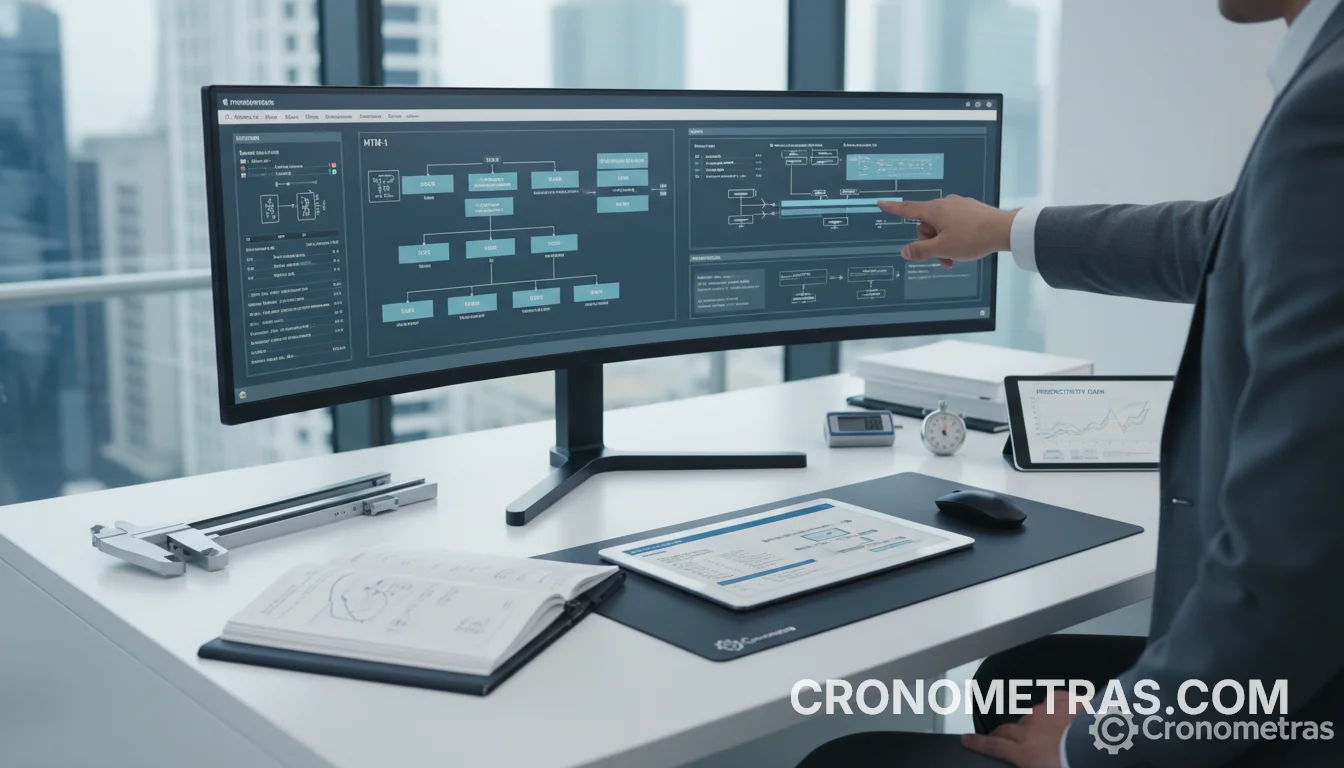
In an environment where variability is the number one enemy of OEE (Overall Equipment Effectiveness), relying exclusively on the stopwatch to define standards is a strategy of the past. MTM-1 (Methods-Time Measurement) is not simply a measurement technique; it is the universal language for designing efficient processes before they even exist physically.
At Cronometras we support companies in stopwatch work measurement, synthetic performance rating and ILO/TAL allowances, ensuring robust data for strategic decision-making.
What is MTM-1? Technical Definition and Fundamentals
For the rigorous industrial engineer, MTM-1 is defined not as an estimation method, but as a Predetermined Time Standard System (PTSS).
Its fundamental principle states that any manual operation can be broken down into universal basic motions. Each of these motions is assigned a predetermined time based on the nature of the movement and the conditions under which it is performed, regardless of the operator carrying it out.
Beyond the Stopwatch: A Standard System (PTSS)
The critical difference between centesimal stopwatch time study and MTM lies in the analyst's human factor.
- Time study: Requires a "Performance Rating" (Activity/Performance) by the time study analyst to normalize the time.
- MTM-1: Does not require performance rating: the time is taken from the tables. The MTM standard inherently implies a performance of 100 BSI (British Standards Institution) or 100 LMS (Lowry, Maynard, Stegemerten).
This means that the resulting time corresponds, by definition, to a qualified operator working at a normal pace, without the need for external value judgments.
The TMU (Time Measurement Unit) Unit of Measure
In high-level methods engineering, the second is too coarse a unit. MTM uses the TMU. For parameterizing ERP systems and cost calculations, it is vital to master the following conversions:
TMU Conversion Table:
- 1 TMU = 0.036 seconds
- 1 Second = 27.8 TMU
- 1 TMU = 0.0006 minutes
- 1 TMU = 0.00001 hours
Motion Syntax: Breakdown of the 19 Basic Motions
The power of MTM-1 lies in its ability to analyze the micro-structure of work. A task is not measured; a logical sequence is coded. Mastering this syntax is what distinguishes a simple time study analyst from a Methods Engineer.
Upper Limb Motions
The analysis focuses on the biomechanics of the arms and hands. Correct coding is crucial for cost calculation:
- Reach (R - Reach): An R30A (Reach for an object in a fixed location without looking) is not the same as an R30C (Reach for an object jumbled with others).
- Grasp (G - Grasp): This is where the greatest improvement opportunity lies.
- Practical Example: A simple touch "Grasp" (G1A) consumes 2.0 TMU. A complex "Grasp" requiring search and selection (G4) consumes 7.3 TMU.
- Impact: If an engineer designs a gravity-fed loading device that allows a G4 to be replaced by a G1A, the time for that motion is reduced by 72% without asking the operator to work faster.
Visual and Body Motions
MTM-1 integrates cognitive and physical load:
- Eye Travel (ET) and Eye Focus (EF): Accounts for the time the operator needs to focus the eyes or travel a distance visually, critical factors in quality inspection tasks.
- Body: Motions such as Turn Body (TB), Bend (S) or Walk (W-P) are heavily penalized in time, forcing the engineer to design ergonomic workstations that minimize these displacements.
Engineering Concept: MTM forces analysis of the HOW (method) and not just the HOW MUCH (time).
MTM-1 vs. Industrial Time Study: Profitability Comparison
Why invest in MTM-1 if time study is faster to carry out? The answer lies in data reliability and usefulness during the design phase. Based on market data and ILO standards:
| Feature | Time Study (Centesimal) | MTM-1 (Predetermined Time Standards) |
|---|---|---|
| Precision | Analyst-dependent (Subjective) | Scientific (Objective) |
| Application Phase | Post-Production (Audit) | Pre-Production (Design/Pre-sales) |
| Analysis Cost | Low (Ratio 1:10) | High (Ratio 1:200*) - Cost-effective in long production runs |
| Trade Union Defense | Questionable (Activity judgment) | High (Accepted international standard) |
*Ratio 1:200: To analyze 1 minute of cycle, approx. 200 minutes of expert analysis are required. This is fully justified in short, repetitive cycles (automotive/electronics) where every hundredth of a second impacts margin.
Argument of Authority: The use of MTM protects the company against legal claims. The Audiencia Nacional (National High Court) and collective bargaining agreements recognize PTSS as objective criteria, eliminating any debate over whether the time study analyst was "tough" or "lenient".
MTM in the Industry 4.0 and 2025 Regulatory Context
MTM has evolved. It is no longer a "pen and paper" technique, but the data engine of the Digital Twin in Industry 4.0.
Integration with Ergonomics (EAWS and ISO 11228)
European and Spanish regulations for 2025 require a fusion of productivity and occupational health. MTM codes automatically feed tools such as EAWS (Ergonomic Assessment Worksheet). When defining a motion as M40B (Move 40cm, 5kg), the system simultaneously calculates the standard time and the biomechanical risk according to ISO 11228, making it possible to prevent musculoskeletal disorders from the design stage.
Digitalization: From Paper to Digital Twin
At Cronometras we work with the tools that define the current standard:
- TiCon (Teamcenter): Standard in the automotive sector (VW Group, Seat) for integrating times into the BOM.
- Video analysis: generates semi-automatic MTM blocks.
- Human Simulation (Siemens Jack): Validation of accessibility and times in 3D CAD environments before building the line.
Cronometras Solution: Design Audit and Technical Productivity
At Cronometras, we do not sell simple measurements; we offer a Process Design Audit. Our consultative methods engineering approach enables your plant to:
- Elimination of Muda in the Design Phase: We detect inefficiencies before manufacturing the first part. We do not wait to see the error on the line; we correct it on the drawing.
- Real OEE Calculation: We define the ideal theoretical cycle time (without losses). The difference between this and your actual time reveals the "hidden technical losses" (micro-stops, lack of skill).
- Complete documentation: Each study is delivered with its methodology, allowances and statistical analysis documented.
Value Proposition: We transform complexity into efficiency. A redesign based on MTM-1 can reduce cycle time by 35% simply by changing the engineering of the feeding components, without increasing the operator's workload.
Frequently Asked Questions about MTM-1 (Technical FAQ)
When should MTM-1 be used and when should MOST or time study be used? Use MTM-1 for short cycles (less than 1 minute), highly repetitive and manual ones where precision is critical. Use MOST for logistics or medium cycles. Use time study only to verify standards or in processes with high variability that cannot be standardized.
Is MTM legal for setting incentives in Spain? Yes. The Estatuto de los Trabajadores (Workers' Statute) requires objective criteria for incentive systems. MTM, being a standardized international standard, offers greater legal certainty than a time study analyst's subjective rating.
What software do I need to implement MTM? Although it can be carried out manually, for industrial environments we recommend TiCon (if you use Siemens/Teamcenter) or AviX for integration with video analysis.
Do you need to standardize your processes with scientific precision?
Stop estimating and start engineering your times. Contact the Cronometras Technical Department. We will carry out a pilot test on your most critical line to demonstrate the potential for cost reduction and method optimization with MTM-1.
[Request a Methods Audit]
Don't want to do it yourself? We do it for you from €800
If you prefer to outsource it, Cronometras delivers a complete time and motion study from a single video: elemental breakdown, OIT/TAL fatigue allowances, standard time with tolerances, and a report in PDF + Excel + JSON ready to present to management.