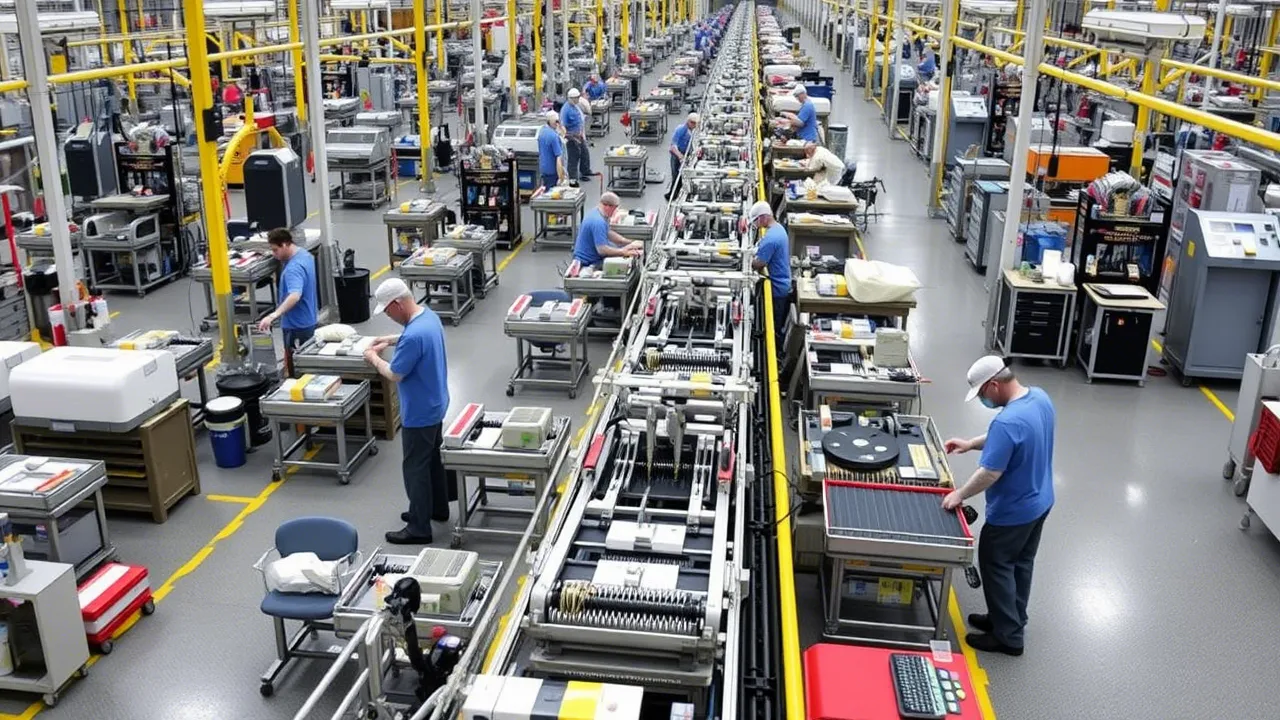
In the current industrial scenario, marked by the transition towards Industry 4.0, line balancing based on simple arithmetic averages is the root cause of an OEE (Overall Equipment Effectiveness) stagnating below 70%.
Achieving a high-performance assembly line requires moving beyond traditional "stopwatch" observation towards scientific predermined time systems.
1. The Anatomy of Imbalance: Why the "Average" Fails
The theoretical Takt Time often fails in practice because it does not account for human variability (the "average error"). We must differentiate between:
- Theoretical Takt Time: The pace required to meet demand.
- Operating Takt Time: The pace adjusted for the target OEE.
2. Measurement Methodologies: Stopwatch vs. MTM/MOST
Traditional timekeeping is susceptible to the Hawthorne Effect and subjective bias. In contrast, predetermined time systems like MTM (Methods-Time Measurement) and MOST (Maynard Operation Sequence Technique) work with "surgical" units called TMU (Time Measurement Units).
- 1 TMU = 0.036 seconds
- 1 hour = 100,000 TMU
Using TMU allows for a granularity that traditional stopwatches simply cannot match, especially in high-speed assembly.
3. Ergonomics and Fatigue Constraints (ISO 11228)
Safety and productivity are two sides of the same coin. According to ISO 11228 standards, allowances (fatigue coefficients) must be mathematically integrated into the work cycle to prevent absenteeism and quality drops.
4. Smoothing Algorithms and the Smoothness Index (SI)
The real challenge is identifying the true bottleneck—not just the slowest station, but the one with the highest variance. Using Ranked Positional Weight (RPW) algorithms, we aim to minimize the Smoothness Index (SI) to ensure an even flow.
A lower SI indicates a more balanced line where idle time is minimized across all workstations.
5. The Cronometras Solution: Digital Twins Fed by Clean Data
The bridge between theory and a >85% OEE lies in "Clean Data." Validating movements in TMU allows for the creation of Digital Twins that accurately predict line performance before a single station is moved.
FAQ: Frequently Asked Questions
How do allowances impact my OEE? Allowances account for necessary rest. If not integrated into the Takt Time, the line will naturally slow down to accommodate fatigue, causing a drop in unplanned OEE.
Is MOST profitable for short production runs? Yes. While the initial analysis takes longer than a simple stopwatch study, the resulting standards are more robust and reusable, leading to a clear reduction in "hidden" inefficiencies.
How can I reduce line variance? Through method standardization and the use of tools like CronometrasApp, which identifies outliers in real-time using the Chauvenet Criterion.
Request a free demo(/en/blog/contact/) to discover how the scientific method can optimize your assembly lines.
Don't want to do it yourself? We do it for you from €800
If you prefer to outsource it, Cronometras delivers a complete time and motion study from a single video: elemental breakdown, OIT/TAL fatigue allowances, standard time with tolerances, and a report in PDF + Excel + JSON ready to present to management.