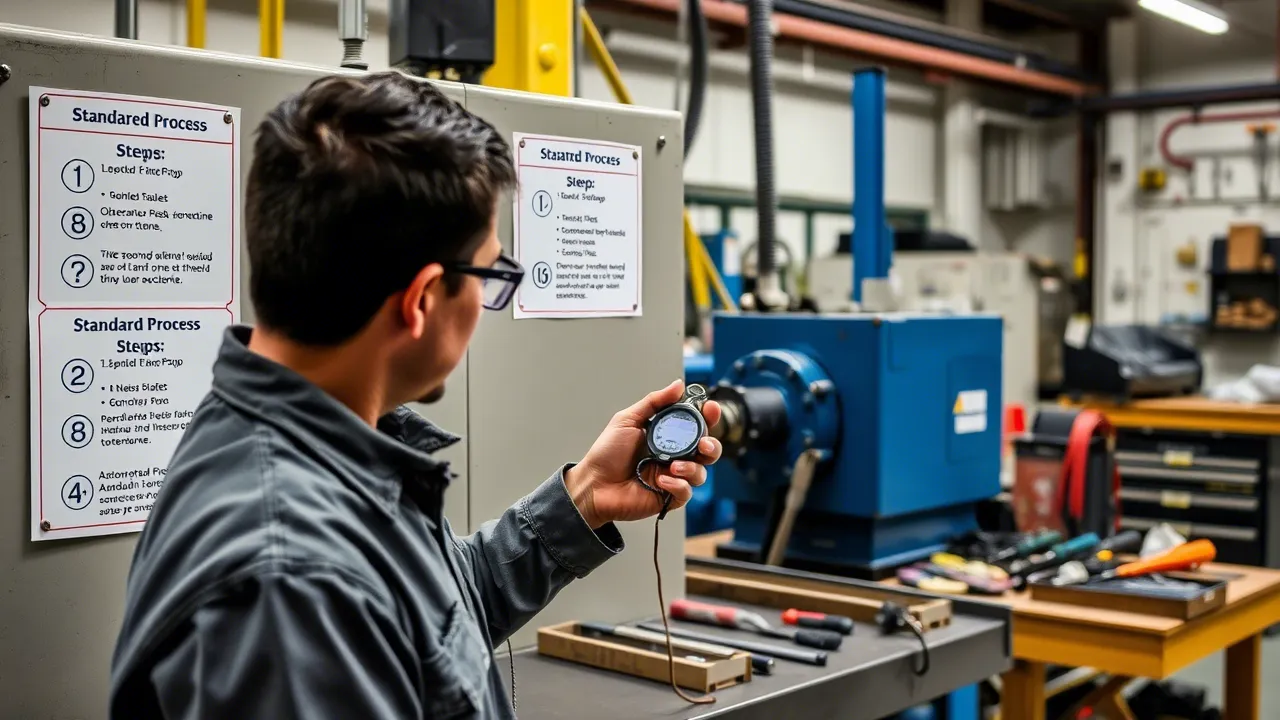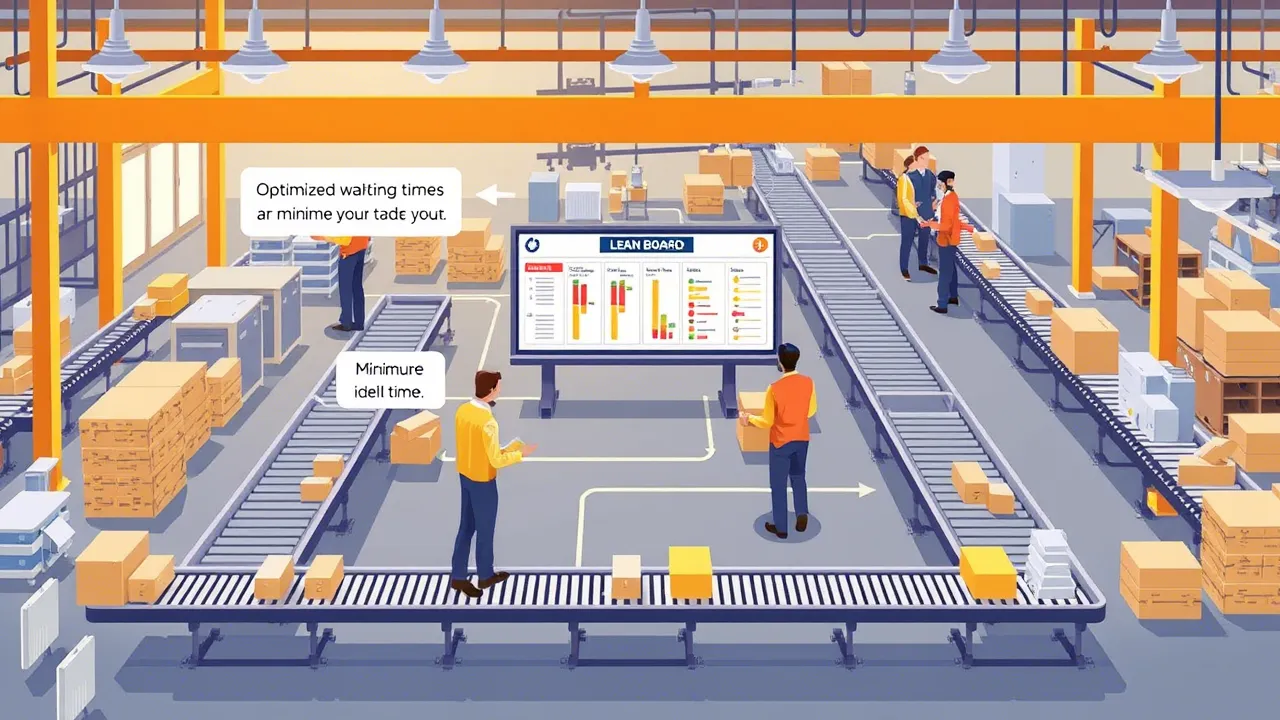
SMED (Single Minute Exchange of Die) has traditionally been misinterpreted as a simple workshop dynamic or a generic "Lean" tool for order and cleanliness. In high-level engineering, this conception is insufficient. From the perspective of Cronometras, SMED is a mathematical and biomechanical challenge: it is about the systematic reduction of TMUs (Time Measurement Units) and the elimination of stochastic variability in the reference change process. We do not simply seek to "go faster", we seek to alter the physics of the method to directly impact OEE (Overall Equipment Effectiveness) Availability.
Technical Anatomy of Changeover Time in Industry 4.0
To manage technical productivity, we must start from a rigorous definition. Changeover time is not simply "the time the machine is stopped". According to operational excellence standards and current technical regulations, format change is defined as the time interval elapsed between the production of the last good piece of batch A at nominal speed and the first good piece of batch B at nominal speed.
The Availability Problem
According to our latest market intelligence reports (2024), 65% of OEE losses in the Spanish industrial sector (Metal-mechanic and Injection) come from non-standardized changeover times and micro-stops associated with startup. A plant with 90-minute format changes and high frequency of short batches is mathematically incapable of competing on costs.
Critical Time Differentiation
For a time analyst, segregation is vital:
- IED (Internal Exchange of Die): Operations that physically can only be performed with the machine stopped. They represent the direct bottleneck and net capacity loss.
- OED (External Exchange of Die): Operations that can be executed with the machine running (masked time). The common error is treating OED as "free time", when it must be timed and optimized with the same rigor as the machine cycle.
Why Traditional Timing Fails in SMED
The classic centesimal timing approach (snapback or cumulative) is usually insufficient for a high-performance SMED project.
- Stopwatch Limitations: Measuring global operation time (e.g., "Change Mold") does not reveal micro-motion inefficiency. The stopwatch tells us how much it takes, but not why. It does not discriminate between an efficient "Reach" (R) motion and one with hesitation or searching.
- The "Adjustment" Trap: At Cronometras we have detected that up to 40% of changeover time is lost in "adjustments". Lack of tooling engineering turns changeover into a trial-and-error process. An adjustment is not a method; it is the absence of a standard. If the operator needs to "tweak" parameters until the part comes out right, the process does not have a stable (Capability Index).
- Performance Factor and Fatigue (ILO): Format changes often imply physical load peaks (handling loads >15kg, awkward postures). A timing that does not correctly apply Rest Coefficients according to ILO regulations will result in an unattainable and dangerous standard time, violating method sustainability.
Advanced Methodology: Integration of MTM and MOST into SMED
Here lies the Cronometras expertise. We elevate SMED from empirical observation to exact science via predetermined time systems.
From Stopwatch to MTM-2 / UAS
Using systems like MTM-2 (Methods-Time Measurement) or Basic MOST allows decomposing the change operation into basic motions.
- Technical Case: Replacing a long-thread screw with a quarter-turn system is not just "saving time". In MTM language, we are eliminating multiple "Turn Action" codes (consuming high TMUs) and replacing them with a simple "Position and Apply Pressure". This granularity allows predicting time savings before making physical investment in tooling.
Video Analysis and Simo-Charts
We use advanced video analysis software (like Timer Pro or AviX) to:
- Segregate IED/OED with frame precision.
- Generate Simo-Charts (Simultaneous Motion Cycle Charts): Efficient SMED requires simultaneous and symmetrical use of both hands, balancing workload and reducing manual cycle time.
Scientific Standardization
The ILO premise is clear: "Without standard method, standard time does not exist". Our goal is to stabilize standard deviation ($\sigma$) of the change process. Only when the method is robust (clear technical instructions, visual marks, poka-yoke tooling), can we certify a standard time for the ERP.
2025 Horizon: Regulations, Ergonomics, and Digitalization
Modern methods engineering does not operate in a vacuum. SMED must align with the 2025 regulatory and technological framework.
UNE-EN ISO 11228 Compliance
Time reduction cannot compromise occupational health. SMED analysis must include biomechanical assessment (NIOSH Equation or OCRA Method) for manual load handling.
- Technical Solution: Implementation of hydraulic or magnetic quick clamping systems (Zero-point clamping). This eliminates manual torque tightening, reducing fatigue and ensuring ISO 11228 compliance, while drastically reducing IED.
Energy Efficiency (ISO 50001)
Changeover time is a "phantom consumer". An injection molder or furnace maintained at regimen temperature during 90 minutes of change consumes energy without producing value. Reducing SMED is, therefore, a direct Industrial Energy Efficiency action.
From Paper to OTS (One Touch Setup)
The trend towards 2025 is total digitalization. The ultimate goal is OTS: changes executed with minimal human intervention, guided by MES (Manufacturing Execution Systems). SOPs (Standard Operating Procedures) must leave paper to integrate into tablets or augmented reality, guiding the operator step by step and validating each stage in real-time.
Cronometras Solution: SMED Methods and Times Audit
At Cronometras, we transform dead times into productive capacity. We don't do group dynamics; we do engineering. Our intervention is structured in three technical phases:
- MTM Diagnosis: Exact quantification of manual workload and detection of wastes invisible to the stopwatch.
- Tooling Engineering: Concrete technical proposals to convert internal operations into external ones and eliminate adjustments (conversion to single-touch).
- Time Certification: Delivery of new standards validated under ILO regulations, ready for loading into your planning system (ERP/MES) and cost calculation.
Is your OEE suffering from low availability and non-standardized changes? Stop guessing and start measuring with scientific precision.
👉 [Request Technical SMED Audit with MTM Specialists]
Technical FAQ
What is the technical difference between SMED and OTS? SMED (Single Minute Exchange of Die) is the methodology to reduce changeover time to less than 10 minutes (single digit). OTS (One Touch Setup) is the final evolution of SMED, where change is performed with a single movement or button, generally in less than 100 seconds, implying high automation and digitalization.
How does the MTM system influence changeover time reduction? MTM allows analyzing the method before it happens. By assigning predetermined time values to human motions, we can design the ideal change procedure on paper, eliminating unnecessary motions and calculating optimal time (Standard Time) without depending on current operator skill or speed.
What do regulations say about ergonomics in mold changes? UNE-EN ISO 11228 establishes limits for manual lifting and transport of loads, as well as repetitive motion frequency. In technical SMED, it is mandatory to validate that process acceleration does not force the operator to exceed these biomechanical limits, prioritizing mechanical aids for peak effort phases.