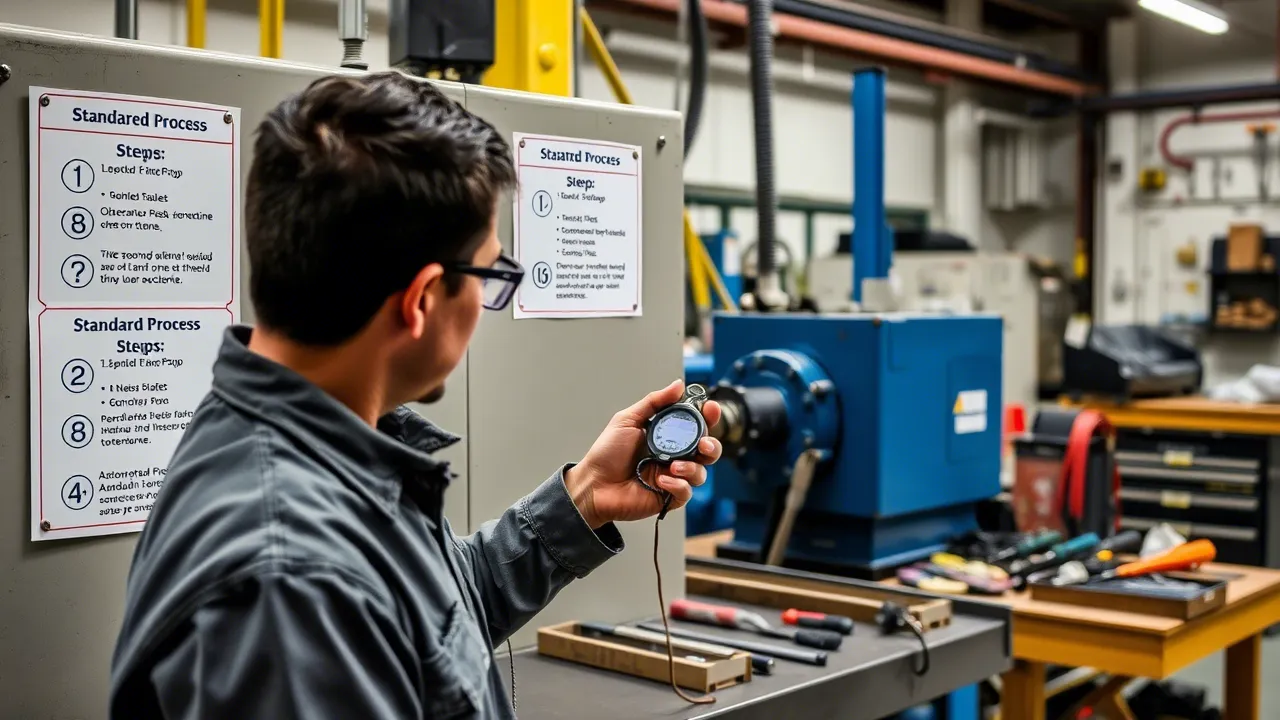
How is productivity measured when the manufacturing cycle lasts 4 hours and the operator seems to be "inactive" in front of a control panel?
This is the most frequent—and costly—technical dilemma in modern methods engineering. A systemic error in the process industry (pharmaceutical, petrochemical, cosmetic, and food) is trying to apply timing methodologies designed for discrete manufacturing (part assembly) in continuous reaction or batch environments.
In this technical guide, we break down Specialized Technique #14 from Cronometras. We analyze the definitive methodology to calculate standard times, saturation, and real OEE in process industries, strictly aligned with prevention and ergonomics regulations projected for the 2025 horizon.
The Inactivity Paradox: Manual Work vs. Dominant Technological Time
The first obstacle for a time analyst in a chemical plant is the visual discontinuity of the cycle. Unlike an automotive assembly line, here the operator does not set the pace; the reactor does. This generates what we call in methods engineering the "Inactivity Paradox".
1. Active Vigilance Definition (ILO Standards)
Seeing an operator observing a manometer or monitoring a temperature curve on a SCADA is not "leisure". According to ILO (International Labour Organization) standards, this is classified as Active Vigilance Time or Attention Time. There is significant mental load: the operator is managing the uncertainty of an exothermic reaction or critical pressure.
Ignoring this time or classifying it as "avoidable inactivity" distorts saturation calculation and jeopardizes process safety.
2. Phase Classification for Timing
To correctly model these processes, Technique #14 requires breaking down "cycle time" into three hermetic categories:
- External Manual Phase: Physical tasks such as loading raw materials (bags, drums), hose connection, or final packaging. These are measurable via Centesimal Timing or MTM systems.
- Technological Phase (Black Box): Reaction, mixing, fermentation, or centrifugation. It is a Dominant Machine Time (DMT). Here the stopwatch is useless; data must be extracted from PLC integration.
- Frequency Manual Phase (The Chaos Variable): Sampling for quality (QC), valve adjustments, or in-process pH corrections.
Hybrid Methodology: Why Centesimal Timing Fails in Chem Sector?
Attempting to time an 8-hour batch cycle with an analyst 100% present (continuous timing) is financially unfeasible and statistically inefficient. Observer fatigue and intrinsic process variability invalidate results.
At Cronometras, we implement a Hybrid Methodology for these scenarios:
1. Work Sampling (Tippett Technique)
For long process phases, we replace the stopwatch with statistics.
- Application: Conducting instantaneous random observations to determine the percentage of time dedicated to Operation, Vigilance, Displacement, and Inactivity.
- Mathematical Rigor: We work with a Confidence Level of 95% and a maximum margin of error of ±5%. This allows auditing entire shifts without constant engineer presence.
2. Standardization with MTM-2 and MOST
Physical loading of raw materials into reactors is a high-wear task. A fatigued operator alters their pace (Activity < 100). Rating this pace "by eye" (Performance Judgment) is subjective and a source of union conflicts.
- Solution: We use predetermined times (MTM-2 or MOST). By assigning standard times to basic motions, we eliminate subjectivity and obtain a fair base time, independent of operator momentary fatigue.
Regulatory Framework 2025: Impact of ISO 11228 and Rest Coefficients (K)
The legal scenario in Spain and the EU is changing drastically. Updates to Prevention Law and UNE-EN ISO 11228 standard on ergonomics force a reevaluation of fatigue allowances.
The Risk of Obsolete Coefficients
Historically, rest coefficients (K Allowances) of 11-12% have been applied. However, the chemical environment presents aggressive conditions that new ILO tables penalize severely:
- Use of complex PPE (chemical suits, autonomous masks).
- Work in ATEX zones.
- Thermal stress (heat/humidity in reactor zones).
Technical Projection: To comply with 2025 regulations, allowances in process plants must be adjusted to the 18% to 25% range.
Warning: Maintaining standard times calculated with old coefficients is not only unrealistic but will be legally indefensible before a labor inspection or ergonomic audit.
Benchmarking: OEE and Saturation Indicators in Process Plants
Based on our Market Research Technical Report (2023-2024), we have detected critical gaps in sector efficiency:
| Indicator | Current Average (Chemical Sector) | Best-in-Class Target |
|---|---|---|
| Global OEE | 60% - 65% | > 85% |
| Operator Saturation | 45% - 55% | 75% - 80% |
| Cycle Variability | ± 15% | ± 2% |
The Hidden Enemy: CIP and SIP
70% of OEE inefficiencies do not come from reaction speed, but from Cleaning (CIP) and Sterilization (SIP) times. Often, these times "hide" in maintenance codes or unplanned stops, representing up to 20% of total available time without standardization.
Cronometras Solutions: Technical Optimization and Man-Machine Charts
To transition from 60% to 85% OEE, measurement is only the first step. Optimization requires advanced methods engineering:
1. SMED Applied to Cleaning Processes
We treat reactor cleaning like a pit stop in Formula 1.
- Conversion: We transform internal times (detergent preparation, purges, hose connection with stopped reactor) into external times (off-line preparation).
- Result: Drastic reduction of Changeover, releasing productive capacity hours.
2. Man-Machine Charts (M-M) and Saturation by Interference
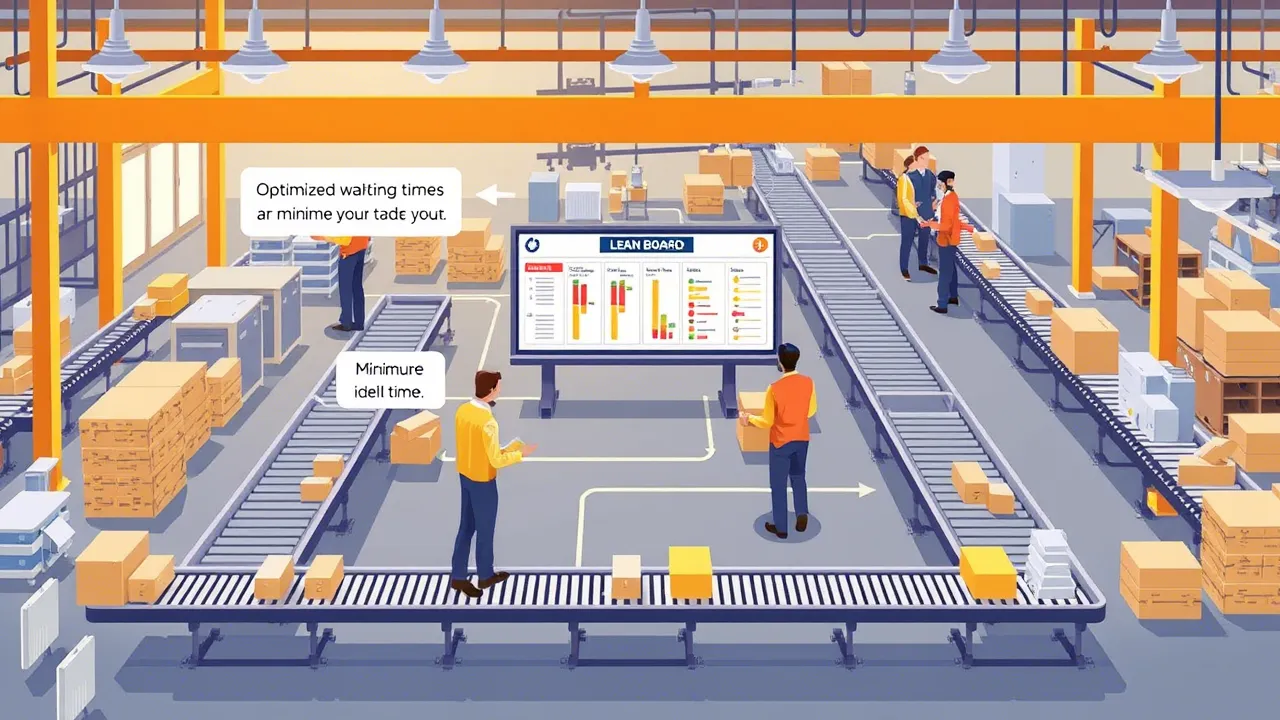
How many reactors can an operator safely attend? We use M-M Charts to visualize and calculate interferences: moments when two or more equipment require simultaneous attention (alarms, loads). This allows defining Optimal Staffing, balancing physical saturation with mental load necessary for critical process vigilance.
3. Data Digitalization (Real-Time OEE)
Paper timing is dead. We integrate calculated standard times (Via MTM/Sampling) with your MES/SCADA system logs. This provides a dynamic OEE distinguishing between performance drop due to machine failure and operational inefficiency.
Would your standard times withstand an audit under 2025 regulations?
Measurement in continuous processes requires precision engineering, not just a stopwatch. If your plant operates with generic fatigue allowances or ignores real impact of cleaning times on OEE, your cost structure is compromised.
At Cronometras, we diagnose your real OEE, apply Technique #14, and adjust your fatigue coefficients to shield your productivity and legality against new European standards.
[> Request Technical Time Audit (Confidential Report)]
Meta Description: Technical guide on time measurement in chemical industry and continuous processes. Analysis of Technique #14, Work Sampling (Tippett), ISO 11228 Standard (2025), and OEE optimization via SMED in cleaning.