Note: the app does not offer the Westinghouse system nor does it use its tables. Cronometras works with synthetic performance rating. This article is historical industry context.
Introduction: Why a System from 1920 Is Still Relevant
In the 1920s, the Westinghouse Electric & Manufacturing Company commissioned a production engineer, Dwight V. Merrick, to carry out research to solve a problem that was holding back the productivity of its plants: stopwatches measured time, but the operator does not always work at the same pace. A cycle measured at 9 seconds when the operator was working fast is not comparable with a 12-second cycle measured when they were working slowly. Without a way to "normalize" the observed pace, time studies produced biased data and the resulting standards were useless for either pay or planning.
Merrick's solution — known as the Westinghouse Performance Rating System (sometimes called the "4-factor system" or simply "Westinghouse") — was to break performance rating down into four independent dimensions: skill, effort, conditions, and consistency. Each dimension is assessed on a graded qualitative scale — classes A to F, with sub-levels in skill and effort — and each grade is assigned a numeric coefficient that adjusts the observed time. The four-factor system was originally published in 1927. The sum of the 4 coefficients produces a rating factor that multiplies the timed time to obtain the normal time (TN).
Almost a century later, Westinghouse remains the theoretical basis of performance rating in modern industrial engineering. The Bedaux, Centesimal, and many national variants (including the ILO guides) share a general principle: the observer's subjective rating structured into independent factors to reduce bias and make the system defensible. Modern time study apps do not apply the Westinghouse system, but they solve the same problem: normalizing the observed pace. CronometrasApp, for example, uses synthetic performance rating: the technician directly assigns the activity on a configurable activity scale (for example, the centesimal scale, from 100 for normal activity to 133 for optimal activity).
This article explains in depth how the Westinghouse System works, why it is important to master it even if you no longer apply it "by hand" in your plant, and how it relates to modern systems (Bedaux, Centesimal, MTM) and to the Work Sampling of WorkSamp for standards auditing.
1. The Four Factors of the Westinghouse System
1.1. Skill (Skill)
Skill reflects the operator's technical competence in performing the task. It depends on their training, experience, coordination, intrinsic work pace, and physical aptitudes. Skill does NOT include effort (that is another factor), but only the operator's ability.
| Grade | Description | Coefficient |
|---|---|---|
| A1 | Outstanding skill (Super skill) | +0,15 |
| A2 | Outstanding skill (lower sub-level) | +0,13 |
| B1 | Excellent skill | +0,11 |
| B2 | Excellent skill (lower sub-level) | +0,08 |
| C1 | Good skill | +0,06 |
| C2 | Good skill (lower sub-level) | +0,03 |
| D | Average skill (Average) | 0,00 |
| E1 | Fair skill | -0,05 |
| E2 | Fair skill (lower sub-level) | -0,10 |
| F1 | Poor skill | -0,16 |
| F2 | Poor skill (lower sub-level) | -0,22 |
In industrial practice, most operators are classified around the middle grades (C and D). An A1 or F2 grade is exceptional and must be documented specially.
1.2. Effort (Effort)
Effort reflects the operator's willingness to apply that skill. It is the difference between "can do it well" (skill) and "is applying that ability to the maximum possible" (effort). An operator with B1 skill may have A1 effort (giving 100%) or C1 effort ("giving away" time).
| Grade | Description | Coefficient |
|---|---|---|
| A1 | Excessive effort (operator straining, unsustainable) | +0,13 |
| A2 | Excessive effort (lower sub-level) | +0,12 |
| B1 | Excellent effort (highly motivated operator) | +0,10 |
| B2 | Excellent effort (lower sub-level) | +0,08 |
| C1 | Good effort (motivated operator) | +0,05 |
| C2 | Good effort (lower sub-level) | +0,02 |
| D | Average effort (operator at their usual pace) | 0,00 |
| E1 | Loose effort (relaxed operator, slow pace) | -0,04 |
| E2 | Loose effort (lower sub-level) | -0,08 |
| F1 | Very loose effort (unmotivated operator) | -0,12 |
| F2 | Poor effort (abnormal pace) | -0,17 |
Key point: skill and effort are two distinct factors and are assessed separately. This is what makes Westinghouse more rigorous than earlier systems that mixed ability and willingness into a single rating.
1.3. Conditions (Conditions)
Conditions reflect the external factors affecting the work: temperature, lighting, noise, ventilation, workstation ergonomics, availability of tools, material quality, layout. It is the only factor that does not depend on the operator, but on the environment.
| Grade | Description | Coefficient |
|---|---|---|
| A | Ideal conditions (optimal in every respect) | +0,06 |
| B | Excellent conditions (adequate, not affecting the pace) | +0,04 |
| C | Good conditions (normal, acceptable) | +0,02 |
| D | Average conditions (some factor slightly affects the pace) | 0,00 |
| E | Fair conditions (several factors affect the pace) | -0,03 |
| F | Bad conditions (operator seriously affected) | -0,07 |
Conditions are observed before starting the time study: the analyst must document the temperature, noise, available space, etc. In a plant with high ambient heat, conditions will rarely be A or B, which implies a negative coefficient carried over to the normal time.
1.4. Consistency (Consistency)
Consistency reflects the uniformity of the operator's pace throughout the cycle. An operator with A consistency maintains a very steady pace; one with D consistency has highly variable times, indicating a loss of control of the method or of attention.
| Grade | Description | Coefficient |
|---|---|---|
| A | Perfect consistency (all cycles practically identical) | +0,04 |
| B | Excellent consistency (variable cycle within an acceptable range) | +0,03 |
| C | Good consistency (variable cycle, within expectations) | +0,01 |
| D | Average consistency (highly variable cycle, hard to time) | 0,00 |
| E | Fair consistency (erratic cycle) | -0,02 |
| F | Poor consistency (unpredictable cycle) | -0,04 |
Consistency is key for Work Sampling: an operator with high consistency has a stable TN and a defensible standard; one with low consistency forces you to take more cycles or apply more complex statistical methods (Westinghouse, Normal distribution, etc.).
2. Calculating Normal Time with Westinghouse
The formula for Normal Time (TN) with the Westinghouse system is:
TN = TO × (1 + Σ Coefficients)
where:
- TO = Observed Time (average of the timed cycles)
- Σ Coefficients = Sum of the coefficients of the 4 factors (Skill + Effort + Conditions + Consistency)
Practical example:
A time study analyst observes a series of welding cycles of a fillet weld in the horizontal position. They calculate an average observed time of 8,20 seconds per cycle. The Westinghouse rating of the operation is:
- Skill: B2 → +0,08
- Effort: C1 → +0,05
- Conditions: C → +0,02
- Consistency: C → +0,01
Σ Coefficients = 0,08 + 0,05 + 0,02 + 0,01 = 0,16
TN = 8,20 × (1 + 0,16) = 8,20 × 1,16 = 9,51 seconds/cycle
The ILO allowances are then applied to this TN to obtain the Standard Time (TE):
TE = TN × (1 + Allowances)
For a welding operation with a total allowance of 20 % (indicative example; the breakdown by items — personal needs, basic fatigue, working conditions — is set case by case):
TE = 9,51 × 1,20 = 11,41 seconds/cycle
This is the standard time used to calculate parts/hour, parts/shift, unit cost, production bonus, line capacity, etc.
3. Criticisms and Limitations of the Westinghouse System
Despite its enormous historical influence, Westinghouse has three recognized limitations that have driven the development of more modern systems:
3.1. Observer subjectivity
The 4-factor rating is, ultimately, subjective. Two time study analysts observing the same operation may arrive at different ratings, especially in intermediate grades. This is mitigated by:
- Specific training of the time study analyst in Westinghouse rating.
- Cross-validation: two independent analysts rate the same operation and the results are compared; when the difference is significant, retraining takes place.
- Inter-observer agreement measures such as Cohen's Kappa.
3.2. Hawthorne effect
The presence of the time study analyst changes the operator's behavior. A systematically observed operator performs at a different pace than usual. This is mitigated by:
- Short and frequent observations (time studies of a few cycles but repeated over several days).
- Work Sampling (Work Sampling) as a complement: random instantaneous observations do not produce a Hawthorne effect.
- Acclimatization period: before timing, the operator works for several days "knowing they are being observed" so that their behavior stabilizes.
3.3. Discrete scale
The scale moves in jumps (for example, +0,15, +0,13, +0,11… in skill) and may be insufficient for operations with fine variability. This is mitigated by:
- Continuous rating systems (such as the British "standard speed" system or fractional systems).
- MTM and MOST: predetermined systems that eliminate subjective rating through basic time tables per movement.
4. From Westinghouse to Modern Systems: A Technical Genealogy
Westinghouse is not an "old" system and "the modern ones are different". It is the foundation upon which later systems were built:
| System | Year | Origin | Relationship with Westinghouse |
|---|---|---|---|
| Westinghouse | 1920s | Westinghouse Electric (Merrick) | Original system, 4 factors |
| Bedaux | 1930s | Charles Bedaux (USA) | Evolution: expresses the coefficient in "B" (Bedaux points). B = 60 corresponds to 100% pace (i.e., Westinghouse = 100). |
| BSI 75/100 | 1940s | British Standards Institution | Classic British scale: 75 = normal pace (Westinghouse = 100 is equivalent to 75 BSI), 100 = fast pace. Proportional to the centesimal (×4/3). |
| Centesimal | 1940s | UIT / OIT | Scale from 0 to 100, where 100 = normal pace (Westinghouse = 100). It is the scale used by the ILO guides and avoids Bedaux fractions. |
| MTM-1 | 1948 | H. B. Maynard, J. L. Stegemerten and G. J. Schwab (Westinghouse) | Breaks with Westinghouse: uses predetermined times per therblig (basic movement), not subjective rating. |
| MOST | late 1960s | K. B. Zandin (H. B. Maynard & Co.) | Evolution of MTM, uses "movement sequences" instead of individual therbligs. |
| MTM-UAS | 1976-1978 | MTM associations of Germany, Switzerland and Austria | Second-level system for batch and series production, derived from MTM-1 analysis. |
| CronometrasApp | 2020s | ProdCont (Spain) | Modern interface with synthetic performance rating (the technician assigns the activity; centesimal scale 100/133) + automatic calculation of TN, ILO/TAL allowances, CI and export to Excel/PDF. Does not implement the Westinghouse system or its tables. |
As you can see, Bedaux, Centesimal, and Westinghouse are the same family (performance rating systems based on the observer's judgment, with a 0-100 / 60-80 / -0,15 to +0,15 scale). MTM and MOST are another family (predetermined systems, which assign the time without rating the pace). Knowing Westinghouse allows you to understand and correctly apply the other performance rating systems; and knowing the differences with MTM/MOST allows you to decide when to use each one.
5. The Relationship Between Westinghouse and Work Sampling
A common confusion is to think that Westinghouse and Work Sampling are "the same system". They are not: Westinghouse is a performance rating system (how you adjust the timed time to obtain the TN); Work Sampling is a technique for auditing time distribution (what percentage of time is devoted to each activity). But they complement each other:
- Westinghouse normalizes the timed cycles to obtain a TN comparable between operators, shifts, and plants.
- Work Sampling audits how that TN is distributed among activities, what percentage goes to waiting, breaks, etc. The WorkSamp tool automates the calculation of the distribution, confidence intervals, and executive reports for auditing.
The recommended practice in an industrial plant is:
- Establish or update the TN of critical operations with well-trained performance rating and a suitable time study tool (for example, Cronometras with its synthetic performance rating).
- Use WorkSamp to audit time distribution in the plant (by trade, by block, by shift) and validate that the TN is not being "paid" in activities that are not direct work.
- Combine both to have a defensible standards system in the face of an external audit, a labor inspection, or a works council.
6. Practical Implementation: How to Put Performance Rating into Practice with Cronometras
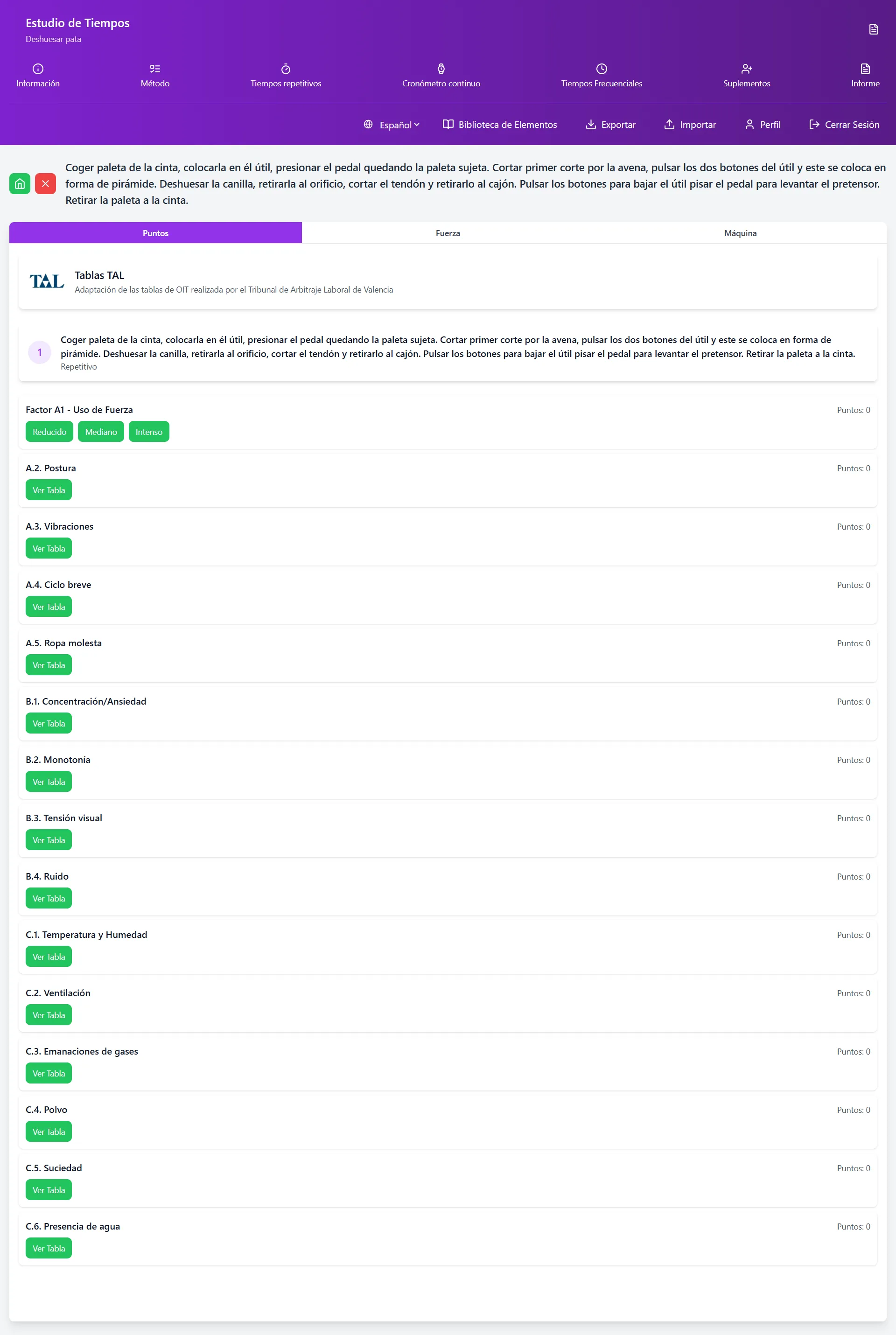
Cronometras works with synthetic performance rating, in which the technician directly assigns the activity on a configurable activity scale (for example, centesimal: 100 for normal activity, 133 for optimal activity). The process is:
- Time the cycles of the operation with the app, using the continuous or snap-back stopwatch, until completing the readings required by the study according to its reliability criterion.
- Rate the pace at the end of each cycle with the rating screen: the technician directly assigns the observed activity on the scale configured for the study (centesimal or Bedaux).
- Calculate the TN automatically from the observed time and the rated activity (on the centesimal scale, TN = TO × activity/100). The app also displays the CI and the remaining readings needed to reach the established reliability criterion (for example, 95%).
- Apply the ILO allowances from the allowances tab, selecting the factors that apply to the operation (posture, heat, noise, monotony, etc.).
- Obtain the TE and export it in the format you need (Excel, PDF or JSON); subsequent integration with planning or standard cost is done from those exported data.
The advantage of CronometrasApp over manual calculation is that it eliminates the mechanical work of rating and calculation: the app calculates averages, CI, allowances, and TE. The analyst concentrates on what adds value: observe, rate, decide. The result is an audit-defensible standard in a fraction of the time a manual system would require.
7. The Relationship with Time and Attendance Control and Incentive Systems
A standard calculated with correct performance rating + ILO/TAL allowances is the foundation upon which wage incentive systems (piece-rate bonuses, production premiums, variable pay) are built. But the standard alone is not enough: you need to know how many actual hours each operator works to correctly pay the bonus. This is where industrial time and attendance control comes in.
The integration of the three tools of the ProdCont ecosystem covers the complete cycle:
- Cronometras establishes the standard (TN + allowances) of each operation. This standard is the "ideal" the operator must reach.
- Induly records the actual time worked by each operator (time and attendance, breaks, shifts, cost centers). It is the "reality" to which the standard is applied.
- WorkSamp audits the distribution of actual time among activities. It makes it possible to know what percentage of actual time is direct work, what percentage is waiting, and what percentage is unproductive.
With these three data sources, an industrial plant can design a defensible pay system in the face of any audit, inspection, or lawsuit. The time standards + ILO/TAL allowances + the time and attendance control of Induly + the audit of WorkSamp form the quartet of modern industrial productivity.
If you need support to design or audit an incentive system based on time standards, the ASETEMYT directory includes consultants specialized in industrial variable pay. And if you want a strategic view of how these tools integrate into a complete ecosystem, the ProdCont website explains it.
8. Conclusion: Westinghouse Is the Alphabet, Not the Final Word
The Westinghouse Performance Rating System is not a historical relic: it is the alphabet upon which all modern systems of subjective performance rating are built. Mastering it is essential to:
- Correctly apply Bedaux, Centesimal and national variants.
- Understand the limitations of subjective systems and when it is better to move to MTM, MOST or other predetermined systems.
- Defend time standards in the face of an external audit, an inspection, or a works council.
- Compare results between plants, shifts, or countries with apparently different but conceptually equivalent rating systems.
And most importantly: even if you work with modern systems such as CronometrasApp or with the Work Sampling of WorkSamp, knowing Westinghouse helps you understand the genealogy of performance rating and validate your results.
The complete cycle of modern industrial productivity — establishing the standard with good performance rating, recording actual time with Induly, auditing the distribution with WorkSamp, and integrating everything into the incentive system — is accessible today with the tools of the ProdCont ecosystem. If you want to go deeper, start with the CronometrasApp rating and allowances module and request a free demo.
Want to master performance rating in your plant? Request a demo of CronometrasApp and we will show you how to apply synthetic performance rating, calculate normal time with ILO/TAL allowances, and export audit-defensible standards to Excel/PDF.
Don't want to do it yourself? We do it for you from €800
If you prefer to outsource it, Cronometras delivers a complete time and motion study from a single video: elemental breakdown, OIT/TAL fatigue allowances, standard time with tolerances, and a report in PDF + Excel + JSON ready to present to management.