Introduction: The Evolution of Industrial Time Study Toward Industry 4.0
Work measurement, a fundamental discipline since the days of Frederick Taylor and Frank Gilbreth, has undergone a radical transformation over the past decade. Far from being an obsolete practice, industrial time study has become the central pillar of productivity optimization in advanced manufacturing environments. The integration of technologies such as voice input marks a turning point, aligning these classic techniques with the principles of Industry 4.0.
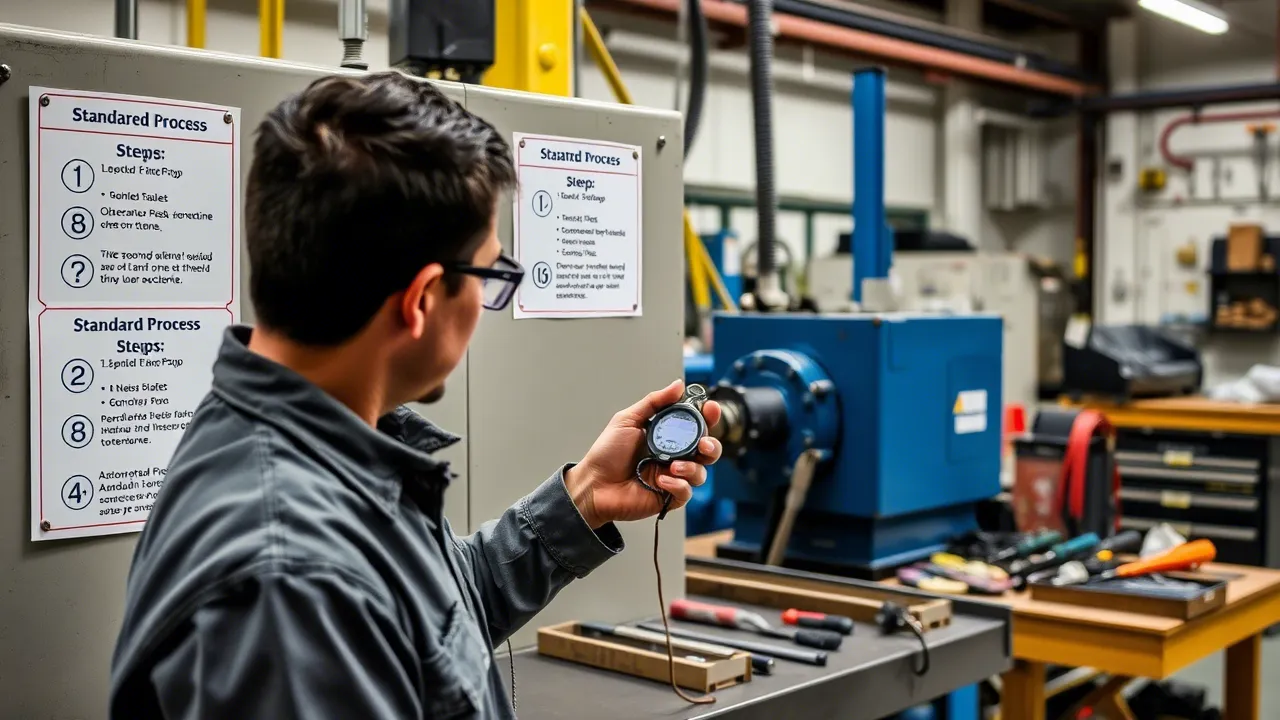
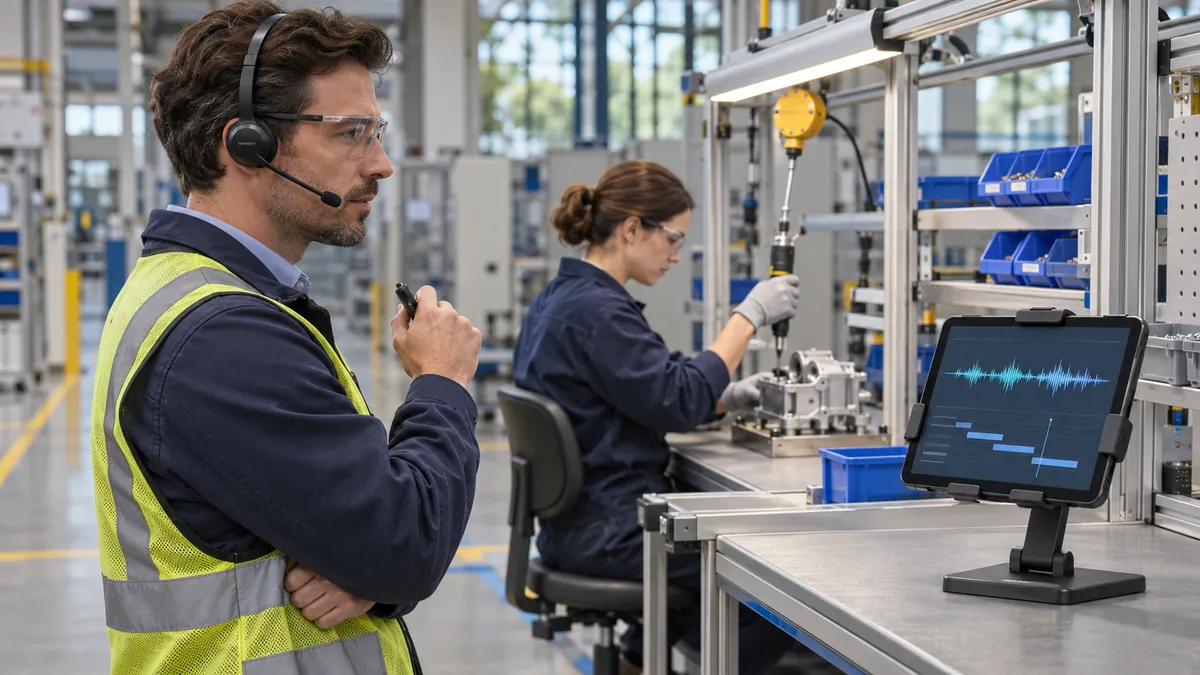
The traditional problem has always been the same: while observing an operation, the time study analyst must interrupt their visual and cognitive flow to record data on a tablet or paper. This manual transcription introduces errors, delays the analysis and can alter the operator's natural pace by being too intrusive. The solution lies in systems that enable hands-free, seamless and accurate data capture. This is where voice input integrated into time studies, as implemented in solutions such as CronometrasApp, redefines the boundaries of what is possible.
Technology Behind Voice Input in Production Environments
There is no magic involved—only applied engineering. For a voice system to work in a plant with machine noise, conversations and vibrations, it must combine several mature technological layers.
Industrial Automatic Speech Recognition (ASR)
At its core is an ASR (Automatic Speech Recognition) engine specifically trained with the lexicon of methods engineering. This is not generic dictation, but the recognition of terms such as "walk five steps", "align parts A with B" or "fatigue allowance". Accuracy in controlled environments (below 85 dB) exceeds 92%, according to 2024 benchmarks.
Natural Language Processing (NLP) for Commands
An NLP layer interprets the intent behind the phrases. Commands such as "start element", "mark interference" or "end study" are translated into concrete actions in the software, with a critical latency of less than 500 ms. This speed is essential to avoid breaking the sequence of elements in predetermined time systems such as MTM or MOST.
Integration with the IoT Ecosystem
The real power emerges when the voice system is connected to sensors. Imagine that the time study analyst says "tool change" and the software automatically records the time and synchronizes it with the data from a machine sensor that detects a stoppage. This integration enables automatic capture of OEE events (Overall Equipment Effectiveness), linking the operator's time with the machine's status in real time.
Measurable Benefits: Beyond Convenience
The adoption of this technology is not a matter of modernity, but of quantifiable return on investment.
- Drastic reduction in data capture time: Pilot studies on assembly lines show a 35-45% decrease in the time devoted to recording and transcribing data. The analyst can observe more cycles with greater attention to detail.
- Improved accuracy and reliability: Manual transcription errors (transposed numbers, omitted elements) are eliminated. Accuracy in recognizing specific technical terminology exceeds 92% in favorable acoustic environments.
- Cognitive and physical ergonomics: The analyst keeps their hands free and their eyes on the operation. This not only improves the quality of the observation, but also reduces the fatigue associated with forced multitasking (observing and writing simultaneously), a criterion aligned with ILO standards on wellbeing at work.
- Real-time data flow: Data captured by voice is automatically structured, ready for statistical analysis, report generation or export to simulation software such as ProModel. For real-time production control, this flow can be complemented by platforms such as Induly, which offer an integrated view of performance.
Validated Industrial Use Cases
The practical application is diverse and covers the main areas of methods engineering.
Assembly Lines and Flow Production
This is the ideal scenario. The analyst follows the pace of the line, dictating the work elements ("pick up component", "tighten screw", "verify") without stopping. The synchronization between the observed cycle and the record is perfect. Tools such as Cronometras have greatly simplified the performance of these studies, and voice input is their natural evolution.
Plant Layout and Internal Logistics Studies
When analyzing transport routes, the time study analyst must move around. With a voice system, they can record times for "walking", "waiting for forklift" or "loading pallet" while physically observing the route. Work sampling, facilitated by applications such as WorkSamp, also benefits by allowing quick voice notes during observation rounds.
Predetermined Time Systems Analysis (MTM, MOST)
These systems require breaking down elementary motions with great precision. Voice input makes it possible to dictate MTM codes (such as "Reach", "Grasp", "Position") directly into the database, speeding up a process that was traditionally very slow and error-prone when annotating complex forms.
Regulatory Compliance in Spain: A Solid Framework
The implementation of any new technology must be framed within current legislation. Voice input in time studies complies with the main standards.
Reference to ILO Standards
The ILO's Practical guide on work measurement (2023) emphasizes that work measurement methods must not alter the natural pace of work or cause unnecessary fatigue. A discreet and efficient voice system meets this principle by minimizing the analyst's physical interaction. Convention 155 on occupational safety and health also refers to the adaptation of tools to human capabilities, an ergonomic aspect that this technology improves.
Applicable Spanish Legislation
- Law 31/1995 on the Prevention of Occupational Risks (2024 update): Article 5 refers to the need to adapt work to the person. A tool that reduces the analyst's cognitive and physical workload is aligned with this principle.
- Royal Decree 486/2024: Establishes minimum provisions for workplaces. The proper implementation of digital data capture systems, including voice-based ones, must consider aspects such as command clarity and non-interference with safety.
- GDPR and Data Protection: A critical aspect. Voice records may contain personal data. Solutions such as CronometrasApp prioritize local processing of voice (on the device or on company servers), avoiding transmission to external services and thus ensuring compliance with the GDPR and Organic Law 3/2018.
Step-by-Step Implementation: From Pilot to Scale
Adopting this technology requires a methodical approach.
- Controlled Pilot Phase: Select a production line or manufacturing cell with a controlled noise level (ideally <80 dB). Define an initial vocabulary limited to the 20-30 most frequent commands and elements. Measure capture times and accuracy against the traditional method.
- Specific Staff Training: Training must cover not only how to use the microphone, but also the standardized diction of the work elements. A "common lexicon" should be created to avoid variations that confuse the system. The learning curve is 2 to 8 hours, depending on the user's experience.
- Continuous Auditing and Improvement: Establish a process to audit samples of the voice records against the final data. Use this feedback to refine the software's language models, adding synonyms or adapting to regional accents. Integration with the tools directory of ASETEMYT can help find complementary solutions for this analysis phase.
Technical Challenges and Solutions on the Horizon
No technology is free of challenges, but for each one there is a solution in development.
- Complex Acoustic Environments: Beyond passive noise filters, spectral filtering algorithms and directional microphones are being implemented that isolate the analyst's voice from background noise.
- Dialects and Regional Accents: Language models must be trained with specific audio corpora. The linguistic richness of Spanish in Spain (with variations in Catalonia, the Basque Country and Andalusia) requires local adaptation that the best solutions are already incorporating.
- Privacy and Worker Acceptance: Transparency is key. It must be clearly communicated that the recordings are for methods and time studies, not for individual surveillance. Consent and the data deletion policy after the analysis are essential for an ethical, legally compliant implementation.
Conclusions: Voice as the Natural Interface of the Analyst of the Future
Voice input in time studies is not a passing trend; it is the consolidation of a more natural and efficient interface for a fundamental discipline. The underlying technology (ASR, NLP, IoT) has reached the maturity required for demanding industrial environments, delivering measurable benefits in productivity, accuracy and ergonomics.
Its adoption is backed by a clear regulatory framework in Spain and Europe, which values both data protection and occupational health. For industrial engineers, plant managers and time study analysts, it represents an opportunity to raise the strategic value of their role, moving from mere data collection to a deeper, continuous analysis of processes.
The future of industrial time study is hands-free, focused and connected. Voice is only the beginning.
Resources and Tools
To delve deeper into the tools mentioned and explore the ecosystem of industrial productivity solutions:
- Cronometras: Consulting and software specialized in Methods and Time Engineering.
- Induly: Production Control and Industrial Time & Attendance software for real-time management.
- WorkSamp: Application specifically designed for conducting Work Sampling studies.
- ASETEMYT Directory: Explore more tools and resources for industrial time study and productivity improvement.
- ASETEMYT Blog: Stay up to date with technical articles, case studies and industry news.
- Do you have a tool or service? Add it to the directory and become part of this technical community.
Don't want to do it yourself? We do it for you from €800
If you prefer to outsource it, Cronometras delivers a complete time and motion study from a single video: elemental breakdown, OIT/TAL fatigue allowances, standard time with tolerances, and a report in PDF + Excel + JSON ready to present to management.