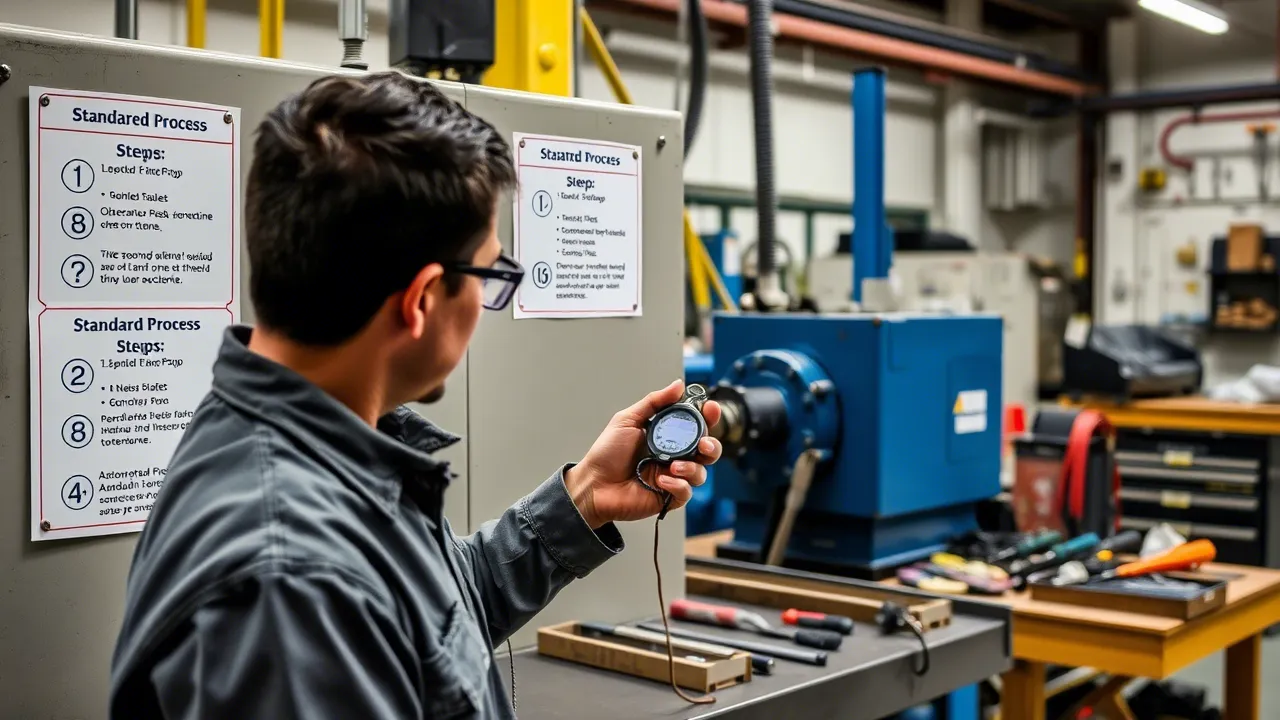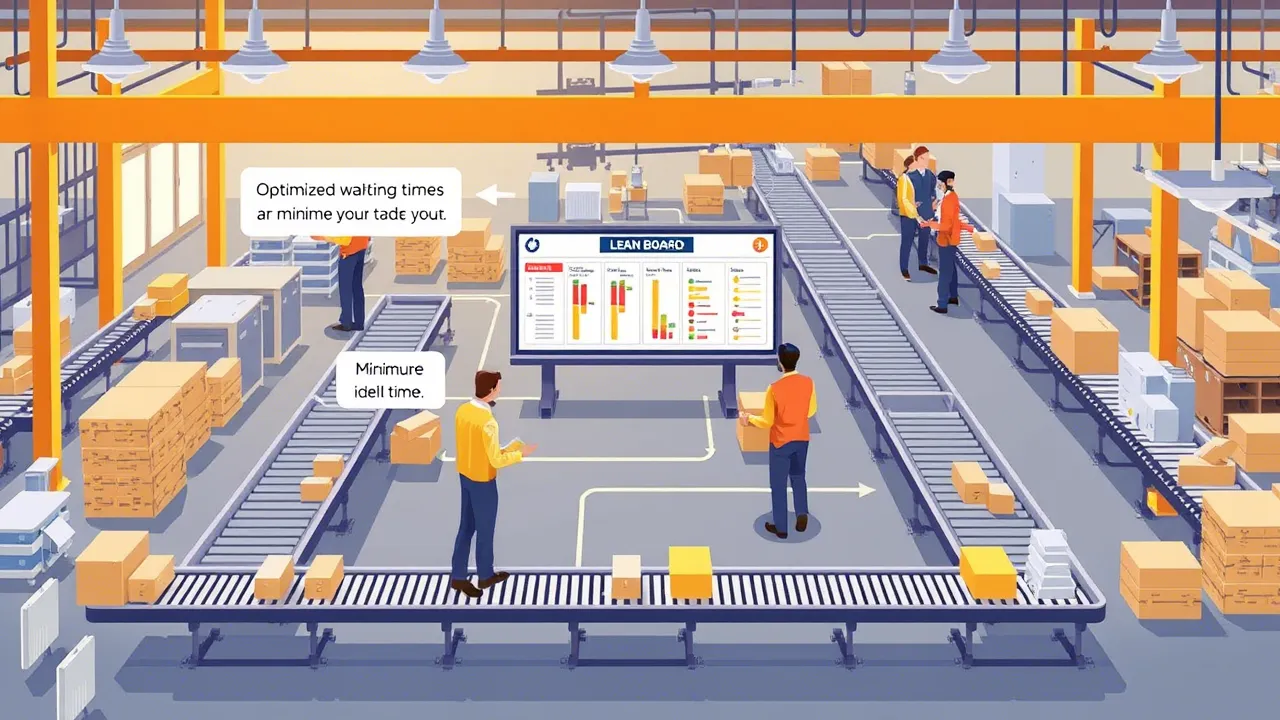
In the Industry 5.0 era, where demand variability and mass customization drastically reduce Cycle Times ($Tm$), intuitive machine assignment calculation is no longer valid. Many Operations Directors face a paradox: they invest in automation, but global OEE does not reach theoretical targets. The hidden cause? Poorly categorized interference micro-stops.
Today we analyze Specialized Technique #16, based on Ashcroft Tables, to calculate with probabilistic precision the interference in multi-machine assignment systems (MMS). This is not a basic guide; it is the technical framework to defend your productivity standards against audits, works councils, and cost deviations.
What are Ashcroft Tables and why is the Man-Machine Chart no longer sufficient?
From Deterministic to Stochastic: The Interference Problem
The traditional Methods Engineer relies on the Man-Machine Chart to balance loads. This method assumes a deterministic scenario: perfect cycles, no variability. However, the industrial reality of 2025 is stochastic.
When an operator manages a fleet of machines, random stops (feeding, small faults, variable inspections) generate what we call Stochastic Synchronization.
- The problem: If two machines stop simultaneously, one must wait. That wait is unproductive time ($I$) beyond the operator's control.
- The solution: Ashcroft Tables use binomial and Poisson distributions to probabilistically quantify the percentage of time a machine will remain idle awaiting service.
ILO Support and Current Regulations
Applying Ashcroft is not a theoretical preference, it is an engineering standard. According to the ILO (International Labour Organization) regulations in its introduction to work study, unproductive times due to machine interference must be compensated through a specific allowance if they cannot be eliminated by methods.
Ignoring this calculation and demanding 100% of theoretical capacity in a multi-machine environment is not only a technical capacity calculation error but a violation of the basis for determining correct times.
Calculation Mechanics: Determining Service Coefficient ($\rho$)
To apply Ashcroft correctly, input precision is non-negotiable. An error of thousandths in base timing multiplies exponentially in the interference and assignment result.
The Critical Saturation Formula
For the technical analyst, the starting point is the Service Coefficient ($\rho$), defined as the ratio between the time the operator dedicates to the machine and the machine's total cycle time.
Where:
- (Occupancy Time): Strict sum of External Manual Load + Internal Manual Load + Standardized walking between stations.
- (Machine Time): Real automatic cycle time (validated, not manufacturer's theoretical).
Why Cronometras recommends MTM-2 or MOST for value?
Here lies the difference between estimation and precision engineering. Using conventional timing to determine introduces operator pace variability (performance factor). At Cronometras, we standardize using Predetermined Time Systems (PMTS) like MTM-2 or MOST. This guarantees "clean" input data, free from human variability, allowing the Ashcroft table to return a reliable probability based exclusively on technical workload, not on observed operator speed.
2025 Feasibility Analysis: Saturation vs. System Efficiency
The "Additional Machine" Trap
Increasing (number of machines) always increases total production, but reduces per-machine efficiency ($E$) and skyrockets workload. System efficiency calculation must consider interference ($I$) obtained from tables:
The goal is not to maximize , but to find the point where the marginal cost of interference exceeds the marginal benefit of extra production.
Real Case Study (Automotive Sector - Injection)
We present data extracted from our 2025-Q1 Technical Report for a Tier 2 plastic injection plant:
- Scenario: Proposal to increase assignment from 3 to 4 injection molding machines per operator.
- Data: min / min. Service ratio .
- Ashcroft Calculation:
- With 3 machines: Interference . Saturation .
- With 4 machines: Interference . Saturation .
Technical Conclusion: Although going to 4 machines is theoretically possible, the 93.7% saturation exceeds the sustainable fatigue threshold (generally 85% according to ISO 11228). This will cause an increase in absenteeism and quality defects due to cognitive fatigue, nullifying productivity gains. The correct technical decision is keeping 3 machines or applying methods engineering to reduce before assigning the fourth.
Legal and Labor Implications of Machine Assignment in Spain
Objective Justification before Works Councils
In collective agreement negotiations (especially Metal and Chemical), "load estimates" are easily contestable. Ashcroft Tables serve as a legal and technical shield. The company does not present an opinion, it presents a mathematical model that explicitly recognizes inevitable wait times ($I$) and adjusts production targets accordingly. This demonstrates good faith and technical rigor.
Cognitive Ergonomics and OEE Blindness
Modern MES (Manufacturing Execution Systems) often fail to label stops. If a machine waits for the operator due to interference, the system usually records it as "Labor Inefficiency". Applying Ashcroft allows correcting OEE, reclassifying those losses as System Saturation (Interference), freeing the operator from responsibility for systemic stops impossible to attend.
Cronometras Solution: Interference Audit and Methods Optimization
It is not enough to calculate interference; it must be managed. Our methodology goes beyond the table:
- Hybrid Audit (Stopwatch + MTM): We validate real with digital technology to capture machine variability and standardize with MTM to eliminate operator variability.
- Cost Scenario Simulation: We calculate the "Break-even Point": At what moment does idle labor cost more than idle machine? (High Capex vs. High Opex).
- Reduction: If the Ashcroft table indicates saturation, our engineers apply SMED and methods improvements to lower service time, making assigning that extra machine viable without burning out the team.
Is your machine assignment based on intuition or mathematical probability?
Poorly calculated saturation is the silent enemy of your OEE. Request a Workload Audit with Ashcroft Technique.
[Contact Cronometras Engineering]
Frequently Asked Questions (Technical FAQ)
What is the difference between Ashcroft and a conventional Man-Machine chart? The Man-Machine chart is deterministic (assumes fixed cycles and perfect synchronization). Ashcroft is stochastic (probabilistic) and calculates efficiency loss caused by random and coincident stops across multiple machines.
Up to what saturation percentage is it recommended to assign machines according to ILO? Although there is no fixed legal limit, ergonomic standards and ILO good practices suggest not exceeding 85% saturation (including rest factors) to maintain quality and safety long-term.
How does automatic cycle variability affect Ashcroft calculation? If has high variability, coefficient fluctuates. In these cases, it is recommended to use weighted average or perform Monte Carlo simulations if standard deviation is very high.
Is using time tables for incentives legally valid in Spain? Yes. Predetermined time systems and mathematical load calculations like Ashcroft are objective tools accepted in Spanish labor jurisdiction to justify task enforceability, provided they are correctly audited and documented.