Every operations manager has to commit to an output figure, and every output figure rests on two things at once: a working-time schedule the law will accept, and work standards the team can actually sustain. Two different rulebooks govern those two things. Labour law tells you when the operator must rest; work measurement tells you how much extra time each unit must carry so the pace holds until the end of the shift. Confusing them is expensive in both directions: apply only the legal breaks and your standards only work on a spreadsheet; apply only the allowances and you may organise the day in a way the law does not allow.
Key Points:
- Legal rest breaks and ILO fatigue allowances answer two different questions: when the operator must stop, and how much recovery time a standard must carry to be sustainable.
- In Spain, a continuous working day longer than six hours requires a rest break of at least 15 minutes (Workers’ Statute, article 34.4); European rules add minimum daily and weekly rest.
- ILO allowances —personal needs, basic fatigue and variable factors— go into the standard time calculation: ST = NT × (1 + Σ allowances).
- Neither replaces the other: legal breaks are a floor in the schedule, allowances are a condition of the standard.
- Avoid double counting: if you grant extra recovery pauses inside working time, either deduct them from the available time or treat them as covered by the allowance — not both.
Two Rules, Two Purposes
A legal break is a scheduling requirement. It says nothing about the job itself: the same 15 minutes apply to a light packing station and to a furnace crew. Its function is to guarantee a minimum recovery window inside the working day.
A fatigue allowance is a measurement requirement. It says nothing about the schedule: it is a percentage carried inside the standard time of each unit so that the standard reflects the real conditions of the job — posture, physical effort, temperature, noise, concentration — and stays achievable across a full shift without eroding the operator’s health.
One lives in the shift plan; the other lives in the calculation of what a unit costs in time. They overlap in purpose —both exist because human performance degrades without recovery— but they are not interchangeable, and neither one covers the other.
What the Law Requires: Spain and the European Framework
In Spain, the Workers’ Statute (Royal Decree-Law 2/2015) sets the floor. According to article 34.4, whenever the continuous daily working period exceeds six hours, a rest break of at least 15 minutes must be established within it. That break counts as effective working time when a collective agreement or the employment contract says so — a detail that changes how much productive time the shift really contains. For workers under 18, the break is at least 30 minutes and applies whenever the continuous working period exceeds four and a half hours.
At European level, Directive 2003/88/EC complements this: its article 3 guarantees a minimum daily rest of 11 consecutive hours in every 24-hour period; article 4 entitles every worker to a rest break whenever the working day is longer than six hours, with the details set by collective agreement; and article 5 guarantees a minimum uninterrupted weekly rest of 24 hours plus the 11 hours of daily rest.
All of these are minimums. Collective agreements routinely improve them, and prevention practice goes further: NTP 916 of Spain’s National Institute for Safety and Health at Work recommends designing breaks by their content, their frequency and duration, and the quality of the rest space, based on the actual fatigue factors of the job — physical effort, repetitive movements, postures, mental load, shift and night work, noise, vibrations, heat or cold. If you want to go deeper into that design side, our article on rest at work covers it.
What none of these texts do is calculate a standard time. The law organises the day; it does not tell you what a unit should cost in minutes.
What the ILO Allowances Require
The work measurement literature, starting from the International Labour Organization’s Introduction to Work Study (edited by George Kanawaty, 4th edition, 1996), structures allowances in two blocks:
- Constant allowances: personal needs —classically around 5% of basic time— and basic fatigue —4% for light work under good conditions in the classic tables—.
- Variable allowances: added according to the real conditions of the job —posture, use of force, lighting, atmosphere, required attention, noise, mental strain, monotony, tediousness—. Each one scales with the severity of the factor; there is no universal fixed percentage.
The arithmetic is simple: ST = NT × (1 + Σ allowances). With a normal time of 10 minutes and 10% of allowances, the standard time is 11 minutes. The percentages vary with the reference table and version used, so the sound practice is to fix one table and apply it consistently across all plant studies. The complete guide to ILO fatigue allowances walks through the structure of the constant and variable blocks and how to apply them factor by factor.
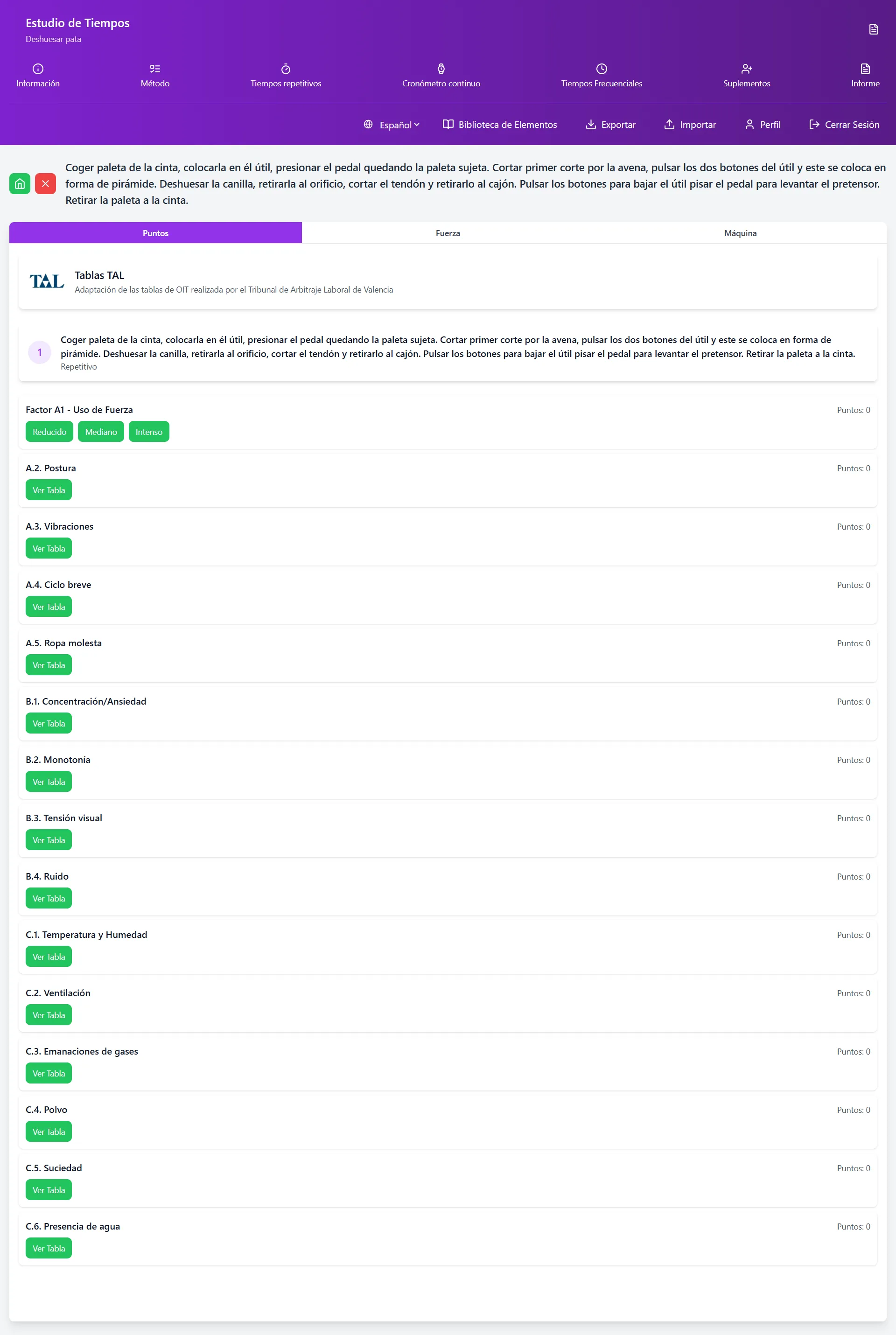
The key idea for planning is this: the allowance is not a break entitlement. It is time carried inside the standard so the operator can absorb personal needs, micro-recovery and unavoidable delays without the standard eroding their health — or your delivery dates. In Cronometras, ILO and TAL allowances are configured by factor —use of force, posture, vibrations, short cycle, restrictive clothing; concentration, monotony, visual strain and noise; temperature and humidity, fumes, dust, dirt and water— and the application applies them when calculating the standard time.
Side-by-Side Comparison
| Legal rest breaks | ILO fatigue allowances | |
|---|---|---|
| Question answered | When must the operator stop? | How much extra time must each unit carry? |
| Set by | Statute and collective agreements | Work measurement practice (ILO manual) |
| Applied to | The shift schedule | The standard time |
| Varies with | Length of the continuous working day, age of the worker | Real job conditions: posture, effort, environment, load |
| If ignored | Legal risk, accumulated fatigue, more errors | Standards nobody can sustain, chronic plan misses |
When to Apply Each Criterion
- Both always apply. Legal breaks belong in every schedule; allowances belong in every standard. There is no scenario where one substitutes for the other.
- Do not subtract legal breaks from the standard time. Breaks are part of the shift plan, not of the work cycle. The standard time measures work content; the schedule measures the day. Deducting the 15-minute break from the standard would mix the two ledgers and produce a number that means nothing in either one.
- Size the variable allowances to the observed workplace, not to a default. Assess posture, effort and environment at the actual station before choosing percentages. A default allowance on a demanding job is how a “sustainable” standard quietly becomes an unachievable one.
- When conditions are harsh, raise the allowance and the prevention response together. A bigger variable allowance pays for recovery in time; it does not fix a hazardous workplace. Rotation, task alternation and additional flexible pauses are the ergonomic answer, and NTP 916 sets the criteria for them.
- Avoid double counting. If you grant recovery pauses inside effective working time beyond the statutory break, either deduct them from the available time or treat them as covered by the fatigue allowance. Doing both inflates the standard; doing neither makes it too tight.
- Review when conditions change. New machinery, a different environment or a reorganised method changes the fatigue factors. Allowances that are never revisited drift away from reality in both directions.
Simulated Practical Case
Example built for teaching purposes to show how the two criteria interact. It does not correspond to a real implementation of any product or to any specific client.
A plant runs an 8-hour shift (480 minutes on site) with a single 30-minute break that satisfies the statutory minimum of 15 minutes. Effective working time: 450 minutes. The task is light assembly with a normal time of 2.00 minutes per unit, already rated for pace.
- Constant allowances: 5% personal needs + 4% basic fatigue = 9%.
- Variable allowances for standing posture and moderate effort (example figures): 3%.
- Total: 12%. Standard time = 2.00 × 1.12 = 2.24 minutes per unit.
- Sustainable daily output: 450 ÷ 2.24 ≈ 200 units, about 26 units per hour.
Now the common mistake: planning from normal time because “the breaks are already in the schedule”. That plan sets 450 ÷ 2.00 = 225 units per day — 24 units and 12% above what the standard can sustain. The gap does not disappear because the law is respected; it shows up as overtime, missed shipments or a team running at a pace nobody can hold.
And the opposite mistake: suppose the plant also grants two extra 5-minute micro-pauses inside effective working time. Treated as non-productive, available time drops to 440 minutes and output to about 196 units — roughly 2% of the day’s output. If instead you consider those pauses covered by the 12% allowance, the figure stays near 200. Either treatment is defensible; applying both at once quietly costs you output you thought you had, and applying neither hides recovery time you are actually giving.
Checklist
- Statutory and collectively agreed break minimums are identified and reflected in the shift schedule.
- One allowance table has been chosen and is applied consistently across all plant studies.
- Variable allowances are sized to the conditions observed at each station.
- Granted pauses and allowances are not counting the same recovery time twice.
- The resulting standard has been compared with real observation over a full shift before being used for commitments.
Conclusion
The law sets the floor for rest; the allowances set the price of the conditions. A plan that honours only the floor burns people out, and a plan that prices only the allowances may organise the day unlawfully. Apply both on purpose —breaks in the schedule, allowances in the standard— and your figures stop being optimistic and start being dependable. If you need standards that hold both legally and operationally, ProdCont can help you set them up.
Don’t want to do it yourself? We do it for you from €800
If you prefer to outsource it, Cronometras delivers a complete time and motion study from a single video: elemental breakdown, OIT/TAL fatigue allowances, standard time with tolerances, and a report in PDF + Excel + JSON ready to present to management.