The End of Data Silos in Work Measurement
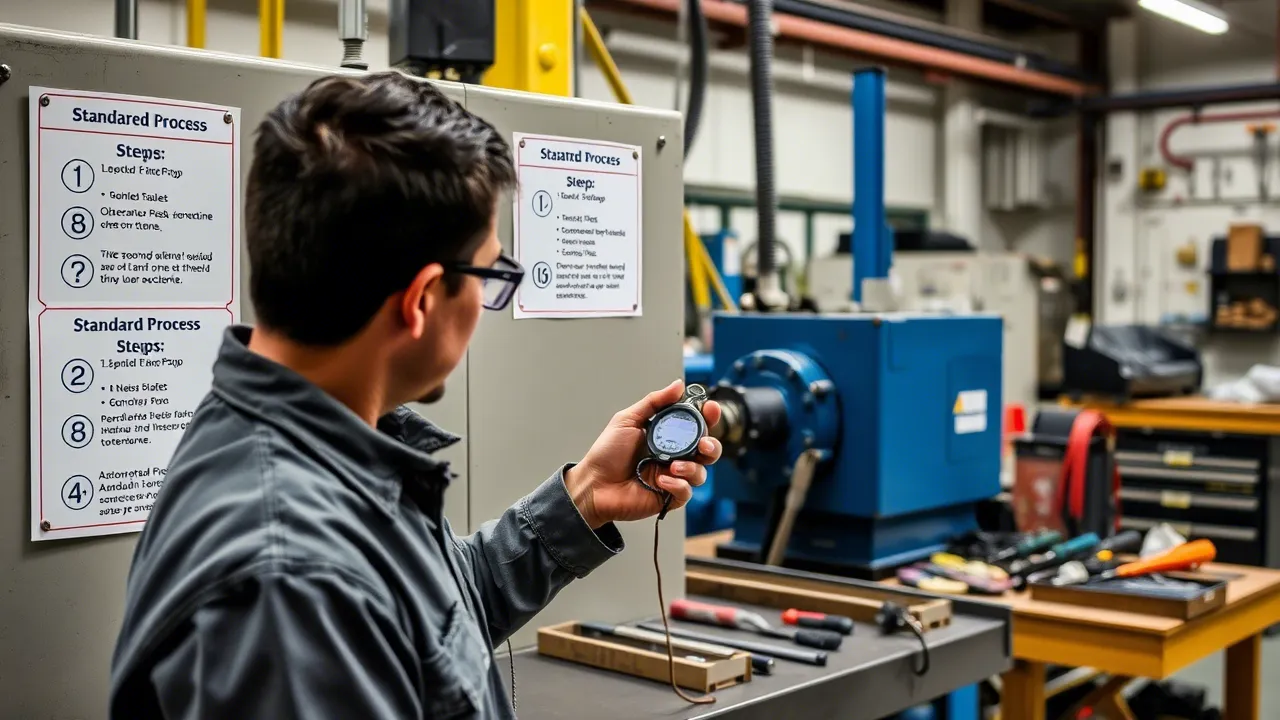
Nowadays, methods engineering faces a chronic information bottleneck: many companies still keep their time studies in spreadsheets, which can make it difficult to centralize and reuse the information. While spreadsheets offer a low barrier to entry for capturing times (whether by continuous method or return-to-zero), prolonged use creates isolated "data silos" that block the scalability of operational analysis.
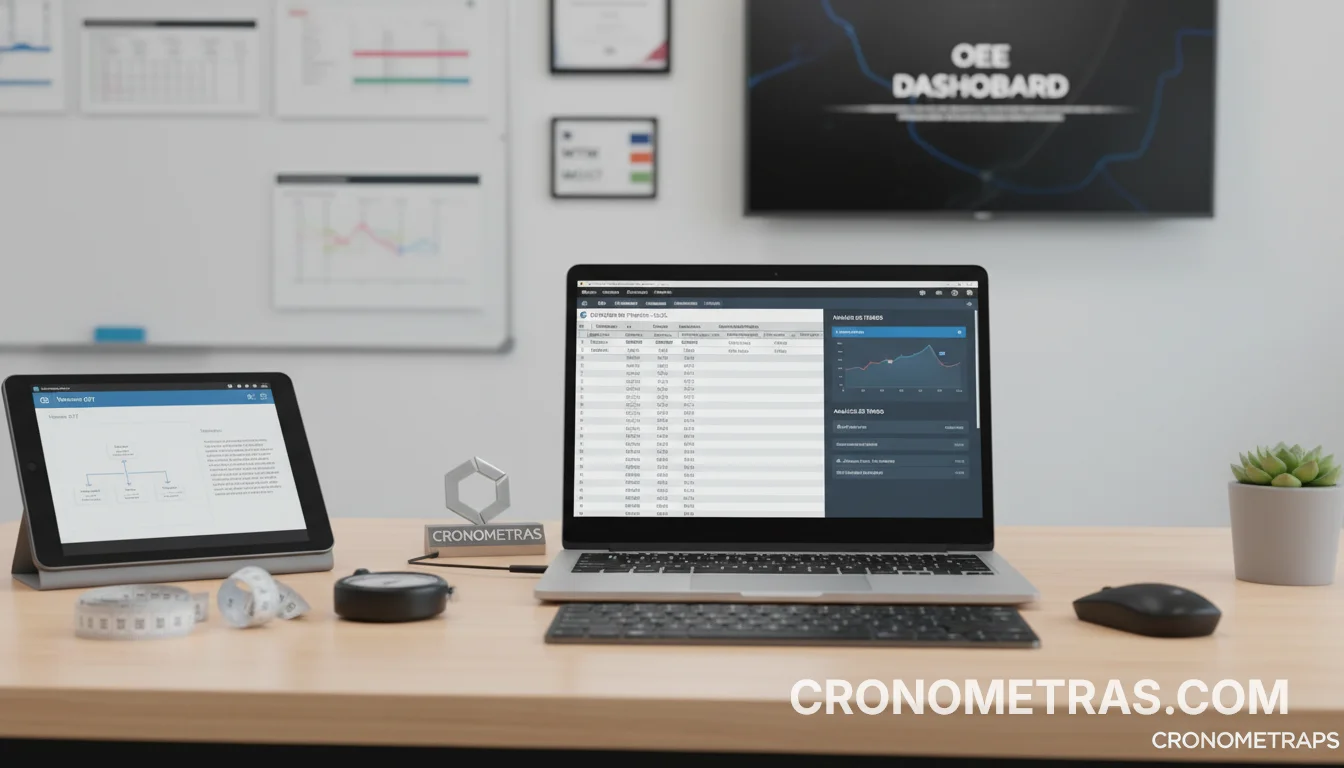
The impact of this isolation is critical when we analyze the overall efficiency of equipment (OEE). The Performance factor within the OEE metric is strictly dependent on the accuracy of the Base Time (or Standard Time). A Base Time calculated and stored in a local Excel file lacks traceability and version control, and is highly vulnerable to accidental alterations in the Allowances formulas (fatigue, personal needs, contingencies) or in the mathematical weighting of the Activity Rating Scale.
For production control systems and high-level MES tools, such as Induly, to calculate OEE and manufacturing costs in real time without deviations, an immutable standard is required. There is an unavoidable technical need to transform these static records into dynamic, relational digital assets.
2025 Regulatory Framework: The Legal Urgency of Time Data Migration
The socio-labor regulatory environment in Spain is heading toward a strict documentary compliance framework for 2025, in which traditional spreadsheets will lose their evidentiary validity in audits and labor disputes.
The recent guidelines of the Labor Inspectorate require absolute algorithmic transparency in the definition of workloads and productivity-based incentive systems. If an operator's pay or performance appraisal depends on a standard, the company is obliged to demonstrate unequivocally how that Base Time was calculated.
By establishing a correct Excel app integration toward cloud-based encrypted environments, the organization is legally protected by guaranteeing the chain of custody of the data: it is recorded which analyst performed the observation, on what date, under what conditions, and which rating scale was applied. This time data migration ensures that the applied allowances are technically justified and aligned with European ergonomics standards (ISO 11228 and ISO 1005-2) and the criteria of the ILO (International Labour Organization). By loading the time study into structured software, the disparity of individual templates is eliminated and centralized regulatory rigor is imposed.
Technical Challenges in the Transition from Tabular Files to Relational Databases
Migrating historical knowledge is not a simple copy-and-paste action. When importing Excel into Cronometras, methods engineers must confront complex structural discrepancies to transform two-dimensional matrices into relational databases:
- Resolving structural heterogeneity: Old templates often mix the recording of regular, irregular (frequency-based) and rare (contingency) elements without a clear hierarchy. Relational mapping requires that every Observed Time (O.T.) be mathematically linked to its frequency of occurrence per machine or operator cycle.
- Mathematical normalization of Rating Scales: Industrial historical records may contain ratings tabulated on historical scales (60/80, 100/133 or centesimal). The import parser must apply standardized conversion factors to obtain a pure Normal Time (N.T.) free of distortions.
- Statistical filters for sample cleansing: In unregulated environments, analysts often "delete" or "hide" rows of abnormally high or low times under a subjective criterion. The technical transition requires the ingestion of raw data and the application of mathematical rigor to identify outlying values (outliers), using automated algorithms such as the Grubbs Test or the establishment of statistical control limits ($\pm 3\sigma$).
(Methodological note: To complement the sample cleansing and avoid time-studying systemic inefficiencies at a micro level, it is recommended to first audit the macro distribution of time in the plant using statistical sampling methodologies supported by professional tools such as WorkSamp.)
ETL Architecture: The Validated Process for Loading a Time Study
To ensure the integrity of the standards library, the workflow must follow an ETL (Extract, Transform, Load) architecture designed specifically for Methods Engineering through platforms such as Cronometras:
- Extraction Phase: Standardized master templates (CSV or XLSX format) are required to structure raw data. Each row must mandatorily define fixed parameters: operation ID, description, type (manual/machine), exact frequencies, arrays of observed times and the applied activity factor or rating.
- Transformation Phase: During import, the analytical engine runs a background audit. It silently validates whether the size of the imported empirical sample meets the required statistical Confidence Level (typically 95%) and remains within a Margin of Error of , based on the fundamental equations established by the ILO.
- Loading Phase (Load): The tabulated elements, once validated, are consolidated into the plant's predetermined-time library. This consolidation is the basis for advanced routines and enables the generation of combined methodologies with the syntax of synthetic systems such as MTM and MOST.
Operational ROI and Knowledge Management in Methods Engineering
The weighty argument for justifying data engineering in the methods department lies in solving the "Denominator Problem" in productivity analytics. The mathematical formula is unforgiving:
A carry-over error of just 4% hidden in the formulas of a spreadsheet when applying fatigue allowances can trigger an analytical disaster. Multiplied by an annual volume of 500.000 units, that deviation generates fictitious bottlenecks or, worse still, a massive underutilization of installed capacity that is completely invisible to the Operations Management.
Likewise, centralizing this data prevents the leakage of industrial know-how. Historically, the turnover of a senior time analyst meant the loss of the plant's "tactical intelligence", since their macros and interconnected sheets became indecipherable for their successor.
Migrating to CronometrasApp represents the definitive leap of continuous improvement departments toward Industry 4.0. It is not merely a document digitalization; it is the foundation of validated, statistically pure and immutable ground, ready to be exported through structured exports (PDF/Excel/JSON) to standard costing systems and the plant's corporate ERP/MES architectures: Cronometras has no direct integration with costing systems beyond this export of structured data.
Don't want to do it yourself? We do it for you from €800
If you prefer to outsource it, Cronometras delivers a complete time and motion study from a single video: elemental breakdown, OIT/TAL fatigue allowances, standard time with tolerances, and a report in PDF + Excel + JSON ready to present to management.