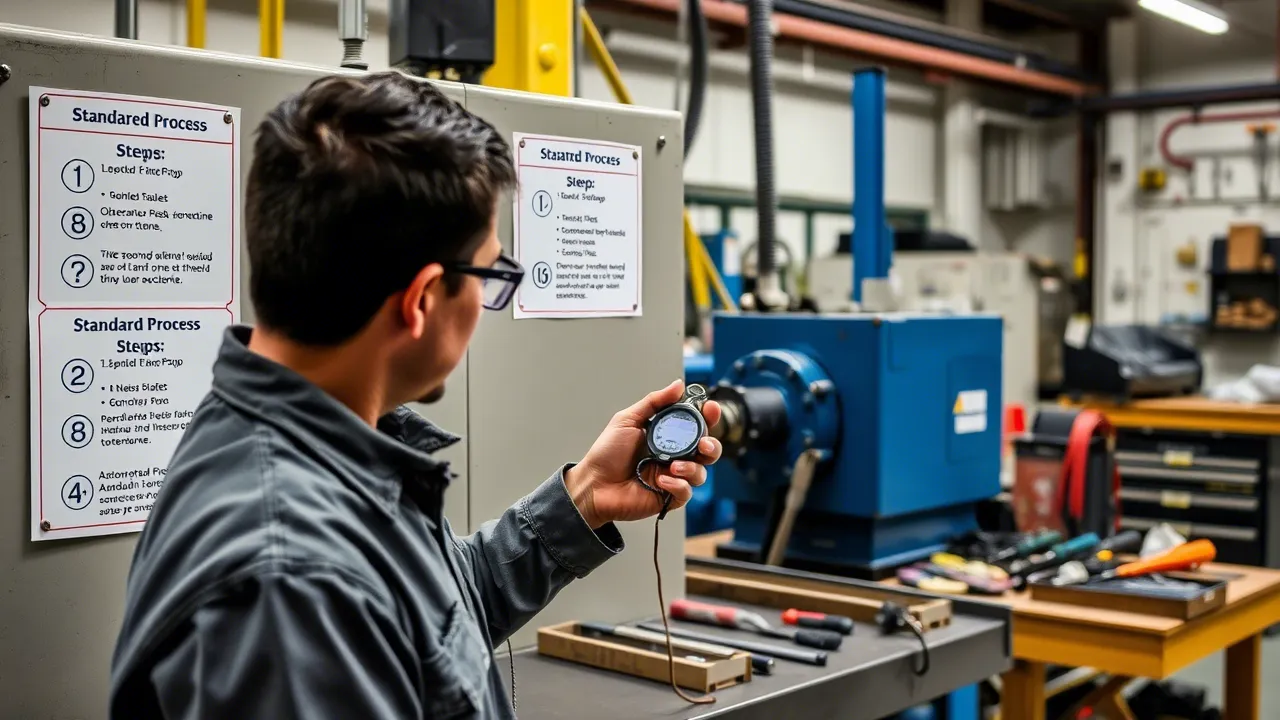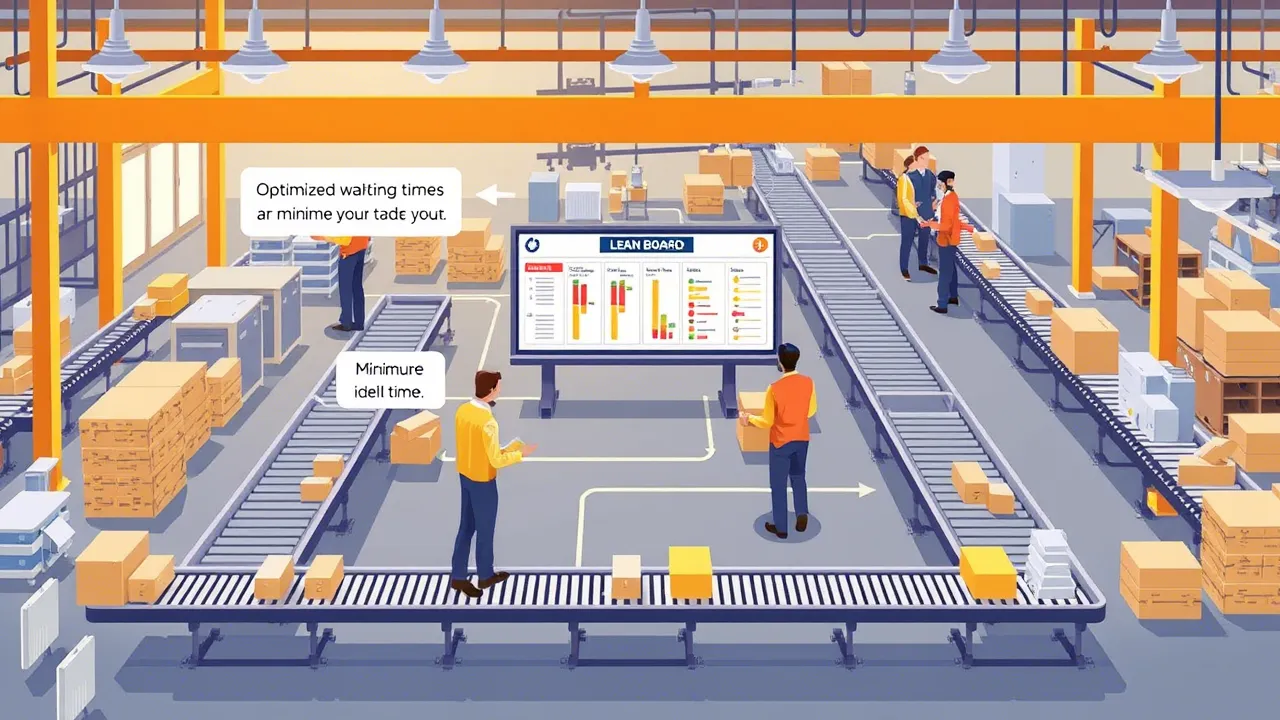
Why do traditional time studies systematically fail when trying to measure maintenance, internal logistics, or line supervision roles? The answer lies in variability: applying continuous time study to non-repetitive tasks generates biased data and high operational cost. Work Sampling is not simple random observation; it is applied statistics to validate technical OEE, audit fatigue allowances, and dimension indirect staff with mathematical rigor.
In this technical guide, we break down methodology according to ILO standards, exact sample size calculation ($N$), and how SaaS technology (Level 2) is transforming this technique in Industry 4.0, allowing capacity diagnostics without the intrusion of continuous monitoring.
Technical Fundamentals: From Probability to Work Measurement
Originated by L.H.C. Tippett, Work Sampling technique is founded on the law of probability and binomial distribution. Unlike intuition or historical estimation, sampling postulates that a sufficient number of random observations allows predicting total system behavior with a controlled margin of error.
For the modern industrial engineer, Work Sampling value lies in its capability to capture operational reality without inducing the Hawthorne Effect (alteration of operator behavior when feeling continuously observed), a common bias in traditional timing.
Critical Differences: Sampling vs. Continuous Timing
| Variable | Continuous Timing | Work Sampling |
|---|---|---|
| Cycle Type | Short and highly repetitive cycles. | Long, irregular, or non-repetitive cycles. |
| Objective | Fix standard time (piece/hour). | Determine utilization % and allowances. |
| Analyst Cost | 1:1 (One analyst per operator). | 1:N (One analyst for 10-20 operators/machines). |
| Intrusion | High (Constant monitoring). | Low (Instant random observation). |
| Ideal Application | Assembly, serial machining. | Maintenance, Warehouse, Setters, Technical Office. |
Sample Size Calculation ($N$): Mathematical Rigor
Validity of a Work Sampling study does not depend on shift duration, but on statistical representativeness. At Cronometras, we do not initiate any field study without defining sample size ($N$) necessary to guarantee legal defense of data before a works council or quality audit.
The Non-Negotiable Formula
To determine number of observations needed, we use the standard formula based on normal approximation to binomial:
Where:
- : Sample size (total number of observations to perform).
- (Confidence Level): Statistical value from normal distribution.
- (Occurrence probability): Preliminary estimate of main activity or inactivity.
- (Tolerated Error): Acceptable precision margin of result.
Critical Parameters in Methods Engineering
Confidence Level ($Z$):
- For internal methods studies or quick diagnostics, we use 95% ($Z=1.96$).
- For standard certifications, labor litigation, or agreements, at Cronometras we work strictly with 99% ($Z=2.58$), practically eliminating possibility that results are due to chance.
Tolerated Error ($e$):
- Defining vs changes cost of study drastically. A 3% error requires almost triple the observations of a 5% one. Choice depends on financial impact of decision to take (e.g., purchasing new machinery vs. shift readjustment).
Preliminary Estimate ($p$):
- Before massive study, we perform pre-sampling (typically 100 observations) to calibrate . If is unknown, we assume maximum variance scenario ($p=0.5$), which maximizes to guarantee coverage.
Critical Plant Applications: Beyond "Working/Not Working"
Modern sampling goes beyond measuring basic productivity. It is a forensic engineering tool for industrial processes.
1. Scientific Determination of Allowances
Many collective agreements (Metal, Automotive) fix theoretical rest coefficients (e.g., 10%). However, does this reflect reality of a foundry or cold storage? Sampling validates allowances for physical fatigue, thermal, and personal needs. A rigorous study can demonstrate that real necessary allowance is 12% (avoiding occupational risks) or 8% (recovering cost-minute), based on empirical data and not subjective negotiations.
2. Technical OEE Audit
MES (Manufacturing Execution Systems) record when a machine stops, but rarely explain human root cause.
- Did machine stop due to breakdown or because operator took 20 minutes extra at lunch?
- Is it a real "material wait" or lack of logistical planning? Sampling categorizes these micro-stops, revealing "hidden OEE" that automation does not detect.
3. Indirect Labor Dimensioning
It is mathematically incorrect to time a forklift driver or quality technician with a snapback stopwatch, as their tasks lack fixed cycle. Work Sampling is the only methodology endorsed by ILO to measure real workload, allowing dimensioning support staff based on real demand and not on work "peaks".
Work Sampling in Industry 4.0: Regulations and Technology
Spanish 2025 industrial scenario presents legal and technological challenges defining how we apply this technique.
Legal Framework (ISO 45003 & GDPR)
Psychosocial risk management (ISO 45003) and Data Protection Law scrutinize invasive digital monitoring (spyware, continuous recording).
- Sampling Advantage: Being random and anonymous (focused on process, not person), Work Sampling is less invasive and complies better with Digital Disconnection Law and privacy rights than continuous video surveillance (Level 3), which presents high legal risks in Europe.
Technological Evolution: From Paper to SaaS
- Level 1 (Obsolete): Pen and paper. Slow, prone to transcription error, and difficult to analyze.
- Level 2 (Cronometras Standard): Apps on Tablets/Smartwatches. Software generates random alerts (vibration), analyst records activity with a georeferenced tap, and data is uploaded to cloud. This guarantees statistical stratification (shifts, hours, days) and eliminates observer "preparation" bias.
- Level 3 (Computer Vision): Although promising, massive CCTV analysis faces union rejection and legal barriers (GDPR) in Spain, making Level 2 the most balanced and viable option today.
Cronometras Solution: Productivity Leak Audit
At Cronometras, we elevate Work Sampling from simple data collection to financial and operational engineering tool. We don't deliver an Excel; we deliver capacity diagnosis impacting your P&L.
Why choose our Digital Sampling approach?
- Level 2 Technology (SaaS + Experts): We use proprietary software that randomizes observation routes, eliminating human bias and guaranteeing data integrity for audits.
- Integration with MTM/MOST: Our sampling is mandatory previous step ("Process Cleaning") before establishing standard times with predetermined systems. Chaos cannot be standardized; first we measure and filter it with sampling.
- Real-Time Results: We generate automatic Pareto Charts identifying critical inefficiencies (unnecessary displacement, waits, interference) at shift end, allowing immediate corrective actions.
Use Case: Suspect your fatigue allowances (10-12%) are inflated or poorly calculated? A Cronometras sampling audit can recover direct percentage points to your plant Cost Minute, scientifically validating real workload.
Technical FAQ
What is the minimum observations for study to be legally defensible? There is no fixed "minimum" number, it depends on statistical formula. However, for agreement discussions or litigation, 99% Confidence Level (Z=2.58$) and maximum error of $\pm 3\% is recommended, usually resulting in several thousand observations (e.g., $N > 2,000$).
Can Work Sampling be applied to administrative or technical office tasks? Absolutely. It is the ideal technique to measure productivity in "knowledge work" (engineering, purchasing, planning), where cycles are mental and not physical. Allows identifying bottlenecks in information flow.
How does sampling affect UNE-EN ISO 11228 ergonomics standard? Advanced sampling allows recording not only activity, but posture (e.g., arm raised, trunk twist). These data feed ergonomic analyses (REBA/RULA) to determine risk exposure in frequency and real duration, complying with prevention regulations.