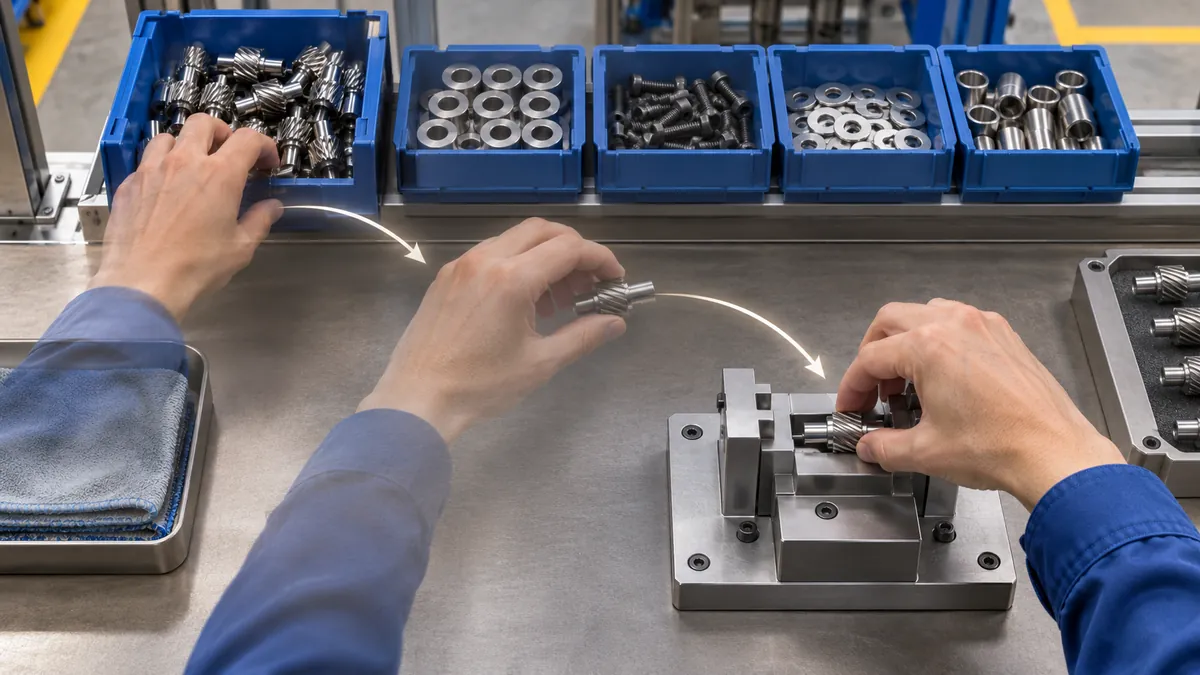
In the field of methods engineering and productivity, the ability to break down, measure and standardize manual work is the foundation of any excellence-driven operation. Faced with the variability inherent to the human factor, predetermined time systems (PTS) emerge as the definitive tool for establishing fair, objective and defensible standard times. Among these, MTM-2 (Methods-Time Measurement 2) has become a de facto standard for micro-motion analysis in high-repetition industrial environments, offering an optimal balance between precision and analytical efficiency. This technical guide delves into its fundamentals, basic motions, TMU values and practical applications, providing industrial engineers, plant managers and time study analysts with the knowledge required for its implementation.
Introduction to the MTM-2 System
The MTM-2 system is a simplified analytical method for determining the standard time required to perform a manual task, based on observing the motions involved and assigning preset time values to each of them. Developed in the 1960s by the MTM Association for Standards and Research as an evolution of MTM-1, its aim was to reduce analysis time and cost without significantly compromising accuracy in common industrial applications.
The fundamental difference between MTM-2 and its predecessor lies in the level of granularity. While MTM-1 breaks an operation down into up to 16 basic motions (such as reach, move, turn, position), MTM-2 groups them into broader, higher-level categories: Get (Obtener), Put (Colocar) and Apply Pressure (Aplicar Presión), in addition to including Grasp (Agarre) and Release (Soltar) as sub-elements or classifications within the former. This simplification reduces the number of elements to be analyzed by approximately 60%, speeding up the study process without losing the essence of measurement by predetermined methods.
The importance of time measurement units (TMU - Time Measurement Units) is central to this system. One TMU equals 0.036 seconds (or, in other words, 100.000 TMU equal 1 hour, and 27.78 TMU equal 1 second). The use of this abstract unit, rather than seconds directly, facilitates calculations and underlines that time is a consequence of the method, not an isolated variable. This principle, aligned with the recommendations of the International Labour Organization (ILO) on fair working conditions, eliminates the subjectivity of classical time study, such as the "rating controversy" or the adjustment factors for fatigue.
Detailed Analysis of the Basic MTM-2 Motions
The core of MTM-2 lies in its technical table of motions and the corresponding TMU values. The fundamental elements are broken down below.
Technical table of Get (G), Put (P) and Apply Pressure (A) motions
| Motion | Symbol | Description and Conditions | Reach or Type | TMU Value |
|---|---|---|---|---|
| GET (G) | G1A | Reach for and pick up a loose object, no obstruction, minimum reach. | Reach ≤ 5 cm | 2.0 |
| G1B | Reach for and pick up a loose object, short to medium reach. | Reach 5 - 20 cm | 3.5 | |
| G1C | Reach for and pick up a loose object, medium to long reach. | Reach 20 - 80 cm | 4.5 | |
| G2 | Reach for and pick up a small, jumbled object or one requiring search/selection. | - | 7.0 | |
| PUT (P) | P1 | Simple placement, no adjustment, in contact or immediate proximity. | Tolerance > 6 mm | 2.0 |
| P2 | Placement with slight adjustment or guiding, no pressure. | Tolerance 2 - 6 mm | 5.0 | |
| P3 | Precise placement or with forced fit, requires visual attention and control. | Tolerance < 2 mm | 9.0 | |
| APPLY PRESSURE (A) | A1 | Apply basic force or pressure, no fine control of the motion. | - | 3.0 |
| A2 | Apply force or pressure with control, adjustment or restricted position. | - | 7.0 |
Classification of Grasp (GR) and Release (RL)
These elements are not always analyzed separately, since they are often implicit in the Get and Put motions. However, in cases where grasping or releasing is particularly complex or critical, they are classified independently:
- Grasp (GR):
- GR1 (Simple grasp, contouring): The object is naturally surrounded by the fingers. 1.5 TMU. Example: Grasping a tool with a cylindrical handle.
- GR2 (Complex grasp, selection): Requires fine manipulation, lifting an object from a pile or selecting among several. 5.0 TMU. Example: Separating a washer from a pile.
- Release (RL):
- RL1 (Normal release): Simple opening of the fingers. 1.0 TMU. Example: Dropping a component into a container.
- RL2 (Controlled release): Release requiring careful positioning or placement. 2.5 TMU. Example: Releasing a delicate object onto a fixture.
Practical Calculation Example
Consider the operation of picking up a screw from a tray (reach of 15 cm) and manually screwing it two turns into a housing.
- Get: Reach for and grasp the screw in the tray (loose object, reach 15 cm). -> G1B = 3.5 TMU.
- Put (Initial positioning): Bring the screw to the thread and start contact. Placement with slight adjustment (guiding). -> P2 = 5.0 TMU.
- Apply Pressure (Screwing): Apply force to turn the screw. It is considered controlled pressure (rotation). -> A2 = 7.0 TMU.
- Release: Release the screw (now seated). -> RL1 = 1.0 TMU.
Total time in TMU = G1B + P2 + A2 + RL1 = 3.5 + 5.0 + 7.0 + 1.0 = 16.5 TMU. Time in seconds = 16.5 TMU * 0.036 s/TMU = 0.594 seconds.
This would be the elemental standard time for that sequence, free of contingencies. To obtain a complete standard time, percentages for fatigue, personal needs and unavoidable delays would be added, following the guidelines of the UNE 66-010 standard or equivalent.
Industrial Application and Standard Time Calculation
Establishing Standard Times on Assembly Lines
MTM-2 is particularly valuable on assembly lines with high manual content, such as in automotive, electronics or consumer goods. Its application makes it possible to:
- Accurate line balancing: Assign tasks with calculated TMU times to each station to equalize the cycle and minimize idle time.
- Ergonomic workplace design: Analyze the motion sequence to reduce unnecessary effort and excessive reaches before implementing the method.
- Labor cost estimation: Based on objective data, not on estimates or historical records that may contain past inefficiencies.
Integration with OEE (Overall Equipment Effectiveness)
OEE measures the availability, performance and quality of a piece of equipment. The performance variable compares actual output with theoretical output based on the ideal cycle time. This is where MTM-2 provides invaluable value:
- The standard cycle time for a manual or semi-automatic operation can be derived directly from an MTM-2 study.
- This standard time becomes the theoretical baseline (100% performance).
- Any deviation of actual time from the MTM-2 time represents a quantifiable performance loss, which can be analyzed (is it due to material delays, lack of skill, inefficient method?).
Performance Formula in OEE using MTM-2:
Performance (%) = (Standard Cycle Time (MTM-2) * Total Output) / Actual Operating Time * 100
Case Study: Electronic Assembly Optimization
An electronic components company was assembling a connector on a PCB using classical time study, obtaining a standard time of 45 seconds, with a performance rating factor of 110% applied by the analyst.
An MTM-2 study revealed the following sequence:
- G1B (3.5) + P3 (9.0) + A2 (7.0) + RL1 (1.0) = 20.5 TMU (0.738 s) for the main insertion.
- Adding other minor operations (checking, reorienting), the total MTM-2 time was 1.150 TMU (41.4 seconds).
Result: The MTM-2 time was 8% lower than the adjusted time study. The difference was not because the worker was slower, but because the subjectively applied performance rating factor was conservative. With the MTM-2 standard, the company obtained an objective figure, defensible to the workers and useful for more aggressive line balancing, increasing productivity by 5% without raising work intensity.
MTM-2 in the Context of Industry 4.0 and Spain (2025)
Digitization of Analysis
Manual paper-based analysis is being replaced by specialized software that streamlines and improves the process:
- Tools such as TiCon or MTM-Easy: They allow MTM-2 sequences to be built by dragging and dropping elements, automatically calculate the total TMU, and generate standardized reports.
- Integration with Digital Gemba and Digital Twins: MTM-2 data can be linked to 3D models of the workplace (digital twin) to simulate and optimize methods virtually before implementing them on the shop floor (Gemba). For complementary work sampling tools at the point of operation, platforms such as WorkSamp offer digital solutions to validate and complement time studies.
Spanish Regulatory Framework
In Spain, the UNE 66-010 standard: "Productivity Management. Work Measurement System" is the national reference. This standard, aligned with ILO conventions, sets out the principles for implementing work measurement systems, including predetermined time systems such as MTM-2. The MTM España Association, as a member of the international MTM Association, is the body responsible for promoting, training and certifying professionals in these methods within the national territory, ensuring the correct application of the standards.
Current Challenges
- Shortage of Certified Analysts: According to data from the association itself, less than 15% of industrial engineers in Spain hold an advanced MTM certification. This training gap limits the systematic adoption of the methodology.
- Integration with Management Systems (ERP/MES): The true potential of MTM-2 is achieved when its standard times feed planning systems (ERP) and execution systems (MES) in real time. This integration, although technically possible, requires a digitalization and data standardization strategy that many companies are still developing.
Relationship and Synergy with Other Systems (MOST, MTM-1)
MTM-2 vs. MOST: When to Use Each System?
The choice between MTM-2 and MOST (Maynard Operation Sequence Technique) depends on the level of granularity and the type of process:
- MTM-2: It is the system of choice for manual micro-motions and repetitive short-cycle tasks (< 1 minute). Its accuracy in breaking down and measuring arm, hand and finger motions is unsurpassed. Example: Assembly of a sub-assembly, manual packaging, simple machine operation.
- MOST: It is designed for macro sequences involving larger-scale object movements (> 1 minute). It is faster to apply for analyzing transport, storage, or equipment handling. Example: Moving a pallet from the warehouse to the production line, changing a tool on a CNC machine.
Hybrid Strategy: In a plant, MOST can be used to analyze the internal logistics flow (receiving, storage, line feeding) and MTM-2 for
Don't want to do it yourself? We do it for you from €800
If you prefer to outsource it, Cronometras delivers a complete time and motion study from a single video: elemental breakdown, OIT/TAL fatigue allowances, standard time with tolerances, and a report in PDF + Excel + JSON ready to present to management.