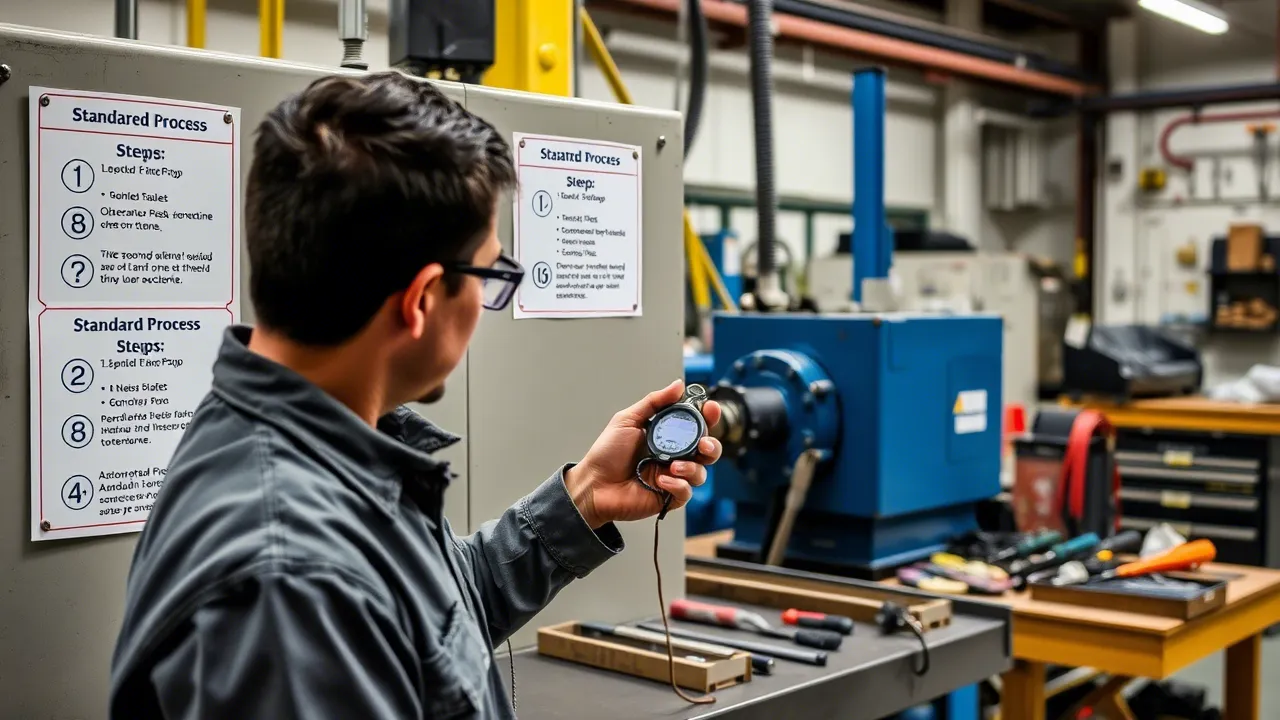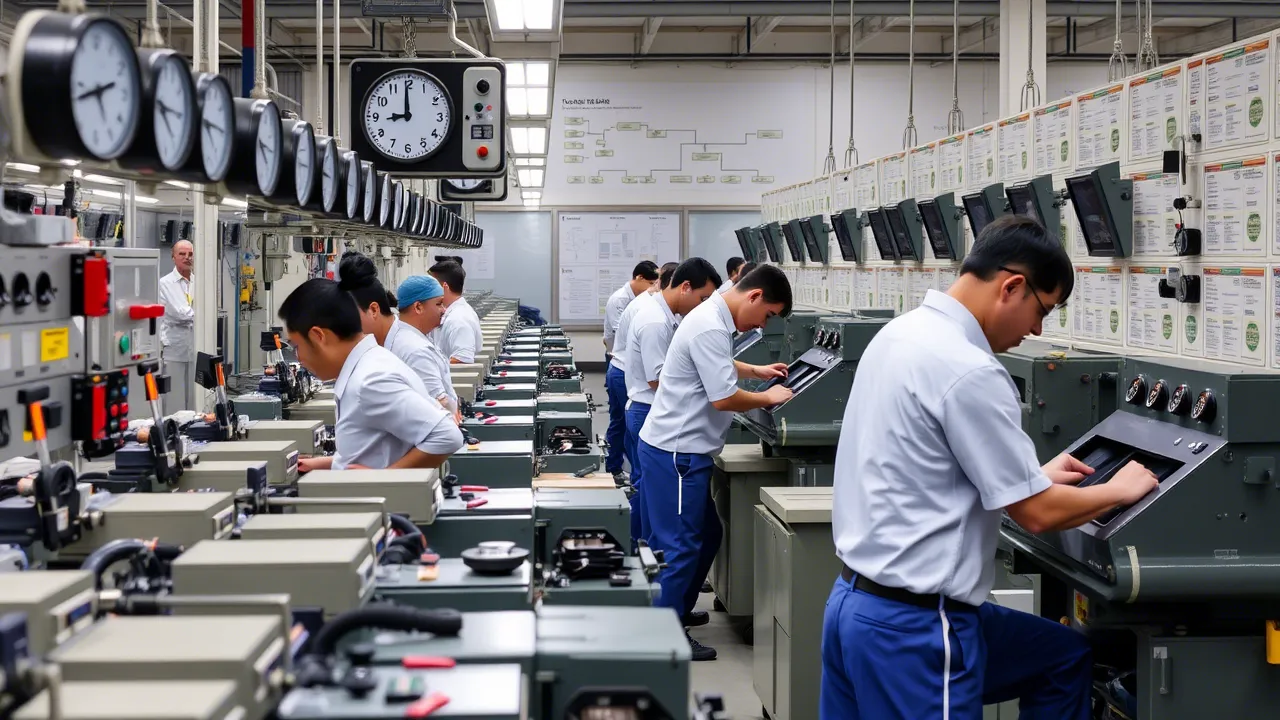
In modern production plants, every second counts. A human error at an assembly station can generate rework, line stoppages, and deviations in standard times that, when accumulated, erode the competitiveness of the entire operation. But what if the very design of the workstation could make the error impossible before it occurs?
The Japanese concept of Poka-Yoke (ポカヨケ), literally "mistake-proofing", is one of the most powerful tools in Lean Manufacturing. Although traditionally associated with quality control, its impact on cycle times and work standardization is profound. In this article, we examine how to integrate Poka-Yoke devices into an industrial time study and why they are natural allies of precision time study.
What Is a Poka-Yoke?
Shigeo Shingo, a Toyota engineer, formalized the concept in the 1960s as part of the Toyota Production System. A Poka-Yoke is any mechanism, device, or procedure that:
- Prevents a human error from becoming a defect, or
- Detects the error immediately after it occurs, stopping the process before it advances.
The Three Levels of Poka-Yoke
| Level | Description | Industrial example |
|---|---|---|
| Level 1 | The device detects the error but does not stop the process | A sensor that emits an audible alert if a component is missing |
| Level 2 | The device stops the operation until the error is corrected | An assembly fixture that only releases the part if all screws are tightened to the correct torque |
| Level 3 | The device physically prevents the error from occurring | Connectors with asymmetric shapes that allow only one assembly orientation |
Regulating Functions: Control vs. Warning
Shingo classified Poka-Yoke devices into two major families according to their regulating function:
1. Control function (stop method)
The device stops the machine or the process when it detects an anomaly. It is the most powerful type because it eliminates the possibility of the defect advancing to the next station.
Impact on times: although it introduces a verification that takes milliseconds, it eliminates the rework time that would occur downstream. The net balance is always positive.
2. Warning function (alert method)
The device signals the anomaly (light, sound, vibration) but does not stop the process. It requires the operator to intervene.
Impact on times: the operator's reaction time introduces variability into the cycle. However, for low-frequency errors, it may be preferable to a complete line stoppage.
Detection Methods at the Workstation
Poka-Yoke devices are implemented through three detection methods:
Physical contact method
It uses the shape, dimension, or position of the part to detect anomalies. These are the most common on assembly lines:
- Guide templates that accept the part only in the correct orientation
- Limit switches that confirm the presence of components
- Go/no-go gauges integrated into the work fixture
Fixed-value method
It verifies that a predetermined number of movements or parts has been completed:
- Tightening cycle counters in electric screwdrivers
- Scales that verify the total weight of a component kit
- Optical sensors that count parts in a tray
Motion-step method
It checks that all the steps of a sequence have been performed in the correct order:
- Presence sensors at each station of an assembly sequence
- Photocells that detect whether the operator has passed a hand through a given area
- Pick-to-light systems that guide the operator step by step
Impact of Poka-Yoke on Cycle Times
When a methods analyst performs a time study, the presence of Poka-Yoke devices modifies several time-study parameters:
1. Variability reduction ($\sigma$)
The main contribution of a Poka-Yoke to the time study is the reduction of the standard deviation in the observed times. Without mistake-proofing devices, "normal" cycles are mixed with cycles that include micro-corrections, verification pauses, and small rework operations that the analyst does not even detect with the naked eye.
The standard time formula illustrates the effect:
Where:
- = Standard time
- = Normal time (observed time × performance rating factor)
- = Allowances (fatigue, contingencies, personal needs)
When a Poka-Yoke eliminates micro-rework, the observed time ($T_o$) stabilizes, reducing the number of observations required according to the General Electric formula:
Where is the number of observations required, the standard deviation, and the mean. By reducing , fewer time studies are needed to reach the same level of statistical confidence.
2. Elimination of non-cyclical elements
Many Poka-Yoke devices absorb verification tasks that were previously the operator's responsibility. For example:
- An operator without a Poka-Yoke spends 0.3 minutes per cycle visually verifying that all screws are in place
- With a presence sensor, that verification takes 0.05 minutes and is more reliable
These 0.25 minutes saved per cycle, in a production of 1,000 units per day, represent 4.1 hours of capacity recovered per month.
3. Reduction of contingency allowances
The ILO allowance tables include a percentage for contingencies (minor interruptions, rework, additional verification). When Poka-Yoke devices eliminate the source of these contingencies, the analyst can justify a reduction in the allowance, which translates directly into a tighter standard time and higher expected productivity.
Integration with CronometrasApp: From Paper to Digital Data
CronometrasApp makes it possible to capture all of this information in a structured way during the on-plant time study:
Customizable element libraries
Each Poka-Yoke installed at the workstation can be recorded as a library element, with its associated verification time. This makes it possible to:
- Compare cycle times before and after installing the device
- Calculate the return on investment (ROI) of each Poka-Yoke in operator minutes
- Reuse the setup at similar stations
Precision stopwatch (reset and cumulative)
During the observation, the analyst can switch between the reset mode (recommended for very short elements such as verification Poka-Yoke devices) and the cumulative mode (for the complete cycle). Voice entry speeds up data collection without taking your eyes off the operator.
Integrated ergonomic analysis
Many Poka-Yoke devices, especially physical-contact ones, modify the posture and movements of the operator. The ergonomic analysis module of CronometrasApp makes it possible to assess whether the device improves or worsens the biomechanical conditions of the workstation, a factor that also affects fatigue allowances.
Export to Excel and PDF
The "before and after" Poka-Yoke data can be exported to spreadsheets to justify the investment to management, with variability reduction charts and annual savings calculations.
Practical Case: Electrical Connector Assembly Station
Initial situation: at an electrical harness assembly station, the operator had to insert 8 connectors into a board. 3% of the units had connectors in the wrong orientation, which required 2.1 additional minutes of rework at the test station.
Poka-Yoke implemented: connectors with asymmetric guides + presence sensor in each housing.
Time-study results:
| Parameter | Before | After | Improvement |
|---|---|---|---|
| Average cycle time ($\bar{x}$) | 4.8 min | 4.2 min | -12.5% |
| Standard deviation ($\sigma$) | 0.9 min | 0.3 min | -66.7% |
| Contingency allowance | 5% | 2% | -3 pp |
| Resulting standard time | 5.54 min | 4.63 min | -16.4% |
| Defects per shift | 12 | 0 | -100% |
| Observations required (GE, 95% confidence) | 56 | 9 | -83.9% |
Case conclusion: the investment in Poka-Yoke paid for itself in 3.2 weeks, and the analyst was able to complete the time study with 9 observations instead of 56, freeing up hours of time-study work for other stations.
Criteria for Deciding Where to Install Poka-Yoke from a Time-Study Perspective
Not all stations benefit equally. The time-study analyst should prioritize those where:
- The standard deviation ($\sigma$) is high relative to the mean cycle time:
- Manual verification elements exist that consume more than 10% of the cycle time
- The rework frequency exceeds 2% of the units
- The contingency allowance assigned is higher than 5%
Beyond Physical Poka-Yoke: Digital Poka-Yoke
With the digitalization of the workstation, new forms of error prevention emerge that also impact times:
- Automatic data validation: CronometrasApp can be configured to reject time studies with outlier values and request confirmation from the analyst
- Step-by-step visual guides: the integrated voice entry of CronometrasApp allows the operator to receive instructions without taking their hands off the work
- Takt alerts: if a cycle deviates from the standard time, the system can alert the supervisor before the delay accumulates
Conclusion
Poka-Yoke devices are not just quality tools: they are strategic allies of industrial time study. By eliminating the source of variability at its origin, they enable faster time studies, tighter standards, and, ultimately, a more competitive plant.
The combination of physical Poka-Yoke devices at the workstation with digital tools like CronometrasApp — with its precision stopwatch, customizable element libraries, voice entry, and ergonomic analysis — allows the methods analyst to take time control to the next level: fewer observations, more precision, and decisions based on real data.
Want to reduce variability in your time studies and justify investments in Poka-Yoke devices with solid data? CronometrasApp gives you the tools.
Don't want to do it yourself? We do it for you from €800
If you prefer to outsource it, Cronometras delivers a complete time and motion study from a single video: elemental breakdown, OIT/TAL fatigue allowances, standard time with tolerances, and a report in PDF + Excel + JSON ready to present to management.