Introduction to Motion Economy in Modern Industry
Historically derived from the fundamental studies of the Gilbreths, the principles of motion economy have evolved dramatically. In the modern manufacturing environment, method engineering has moved beyond the classical view of simply seeking operator "speed". Today, the central objective is the reduction of work content through kinematic optimization.
For the industrial engineer and the plant manager, manual efficiency and movement ergonomics are no longer isolated or merely academic concepts. They have become non-negotiable requirements both for legal compliance —in the prevention of Musculoskeletal Disorders (TME)— and for productive maximization, becoming the central axis of operational profitability and cycle time stabilization.
Evolution of Work Measurement: From Time Study to Method Auditing
The current situation in mature plants shows a profound paradigm shift in how manual work is measured, analyzed, and optimized.
The transition toward Predetermined Time Systems (PTS)
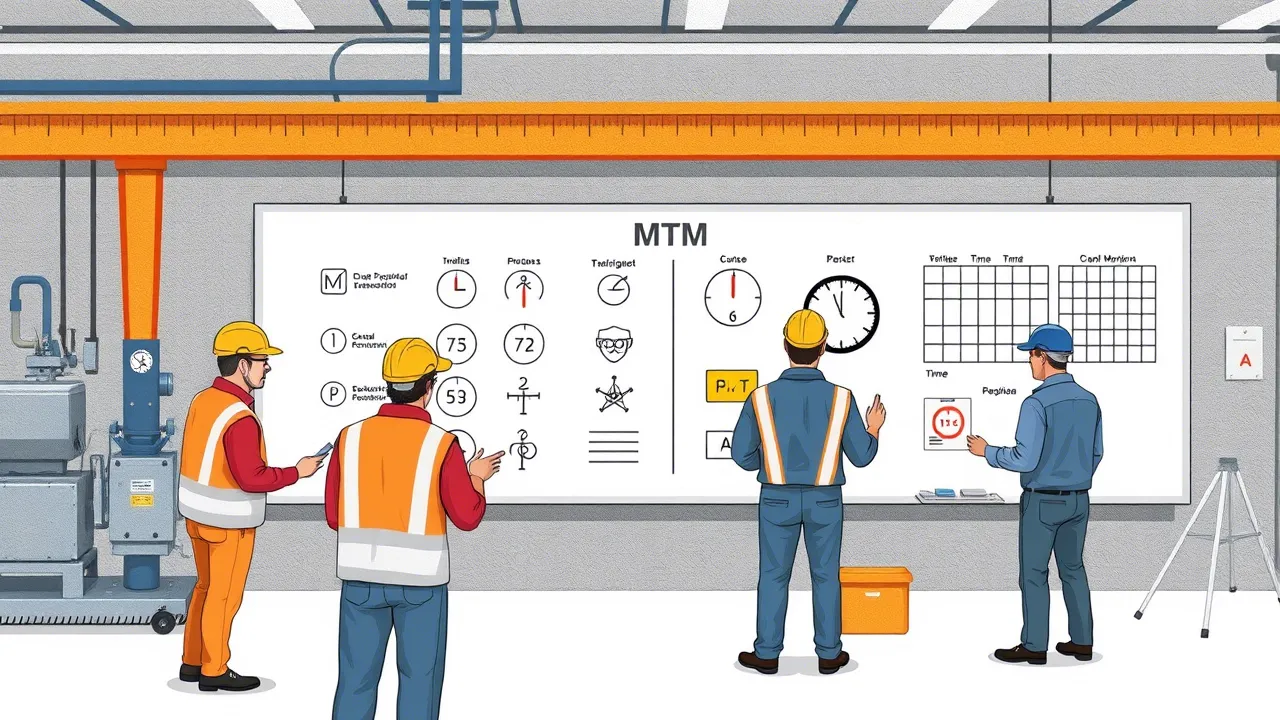
Assembly and manufacturing lines are migrating from traditional hundredth-of-a-minute time study to Predetermined Time Systems (PTS), such as MTM-1, MTM-UAS, and BasicMOST. This transition is no coincidence: unlike the stopwatch, the PTS forces the analyst to thoroughly audit the method and the motion economy before assigning a Time Measurement Unit (TMU). The premise is clear: an inefficient method should not be time-studied.
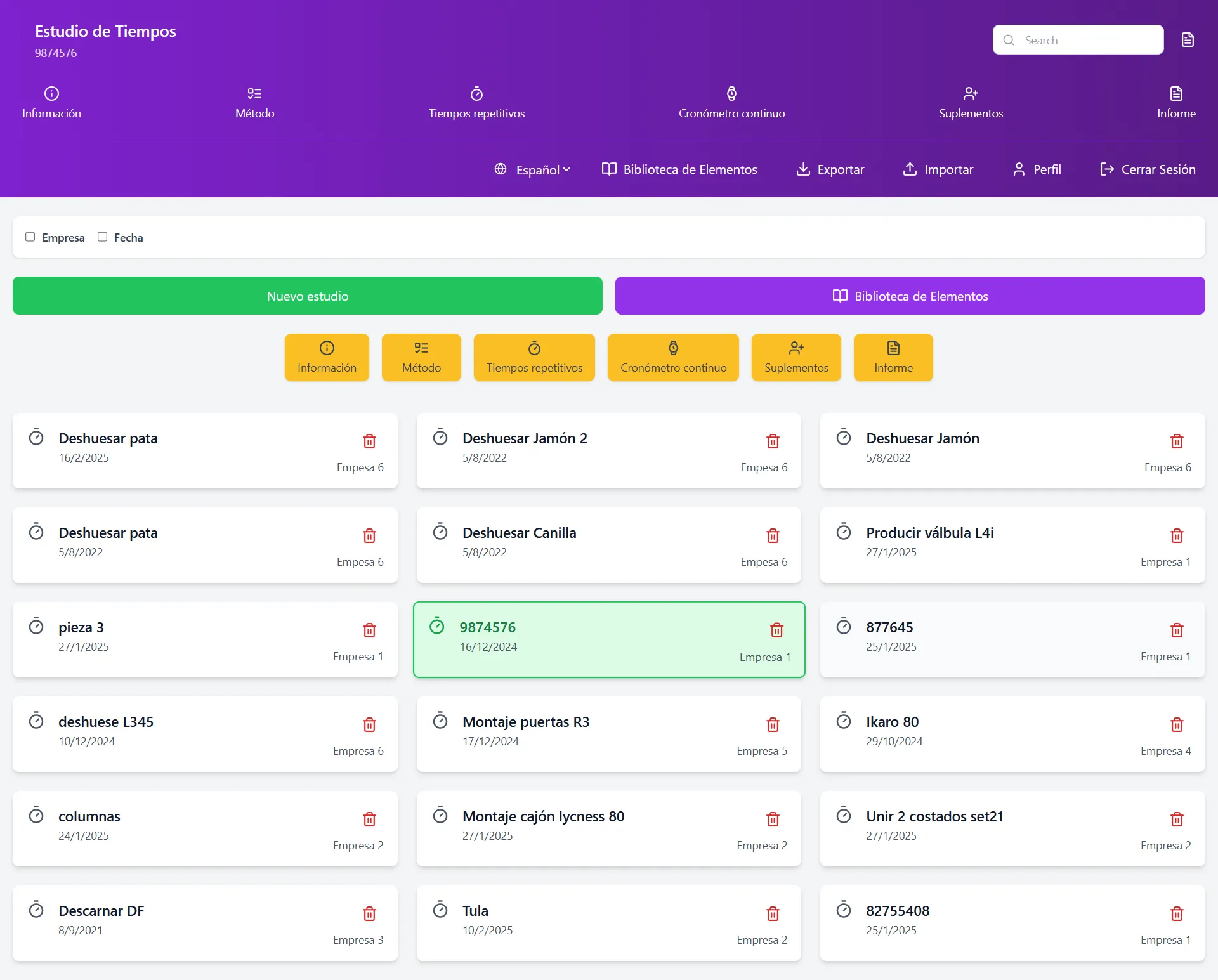
To carry out these studies accurately, the use of specialized software such as Cronometras becomes vital, making it possible to perform time and motion analysis with Multi Crono functionality and video recording, guaranteeing an indisputable empirical basis for continuous improvement.
Micromovements as a critical performance factor
Losses in the Performance rate within the OEE (Overall Equipment Effectiveness) calculation are rarely due to major stoppages; they are usually hidden in micro-stops. Excessive reaches, complex grasps, or positionings without physical guides silently degrade the actual cycle time relative to the standard time.
Currently, the integration of machine vision and artificial intelligence enables the automatic mapping of these biomechanical inefficiencies, capturing postures and translating video analysis into processable kinematic data.
The Technical Framework of the OIT: The Three Pillars of Motion Economy
Based on the guidelines of the International Labour Organization (OIT) ("Introduction to the Study of Work"), motion economy is deployed across three technical areas that every engineering department must rigorously audit:
1. Biomechanical use of the human body
Manual efficiency requires that work be restricted to the lowest possible class of movement:
- Class I: Fingers.
- Class II: Hand and wrist.
- Class III: Forearm.
The recurring involvement of Class IV movements (arm and shoulder) or Class V (torso) exponentially penalizes the standard time and triggers neuromuscular fatigue. Likewise, the principle of simultaneity dictates that the movements of both hands must begin and end at the same time, which allows the elimination of the "Hold" Therblig (the inefficient element par excellence).
2. Workstation design (spatial efficiency)
The station layout must respect the strict delimitation of normal and maximum work areas, both in the horizontal and vertical planes. The implementation of gravity feeders and drop deliveries makes it possible to evacuate finished parts by exploiting potential energy, completely neutralizing the MTM "Reach" and "Move" movements.
3. Tool and equipment configuration
Micro-optimization of the workstation includes the pre-positioning of tools using jib balancers and the design of fixtures with insertion guides (chamfers). These strategies transform highly complex sequences —such as a "Transfer Grasp" followed by an exact "Position"— into fluid kinematic flows with very low TMU value.
Regulatory Landscape and Industrial Ergonomics (2025 Outlook)
Looking ahead to 2025, pressure from the Labor Inspectorate in Europe and Spain marks a tightening of ergonomic monitoring. Workstation design has transcended productivity to become a legal mandate.
ISO Standards and Occupational Risk Prevention
The regulations require compliance with the ISO 11228 family (manual handling of loads) and ISO 14738 (ergonomic design of work systems). To fully understand how compliance with these regulations affects production speed, we recommend reading Impact of Ergonomics on Cycle Times.
Biomechanical audits and workforce aging
Prevention services require rigorous assessments using methods such as OCRA, RULA, or REBA. Proper application of motion economy reduces critical frequencies and improves joint angles, drastically lowering the Risk Index.
Furthermore, in the face of workforce aging, analysts must adapt the MTM standards, correctly calculating fatigue allowances and optimizing reaches to sustain the Takt Time. In this regard, the use of scientific work sampling tools such as WorkSamp proves invaluable for analyzing the actual distribution of working time, calculating fatigue allowances, and detecting ergonomic improvement opportunities at the Gemba.
Method Engineering Solutions Applied to the Gemba
From the perspective of the technical consulting services of Cronometras, the implementation of these improvements on the production line translates into very concrete physical and analytical interventions:
Station redesign with Karakuri and Lean Design
The use of passive mechanical kinematics (Karakuri) makes it possible to automatically bring components to the operator at the exact pace of the Takt Time. In doing so, we systematically convert costly Class IV movements into efficient Class II movements.
Combined MTM analysis and bimanual synchronization
For high-repetition processes, the MTM-1 audit reveals major opportunities. For example, transforming a logistics control variable such as a "Type C" reach (reaching for a jumbled object) into a "Type A" reach (object in a fixed location) reduces the movement time by more than 30%.
The analysis is crowned with the creation of Simo Charts (bimanual diagrams), balancing the workload between the right and left hands to eradicate the passive waiting times of the limbs. This synchronization is a critical step that must be documented before scaling up to broader analyses, as detailed in our guide on Value Stream Mapping (VSM) and Time Study.
KPIs and Data Analytics: The Impact of Manual Efficiency
The justification for investing in method and time consulting is grounded in its direct impact on financial and operational KPIs:
Reduction of TMU and recovery of productive time
Lowering the control level of a basic movement generates a massive aggregate impact. Moving from a high control level (e.g., Grasp G4) to a simple level (Grasp G1A) saves approximately 5.3 TMU (0.19 seconds) per cycle.
In an assembly environment with 10.000 cycles per shift, the math is irrefutable:
Result: 31 minutes of pure productive time recovered per operator and per shift.
Direct OEE improvement and risk mitigation
Ergonomic design under these principles eliminates micro-stops caused by workers adjusting their posture. This translates into a net increase of between 4% and 7% in the OEE Performance rate. To monitor this increase in plant availability and profitability in real time, integration with production control software such as Induly provides operations management with the necessary visibility.
At the safety level, keeping all reaches within the "normal grasp area" radius (~40 cm from the elbow) reduces the incidence of shoulder pathologies (tendinitis, bursitis) by an estimated 60%.
Acceleration of the learning curve (Onboarding)
A workstation designed under strict principles of motion economy possesses an inherent kinematic naturalness. Combined with visual SOPs (Standard Operating Procedures), it reduces the training time of new operators by up to 35%, mitigating the hidden cost of staff turnover.
Technical Conclusion
For plant management and industrial engineering leadership, motion economy is not a vestige of the Taylorist past, but the technological and regulatory bridge toward operational excellence in 2025.
From Cronometras, we reaffirm an axiom of our technical consulting: what has not been previously standardized cannot be measured accurately, and a method that does not respect maximum biomechanical efficiency should not be standardized.
Workstation redesign supported by MTM and MOST tools is not an "ergonomics expense"; it is an auditable and direct investment in OEE improvement, occupational health and, ultimately, the sustained reduction of the Standard Cost of the Product.
Recommended reading on the Cronometras blog:
- Impact of Ergonomics on Cycle Times
- Work Sampling: Work Sampling for Analysts
- Value Stream Mapping (VSM) and Time Study
Don't want to do it yourself? We do it for you from €800
If you prefer to outsource it, Cronometras delivers a complete time and motion study from a single video: elemental breakdown, OIT/TAL fatigue allowances, standard time with tolerances, and a report in PDF + Excel + JSON ready to present to management.