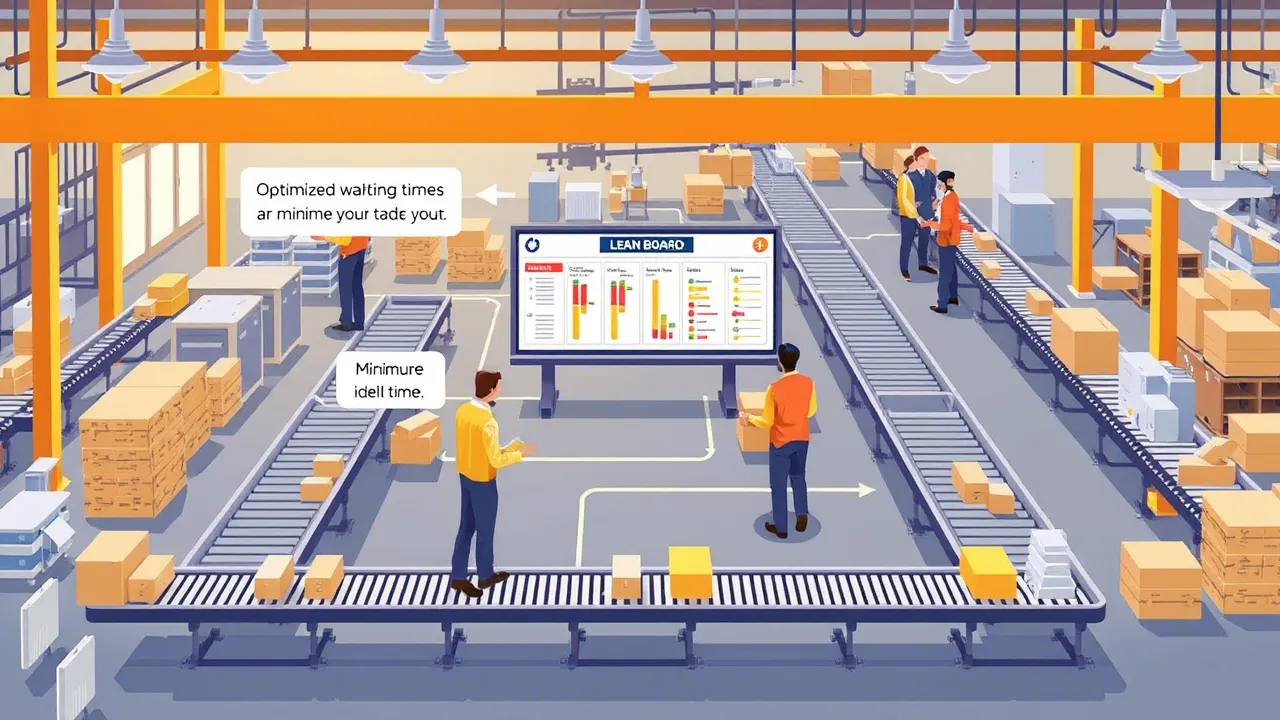
The concept of Value Stream Mapping (VSM) has often been trivialized as a simple drawing or visual management exercise. However, for Engineering Management and Continuous Improvement departments, VSM must be understood as a flow balance equation. A visually attractive map with incorrect data is not just a waste of time; it is a passport to failure in the implementation of Lean philosophy and a direct threat to plant profitability.
Beyond visual management: VSM as a plant physics tool
To build a robust production system, we must stop treating VSM as a static diagram and start treating it as a plant physics tool. The validity of the Lead Time (L/T) calculation and the real identification of the bottleneck depend stochastically on the accuracy of the inputs.
The 65% failure rate in the "Future State"
Recent market research (Process Engineering Division, 2023-2025) indicates that as many as 65% of value stream maps fail in the implementation phase of the Future State. The root cause is not a poor choice of pull or kanban strategy, but the lack of integrity of the time data. When the Takt Time is calculated on databases contaminated by subjective estimates, the system collapses on first contact with the real variability of production.
Why ERP standard times are useless for continuous improvement
There is a dangerous practice in industrial engineering: feeding the VSM "Data Box" with the theoretical standard times stored in the ERP. These data are usually static, obsolete, and do not reflect machine degradation or the current learning curve.
To obtain a real view of profitability and feed the system with real-time OEE data and manufacturing costs, using a Production Control and Industrial Time-Recording software such as Induly is essential to overcome the rigidity of the traditional ERP, enabling decision-making based on the reality of the shop floor (Gemba).
Anatomy of the "Data Box": Time metrology for engineers
This is not about filling in boxes, but about applying forensic engineering to the data. Each variable in the VSM data box must be audited.
Cycle Time (T/C): Centesimal time study vs. Estimation
The Cycle Time is the critical variable. Its measurement requires centesimal time study or high-frequency video analysis. Advanced tools such as Cronometras make it possible to segregate machine time from manual time with millimeter precision, capturing the reality of the cycle and enabling the application of techniques such as SMED to the Changeover Time (C/O) with reliable data.
The fallacy of the arithmetic mean: The impact of the Standard Deviation ($\sigma$)
In industrial time study, the average is the enemy of accuracy. A process with an average T/C of 40s and a standard deviation ($\sigma$) of 2s is radically different from one with the same average but a of 15s. The second scenario guarantees stockouts and floating bottlenecks, even though the average suggests that the Takt Time is being met. A scientific VSM must incorporate variability ($\sigma$) into its calculations in order to design realistic safety buffers.
OEE and Uptime: Integrating speed losses and real micro-stops
The Uptime in the VSM must not be based on the shift supervisor's "gut feelings". It must be derived from a rigorous OEE (Overall Equipment Effectiveness) calculation. Field studies indicate that 15% of the Lead Time is lost to unreported micro-inefficiencies.
Before starting a detailed time study, it is advisable to carry out a preliminary work sampling to identify the real distribution of time (VA/NVA). For this purpose, an application for Work Sampling studies such as WorkSamp makes Work Sampling easier with statistical rigor, identifying hidden losses that linear time study might overlook.
Measurement Methodologies: Validating the Current State and Designing the Future
We must technically differentiate between what "is" (physical measurement) and what "should be" (motion analysis).
The "Current State": Time study with performance rating (Bedaux scale)
For the current-state map, the use of the stopwatch is imperative. However, the observed time ($T_{obs}$) is worthless unless it is normalized through Performance Rating (Normal vs. Optimum activity, typically on the Bedaux or 100-133 scale). Only Normal Time ($T_n$) allows fair comparisons between shifts and operators.
The "Future State": Waste-free method design using MTM and MOST
While the stopwatch validates the present, Predetermined Time Systems (MTM-1, MTM-2, MOST) are the only scientific route to design the future. The use of MTM makes it possible to simulate how much time will be saved by eliminating a motion (e.g., "Reach R10" or "Position P1") before making physical changes to the line. This turns the VSM from a "wish list" into a predictive engineering model.
Technical comparison:
- Estimation: Discardable for investment decision-making.
- Time study (Stopwatch): Mandatory to validate the Current State and OEE.
- MTM / MOST: Critical for designing Muda-free methods in the Future State.
Regulatory and Labor Context in Spain (2025 Projection)
Time engineering does not happen in a vacuum; it is subject to strict labor regulations and collective bargaining agreements.
Rest and Fatigue Coefficients: The OIT mandate
According to OIT regulations and the labor projection in Spain for 2025, it is mandatory to apply allowances for fatigue (physical and mental) and personal needs. A VSM that uses net times without rest coefficients ($K$) will result in an unachievable production plan that can be legally challenged before a works council.
Ergonomics and Time (ISO 11228): Synchronization with OCRA and NIOSH assessments
The technical trend demands the merging of time study with ergonomic assessment. Reducing the Lead Time cannot violate the operator's biomechanical limits (ISO 11228). By using Cronometras, engineers can ensure that the captured data serves both for line balancing and for the ergonomic justification of workstations.
Legal certainty in incentive systems and activity bonus
Industrial digitalization demands traceability. Activity bonus systems must be based on auditable technical measurements. A change in pace dictated by a VSM must be backed by a methods study (MTM/MOST) that guarantees that the new standard is achievable under normal activity.
Implementation Strategy: Data Integrity Audit
Before investing in automation or line reengineering based on a VSM, it is imperative to audit the quality of the time data.
Technical hybridization: Digitalizing shop-floor data collection
The era of paper and the analog stopwatch is over because it is inefficient. Technical hybridization involves using software on tablets that automatically calculates the standard deviation, the cycles to be observed, and the OIT allowances in real time.
- For continuous production and cost control: Induly.
- For activity sampling and initial diagnosis: WorkSamp.
- For in-depth methods and times analysis: Cronometras.
The Cronometras approach: Methods engineering as a Lean prerequisite
Positioning work measurement not as an administrative task, but as a Data Integrity Audit is vital. Without certified times, the VSM is speculation. The integration of scientific measurement tools ensures that the path to operational excellence is paved with data, not with intentions.
Don't want to do it yourself? We do it for you from €800
If you prefer to outsource it, Cronometras delivers a complete time and motion study from a single video: elemental breakdown, OIT/TAL fatigue allowances, standard time with tolerances, and a report in PDF + Excel + JSON ready to present to management.