In the current metal-mechanic and automotive scenario, the acquisition of a robotic cell (MIG/MAG, TIG, or Laser) is often perceived as the "holy grail" of productivity. However, field data tell a different story. According to the technical research report projected to the 2025 scenario by the Cronometras Market Intelligence Department, there is a critical dissonance between installed capacity and actual performance.
The premise is hard but necessary: automating an inefficient process only magnifies inefficiency. This technical article breaks down time architecture in robotic environments and how methods engineering is the only vector capable of unlocking the real ROI of automation.
The Automation Paradox: Why the Robot is Not Enough
The myth of linear productivity in industrial investment
There is a misconception that replacing a manual welder with a robotic arm guarantees a proportional and linear increase in output. Operational reality shows that the robot, although tireless and precise, is a slave to its environment. If supply logistics, fixture design, or material supply strategy fail, the fastest machine in the world will generate costlier wait times.
Identifying 70% of hidden inefficiencies in process periphery
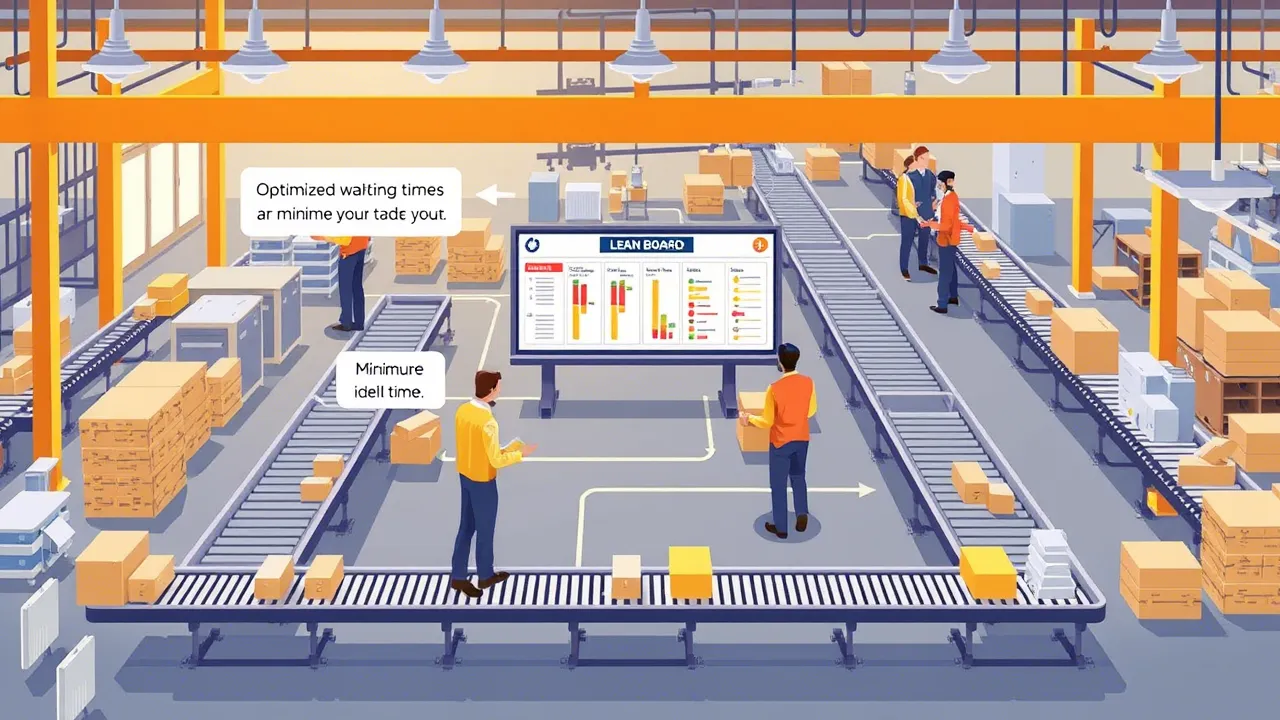
Our audits reveal an alarming fact: 70% of inefficiencies in a welding cell do not come from robot kinematics, but from the periphery. These inefficiencies reside in fixture feeding, loading ergonomics, part evacuation, and unregistered micro-stops. The robot is not the bottleneck; the peripheral system's inability to keep pace with the machine is.
Methods Engineering vs. Robotic Programming: Where is the Bottleneck?
While the programmer focuses on motion interpolation and amperometry, the methods engineer must focus on flow. Conflict arises when robot code is optimized to gain 0.5 seconds on a trajectory, but 12 seconds of idle time caused by an operator walking three steps to pick up a component are ignored. The battle for productivity is won in human work method design, not just on the Teach Pendant.
Technical Analysis of Cycle Time in Welding Cells
Breaking down time structure: Technological (Tt) vs. Manual (Tm)
Traditional "snapback" timing is obsolete in this environment. Strict segregation is required:
- Technological Time ($T_t$): Composed of Arc-on time (effective arc on time) plus air time (empty movements of the TCP - Tool Center Point).
- Manual Time ($Tm$): Includes component loading into the fixture, clamp actuation (pneumatic or manual), unloading, visual inspection, and torch cleaning.
The productivity equation depends on minimizing the gap where the robot waits for the human ($T_m > T_t$) or the human waits for the robot ($T_t > T_m$).
The reality of Arc-on time in the Spanish metal-mechanic industry
In the current industrial fabric, particularly in metalworking SMEs, the average Arc-on time rarely exceeds 45% of total available time without deep methods intervention. The rest is air time, loading/unloading time, and minor stops. Raising this ratio does not depend on buying a faster robot, but on densifying welding operations and optimizing external loading (rotary tables or double stations).
Limitations of snapback timing in robotic environments
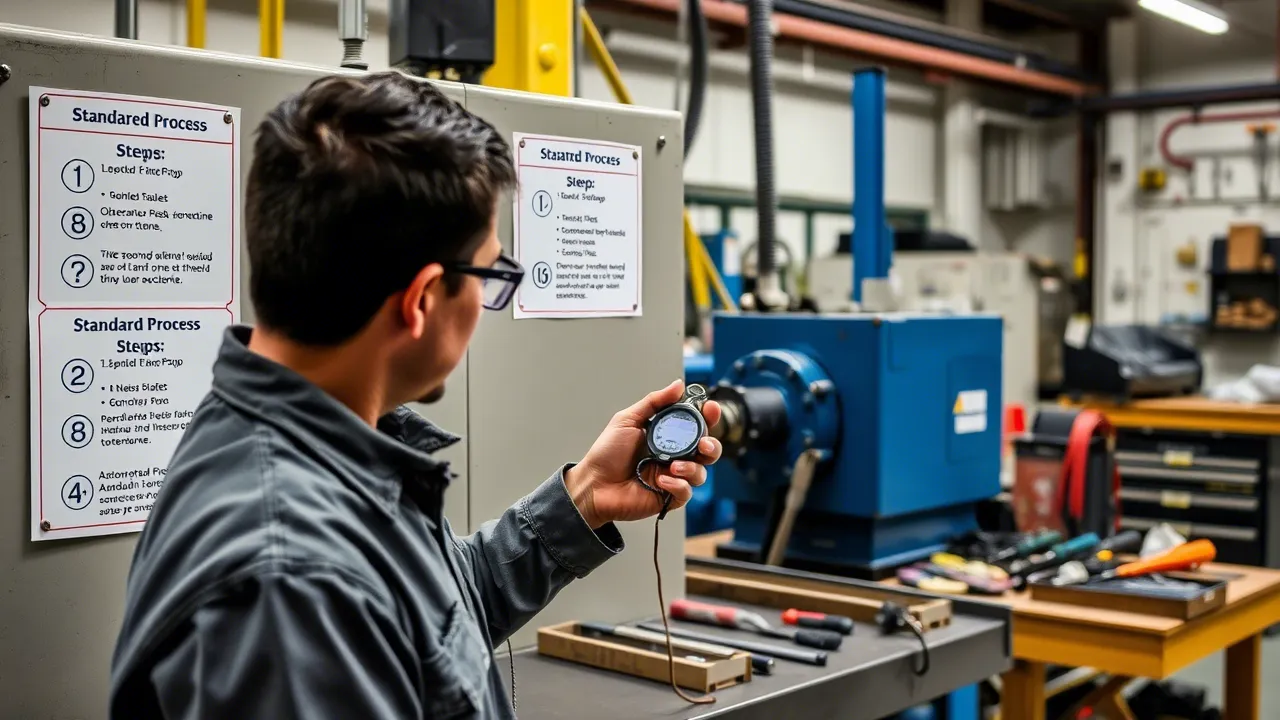
The stopwatch does not discriminate between a stop for nozzle cleaning (necessary) and a stop for lack of material (avoidable). In Cronometras, we advocate for integrated measurement correlating PLC logs with analyst observation to segregate value-added times from pure interference times.
OEE in Welding: Real Measurement of Overall Equipment Effectiveness
Availability: The impact of micro-stops (wire changes and cleaning)
Availability is usually overestimated. "Invisible" elements like the spatter cleaning cycle in the cleaning station, wire spool changes, or jams in the liner constitute constant erosion of OEE. A 30-second micro-stop every 10 cycles represents a massive loss of accumulated availability often not tabulated in standard MES systems.
Performance and Speed: Differences between theoretical and real cm/min
The welding speed parameter (cm/min) in the technical sheet is theoretical. In production, real speed is frequently reduced by operators or supervisors to compensate for deviations in part quality or joint gap. This speed reduction is a symptom of a failure in the prior forming process, directly impacting the OEE Performance indicator.
Quality and Rework: When manual finishing destroys robot profitability
If a robotic process systematically requires subsequent manual rework exceeding 2%, the cell has failed technically. The cost of the "reworker" destroys the robot's savings. Quality must be guaranteed through fixture repeatability and torch maintenance, not through post-mortem corrective labor.
Man-Machine Synchronization: Optimization Tools
Application of MTM-UAS and MOST to predict loading and unloading times
The stopwatch is reactive; predetermined time systems (like MTM-UAS) are predictive. Before installing the cell, we must know exactly how much standard time fixture loading requires.
- Case study: If MTM dictates 40s of manual loading and the robot cycle is 20s, the cell will be stopped 50% of the time unless a double station is implemented or workload is rebalanced.
The Man-Machine Chart and Optimal Operator Saturation (85-90%)
The technical objective is to reach operator saturation between 85% and 90%, considering ILO rest coefficients. An unbalanced Man-Machine diagram is a capital leak. If the operator has 40% saturation, we are paying for "active waiting".
"Hidden Time" Strategies: Value-added operations during automatic cycle
The key is "Hidden Time". While Technological Time ($T_t$) executes, the operator must perform value-adding operations: deburring, palletizing, dimensional control, or kitting for the next cycle. Transforming wait time into production time is the essence of modern methods engineering.
2025 Regulations: Ergonomics, Safety, and Fatigue according to ILO
UNE-EN ISO 11228: Impact of load handling on standard time
Towards 2025, manual load handling regulations are tightening. When calculating standard time, it is imperative to apply recovery coefficients if the station design forces awkward postures or high frequencies. Ignoring fatigue in high-cycle cell feeding increases micro-absenteeism and reduces global OEE by up to 15% annually due to human pace degradation.
Rest and Recovery Coefficients in Cell Feeding
The "robot operator" does not exist. Time engineering must integrate fatigue supplements (physical and mental/sustained attention) dictated by the ILO. A capacity calculation assuming a constant 100% pace for 8 hours is a technical fiction leading to failed production planning.
Safety in Cobots (ISO/TS 15066): The Challenge of Variable Cycle Times
Integrating collaborative robots (Cobots) introduces a complex variable: adaptive speed. According to ISO/TS 15066, the robot must reduce its speed upon human proximity. This means Cycle Time ($T_c$) is no longer a constant, but a variable dependent on operator position. Dynamic studies (simulation or MOST) are required to define a legal and realistic standard time.
Technological Route Audit and "Digital Twin"
TCP Trajectory Optimization and Air Time Reduction
A code audit can reveal critical opportunities. Reducing torch approach distance (from 50mm to safe 10mm) and optimizing robot wrist reorientation to minimize air time can reduce between 12% and 18% in parts with multiple short welds.
From Stopwatch to PLC Telemetry: New 4.0 Measurement Standards
Measurement evolves towards data extraction. Timing must be validated with PLC telemetry to identify micro-deviations invisible to the human eye. Industry 4.0 demands that "standard time" be live data, fed by the Process Digital Twin.
The Importance of Fixture Repeatability in Technical Productivity
Technical productivity in welding depends 60% on fixture quality and repeatability and only 40% on the robot. A poorly designed fixture requiring manual adjustments by the operator in every cycle invalidates any attempt at time standardization.
Conclusions: Towards a Kinematic and Human Synchronization Audit
Efficiency in robotic welding is not bought "turnkey"; it is built through methods engineering. In Cronometras, we conclude that for the 2025 horizon, the time analyst role must transmute into that of a Kinematic and Human Synchronization Auditor.
It is imperative to merge MTM precision to validate station design, ILO regulatory rigor to ensure human sustainability, and robot data analytics to optimize the technological route. Only by mastering this triad can capital investment be transformed into a real competitive advantage.