1. Introduction to SMED: Origins and Fundamentals
Technical definition and historical origin
The SMED (Single Minute Exchange of Die) methodology represents one of the fundamental pillars of modern methods engineering. Developed by the Japanese engineer Shigeo Shingo from 1950 within the Toyota Production System (TPS), this systematic technique arose from the critical need to reduce tool changeover times in high-tonnage stamping presses.
The central concept is elegant in its simplicity but revolutionary in its application: to rigorously distinguish between the activities that require the machine to be stopped (internal) and those that can be performed while the equipment continues producing (external). This distinction, apparently obvious, was the basis that enabled Toyota to reduce die changeovers from 4 hours to less than 10 minutes on its 1000-ton presses, an achievement documented in 1971 that changed global production philosophy forever.
The fundamental principle: IED vs. EED
SMED engineering is based on a fundamental equation that every time study analyst must master:
TOTAL CHANGEOVER TIME = INTERNAL ACTIVITIES (IED) + EXTERNAL ACTIVITIES (EED)
- Internal Activities (IED - Internal Exchange of Die): Tasks that can only be carried out with the machine stopped. They include the dismantling of tooling, specific parameter adjustments and post-changeover verifications.
- External Activities (EED - External Exchange of Die): Tasks that can (and should) be carried out while the machine is in production. Examples: tool preparation, material transport, parameter pre-adjustments.
The SMED methodology is not simply "doing things faster". It is a systematic process of observation, analysis and re-engineering that converts internal activities into external ones, standardizes sequences and eliminates wasted movements. For an industrial time study analyst, this analysis requires precise time study techniques, where tools such as those offered by Cronometras have greatly simplified the capture and analysis of critical data.
Central objective: the single digit
The name "Single Minute" (single digit) sets the original goal: to reduce changeovers to less than 10 minutes. However, in contemporary industrial application, the objective is adapted to the context: it may be a reduction from 120 to 20 minutes on a pharmaceutical line, or from 45 to 8 minutes in a CNC machining center. The essential point is the principle of dramatic reduction through re-engineering of the changeover process, not the absolute number.
2. Current State of SMED Implementation in Spain (2025)
Sector overview: uneven but growing adoption
According to consolidated data from the INE (Encuesta Industrial 2023) and sector estimates from CEOE-AENOR, the formal adoption of SMED in Spanish industry shows a heterogeneous landscape but with a clearly upward trend:
Automotive and components (60-70% adoption): Here SMED is not an option but a contractual requirement. Tier 1 and Tier 2 suppliers of Volkswagen Navarra, SEAT Martorell or Stellantis Vigo must demonstrate quick changeover capabilities to respond to just-in-time production and the growing customization of vehicles.
Food and beverages (35-45%): Driven by market fragmentation (more SKUs, smaller batches), quick format changeover on packaging lines has become a critical competitive factor. The pressure to reduce downtime between products is constant.
Pharmaceutical (30-40%): Adoption is conditioned by the rigorous GMP and FDA validation protocols. However, the pressure to reduce costs and increase flexibility is driving SMED projects specifically designed for regulated environments.
Metalworking and plastics (20-35%): Sectors with high heterogeneity. While large companies have formally implemented SMED, many SMEs still operate with traditional changeover methods, representing enormous improvement potential.
Raw data and reference benchmarks
The following data come from sector benchmarking carried out in 2024 with Spanish manufacturing companies:
Typical changeover time reduction by type of operation:
- Die changeover in 250-800 ton presses: from 90-180 minutes to 8-15 minutes (85-92% reduction)
- Mold changeover in plastic injection molding: from 45-120 minutes to 10-20 minutes (75-83% reduction)
- Format changeover on food packaging lines: from 30-60 minutes to 5-12 minutes (78-87% reduction)
- Tooling changeover in multi-axis CNC centers: from 20-45 minutes to 3-8 minutes (80-88% reduction)
Quantifiable impact on OEE (Overall Equipment Effectiveness): Reduction in changeover times directly impacts the Availability component of OEE:
Availability = (Planned time - Downtime) / Planned time
Where format changeovers typically represent between 15-35% of total planned downtime. The documented results show:
- Typical availability improvement: +5 to +15 percentage points
- Typical overall OEE improvement: +3 to +10 percentage points
- Average OEE in the Spanish industrial sector: 58-65% (vs. world-class benchmark of 85%+)
To isolate and measure this impact precisely, OEE analysis must be complemented with work sampling studies that make it possible to identify loss patterns. Applications such as WorkSamp greatly facilitate this task through automated random sampling, providing objective data for decision-making.
3. Regulatory Framework and Applicable Standards
Relationship with quality management systems
SMED does not operate in a regulatory vacuum. It is integrated as a compliance tool within several management frameworks:
UNE-EN ISO 9001:2015: Clause 10.3 (Continuous improvement) requires evidence of systematic actions to improve the suitability of the system. SMED provides a structured and documented method to improve production efficiency.
UNE-EN ISO 14001:2015: Quick changeovers reduce energy consumption during stoppages and minimize start-up waste (nonconforming material during adjustments), contributing to environmental objectives.
IATF 16949 (Automotive): Specifically requires the implementation of quick changeover techniques as part of the production efficiency requirements for automotive suppliers.
International productivity standards
The ILO (International Labour Organization) establishes work measurement principles that underpin SMED analysis. Predetermined time systems such as MTM (Methods-Time Measurement) and MOST (Maynard Operation Sequence Technique) provide the analytical basis for breaking down and standardizing movements during changeovers.
A competent SMED analyst must be able to:
- Break down the current changeover into measurable elements
- Assign predetermined times to each activity
- Identify inefficient movements according to recognized standards
- Design the new optimized sequence with calculated target times
Spanish and European regulatory context
In Spain, programs such as ICEX Next and the grants from IVACE (Instituto Valenciano de Competitividad Empresarial) finance production improvement projects that include SMED implementations. At European level, the demands of OEMs (Original Equipment Manufacturers) in transnational supply chains have made SMED a de facto requirement for first-tier suppliers.
4. Practical Implementation Methodology: Step by Step
Phase 1: Observation and measurement of the current changeover
Objective: Establish the objective baseline of the current state.
Key activities:
- Complete video recording of the changeover from the last good part to the first good part of the new batch
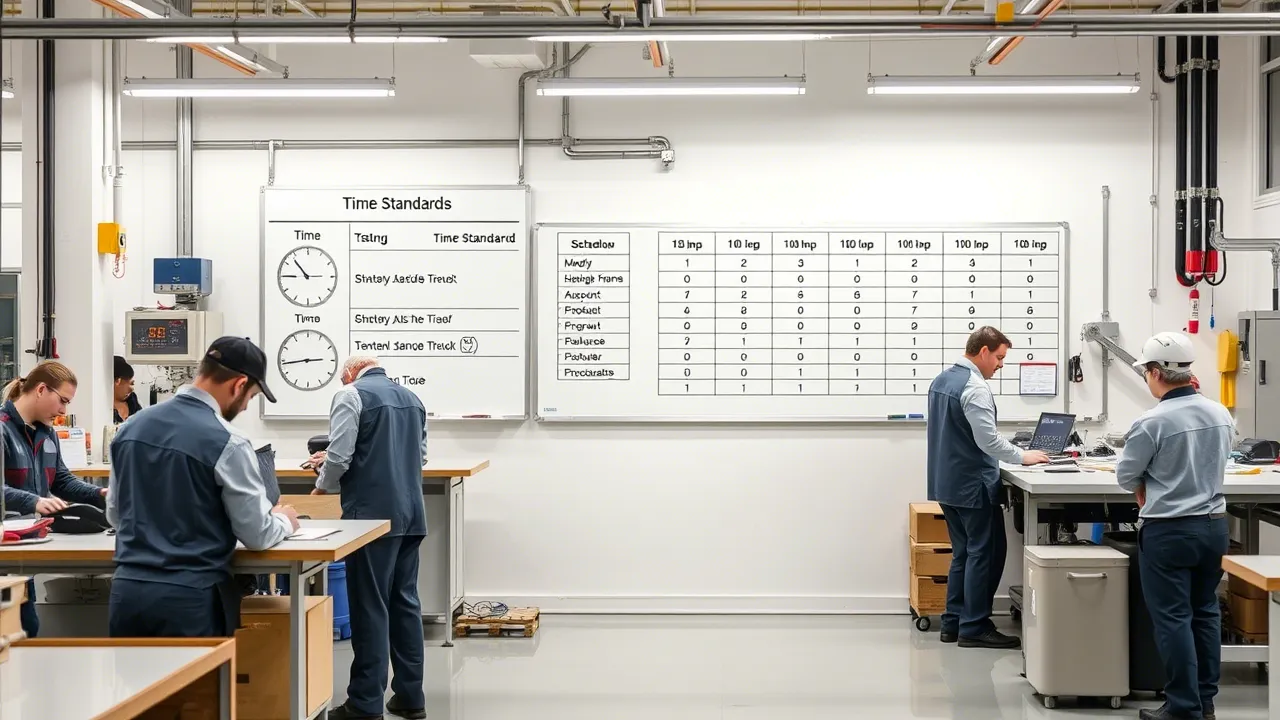
- Elemental time study of each activity, identifying the operator(s) and resources involved
- Fishbone diagram to classify causes of delay (method, machine, material, manpower, environment)
- Calculation of the current OEE specific to the machine or line under study
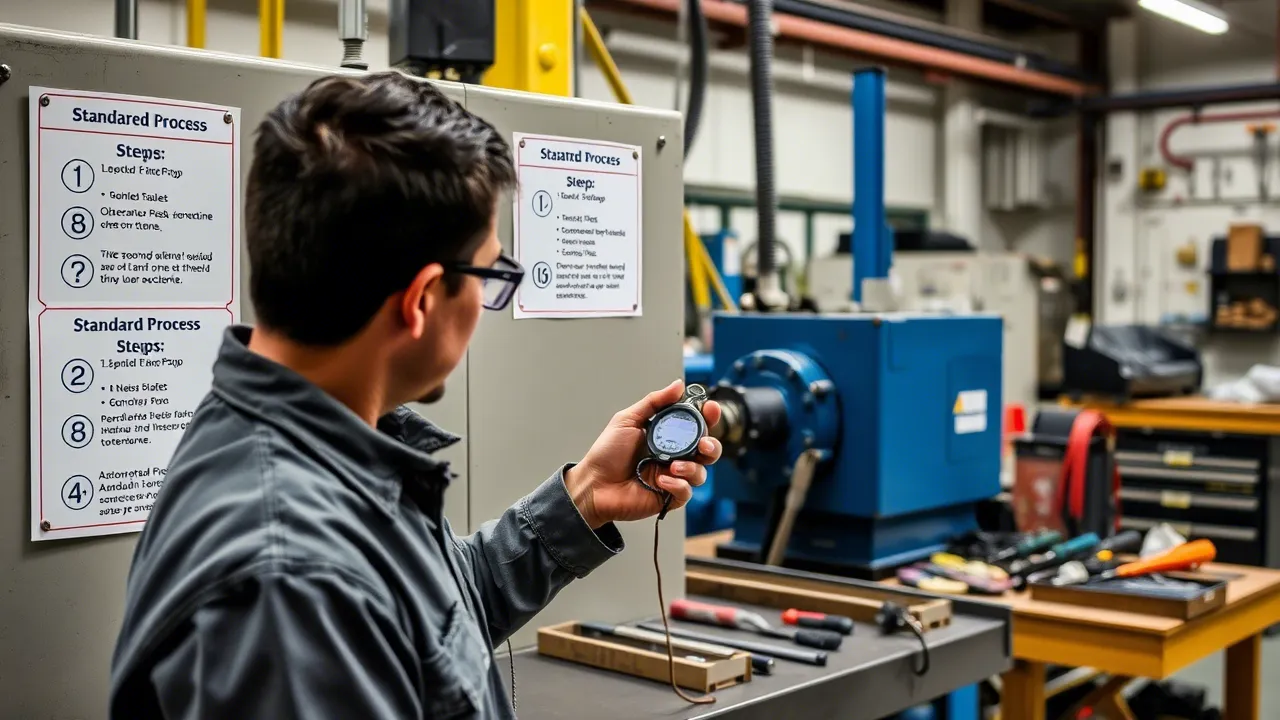
Tools: Industrial stopwatches, video analysis software, standardized recording formats. To capture data precisely and generate automatic reports, specialized platforms such as those found in the ASETEMYT Directory are valuable resources for the methods engineer.
Phase 2: Separation and reclassification of activities
Objective: Rigorously classify each element as internal or external.
Key questions for each activity:
- Can it be performed while the machine produces? → External
- Does it absolutely require the machine to be stopped? → Internal
- Could it become external with additional preparation or equipment? → Candidate for conversion
Result: Two clearly differentiated lists with assigned times. This phase usually reveals that between 30-50% of the activities classified as internal can, in fact, be carried out externally.
Phase 3: Conversion of internal activities into external ones
Objective: Minimize machine downtime through external preparation.
Common conversion strategies:
- Pre-heating/pre-cooling of tools while the machine produces
- Pre-adjustment of parameters on external measuring devices
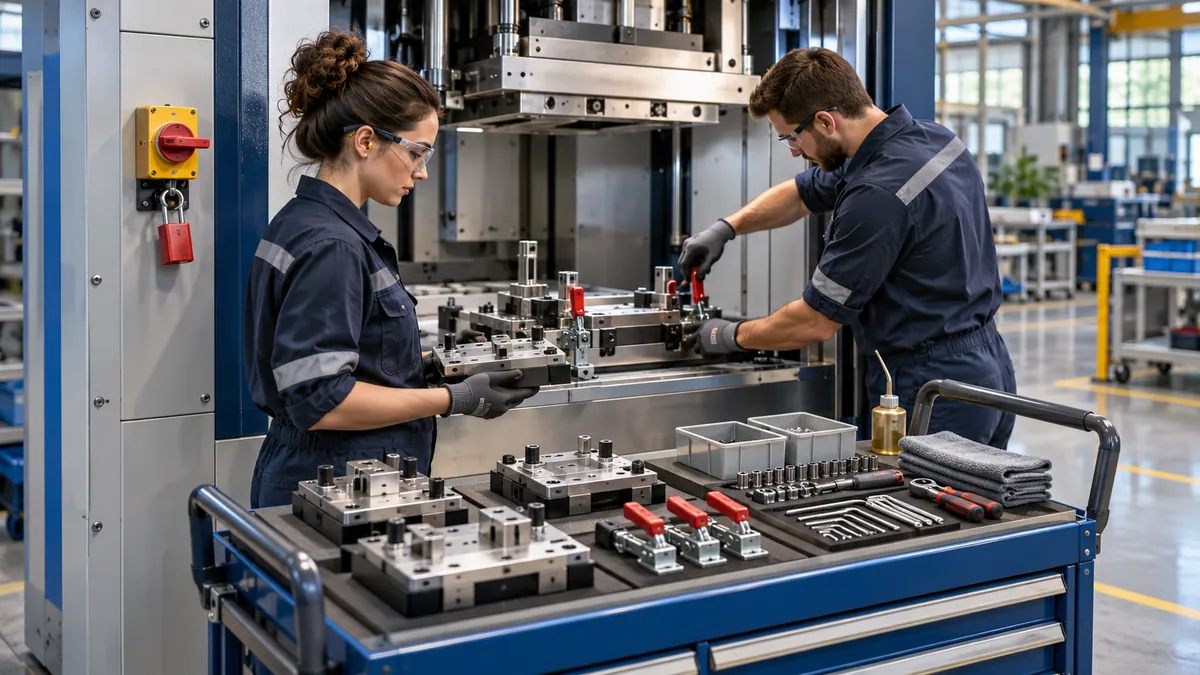
- Preparation of complete kits of tools and materials on organized carts
- Standardization of interfaces (flanges, clamping systems) to reduce adjustments
Phase 4: Standardization and continuous improvement
Objective: Institutionalize the new process and prevent regressions.
Essential elements:
- Written standardized procedure with target times per element
- Certified training of all potential operators
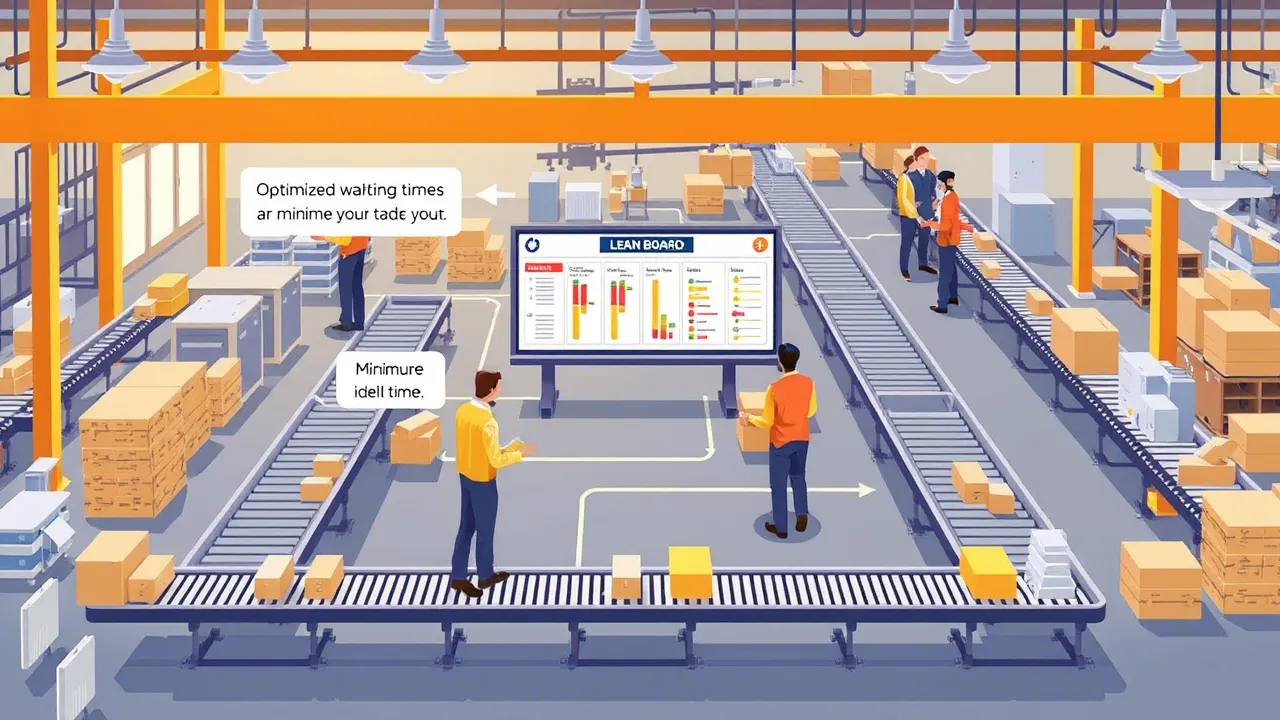
- Visual management system (boards, signals, checklists)
- Periodic audits of standard compliance
- Continuous review according to the PDCA (Plan-Do-Check-Act) methodology
5. Measurement Tools and Techniques for SMED
Industrial time study: traditional vs. digital
Time study remains the backbone of SMED analysis. While traditional methods (stopwatch and recording sheet) remain valid, technology has transformed the possibilities:
Emerging digital technologies:
- IoT sensors that automatically detect machine states (stopped, running, changeover)
- Tablet recording applications that eliminate manual transcription and reduce errors
- Video recognition systems that identify activities and assign times automatically
- Integration with MES systems (Manufacturing Execution Systems) to correlate changeover data with production
For real-time production control and continuous post-implementation monitoring, platforms such as Induly offer industrial time and attendance tracking and control solutions that make it possible to verify that the new changeover standards are being sustained.
OEE analysis to isolate the impact of SMED
To accurately quantify the return on investment in SMED, it is crucial to break down OEE into its components before and after:
Specific metrics to monitor:
- MTBF (Mean Time Between Failures) and MTTR (Mean Time To Repair) for changeovers
- Percentage of changeover time over total planned time
- Production rate during the adjustment ramp after the changeover (quality of first parts)
- Energy consumption during the changeover process
Visual management and tooling standardization
The physical implementation of SMED requires concrete solutions:
Shadow boards: Boards with silhouettes of each tool, allowing instant identification of missing items before the changeover.
Pre-configured tool carts: Mobile units with all the material needed for a specific changeover, organized according to the standardized sequence.
Pre-adjustment devices: Systems that allow parameters (temperature, pressure, position) to be adjusted outside the machine, reducing internal calibration time.
6. Success Cases and Result Data in Industry
Automotive sector: high-tonnage presses
Stamping plant in Navarra (Tier 1 supplier):
- Initial situation: Die changeover on a 600-ton press: 145 minutes average
- SMED intervention: Analysis of 23 elements, conversion of 9 internal activities to external, implementation of a pre-assembly bench and quick clamping systems
- Result: Changeover time reduced to 11 minutes (92.4% reduction)
- Production impact: Additional production capacity equivalent to 18 monthly shifts released
- ROI: Investment recovered in 4.2 months thanks to increased availability
Food sector: packaging lines
Dairy products factory in Valencia:
- Challenge: Format changeover between 5 types of container (200ml to 1L) on an aseptic packaging line
- Solution: Implementation of SMED with a focus on CIP (Clean-In-Place) cleaning and doser adjustment
- Initial time: 58 minutes average
- Post-SMED time: 9 minutes (84.5% reduction)
- Additional benefit: Reduction of 30% in water and cleaning chemical consumption during changeovers
Return on investment (ROI) calculation - Practical example
Base data for calculation:
- Machine: Injection molding press with 3 changeovers/day
- Current changeover time: 75 minutes
- Post-SMED changeover time: 15 minutes
- Available productive hours: 22 hours/day
- Machine hour cost: 120€
- SMED implementation cost: 25.000€
Calculation:
- Time saved per changeover: 60 minutes (1 hour)
- Time saved per day: 3 changeovers × 1 hour = 3 hours
- Additional daily production: 3 hours × 120€/hour = 360€/day
- Additional annual production (250 days): 90.000€
- ROI: (90.000€ - 25.000€) / 25.000€ × 100 = 260%
- Payback period: 25.000€ / 360€/día = 69.4 days (≈2.3 months)
7. Barriers, Challenges and Overcoming Strategies
Cultural factors and resistance to change
The main barrier is not technical but human. In plants with a long tradition, veteran operators may see SMED as a criticism of their established methods. Resistance manifests itself as:
- "We have always done it this way"
- "It cannot be done any faster"
- "Rushing leads to mistakes"
Overcoming strategies:
- Involve operators from day one as experts in the current process
- Demonstrate with data (not opinions) the improvement opportunities
- Celebrate early successes with recognition for the team
- Train in the principles (IED vs. EED) so that they understand the "why"
Limitations in industrial SMEs
Small and medium-sized enterprises face specific challenges:
- Limited resources to devote engineers exclusively to SMED projects
- Lack of specific training in methods and time engineering
- Absence of basic measurement systems to establish baselines
- Short-term vision that prioritizes immediate production over structural improvement
Adapted solutions:
- Phased implementation, starting with the machine or line with the greatest potential impact
- Practical training of supervisors in basic time study techniques
- Collaboration with specialized consultants for specific high-return projects
- Use of accessible tools such as those offered by the ASETEMYT ecosystem to professionalize analysis without large investments
Integration with other improvement systems
SMED is not an isolated technique. Its maximum potential is achieved when it is integrated with:
- TPM (Total Productive Maintenance): Quick changeovers facilitate productive maintenance by reducing the excuse "we do not stop to maintain"
- Lean Manufacturing: SMED is a core tool for reducing the waste of overproduction (enabling smaller batches)
- Productive maintenance: The organization for quick changeovers (tools, materials, information) also benefits maintenance activities
8. The Future of SMED: Digitalization and New Technologies
Digital twins and changeover simulation
Digital twin technology (exact virtual replicas of physical assets) is transforming changeover preparation:
Emerging applications:
- Virtual simulation of the complete changeover before physically carrying it out, identifying interferences and optimizing sequences
- Operator training in virtual environments without the risk of damaging real equipment
- Predictive analysis that identifies optimal changeover parameters based on historical production and quality data
Predictive time study using artificial intelligence
AI systems are beginning to automate aspects of SMED analysis that previously required experienced engineers:
Capabilities under development:
- Automatic recognition of activities through video analysis, classifying elements as internal/external
- Suggestion of conversion opportunities based on movement pattern analysis
- Prediction of optimal times for new changeovers based on similarities with historical changeovers
- Detection of deviations in real time during the execution of standardized changeovers
Integration with Industry 4.0 and IoT
The future of SMED is inseparably linked to the connected factory:
Converging technologies:
- Sensors on tooling that automatically report status, location and configuration
- Augmented reality assistants that guide the operator step by step during the changeover
- Self-adjusting systems that automatically calibrate machine parameters based on the product to be manufactured
- Blockchain for complete traceability of changeovers, parameters and quality results
Methods and time engineering, far from being an obsolete discipline, is experiencing a technological renaissance. The fundamental techniques of time study and motion analysis remain valid, but now enhanced by tools that Shigeo Shingo could not have imagined. For industrial engineers who master both classical principles and new technologies, the field of industrial productivity offers unprecedented opportunities.
Resources and Tools
To go deeper into the implementation of SMED and access specialized tools:
- Cronometras: Specialized consulting in methods and time engineering, offering solutions for the precise measurement of industrial processes.
- Induly: Production Control and Industrial Time and Attendance software for monitoring post-SMED performance in real time.
- WorkSamp: Specialized application for conducting work sampling studies (Work Sampling), complementing the analysis of changeover times.
- ASETEMYT Directory: Compilation of tools, services and professionals specialized in industrial time study and productivity improvement.
- ASETEMYT Blog: Technical articles and case studies on methods engineering, work measurement and industrial optimization.
- Add your company: For professionals and companies in the sector who wish to be part of the specialized directory.
The successful implementation of SMED combines the analytical rigor of traditional methods engineering with the possibilities offered by new technologies. The first step, as always in productivity improvement, is to measure precisely in order to truly understand where we stand and how much we can improve.
Don't want to do it yourself? We do it for you from €800
If you prefer to outsource it, Cronometras delivers a complete time and motion study from a single video: elemental breakdown, OIT/TAL fatigue allowances, standard time with tolerances, and a report in PDF + Excel + JSON ready to present to management.