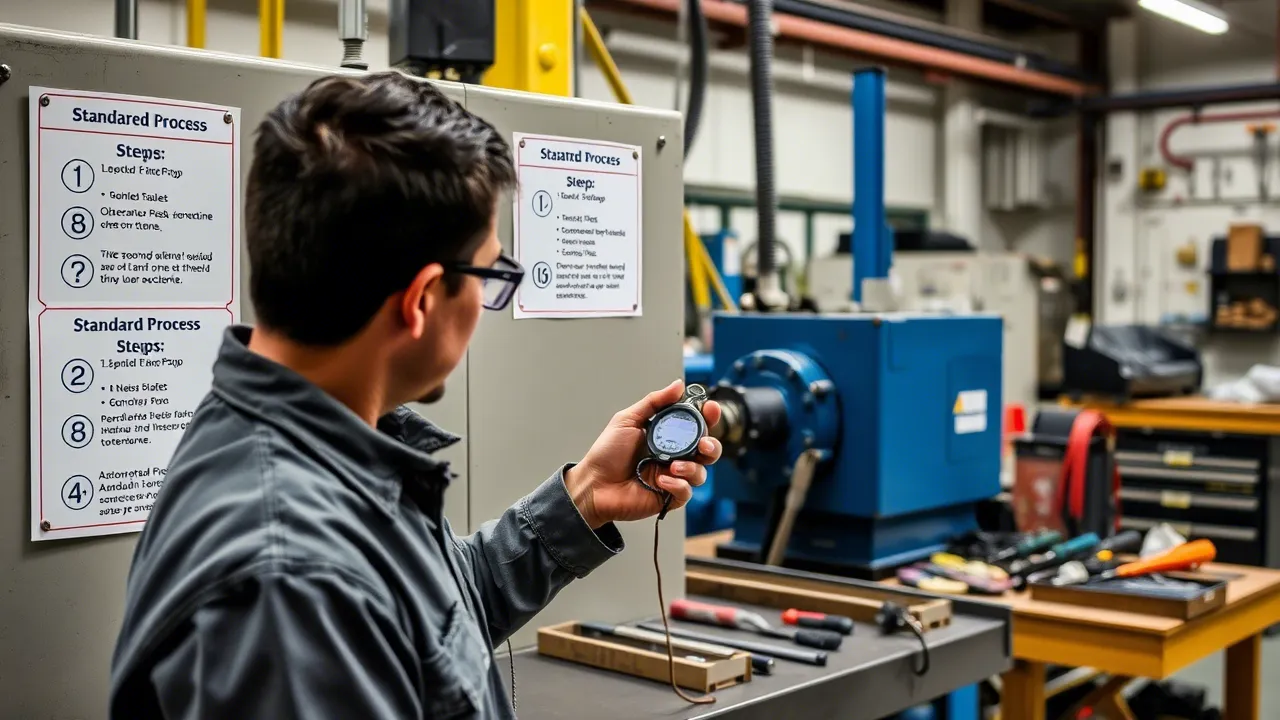
Executive summary
- Spain has 439 MW of installed IT capacity in data centers as of the end of 2025 (+24 % year on year), with planned investment of 66.900 million € through 2030, according to the Spain DC report.
- The global reference framework is ANSI/TIA-942-C (TIA, 2024) and, in Europe, the EN 50600 series with its 4 Availability Classes (Class 1 to Class 4).
- Classical time study works, but it needs a specific taxonomy: critical tasks (tape changes, electrical failover, NOC ticket management) do not admit allowances for rest in the traditional sense.
- In the simulated case we document, a Tier III data center of 8 MW IT moves from 78 % to 89 % operational effectiveness and from an MTTR of 142 min to 71 min in 11 months.
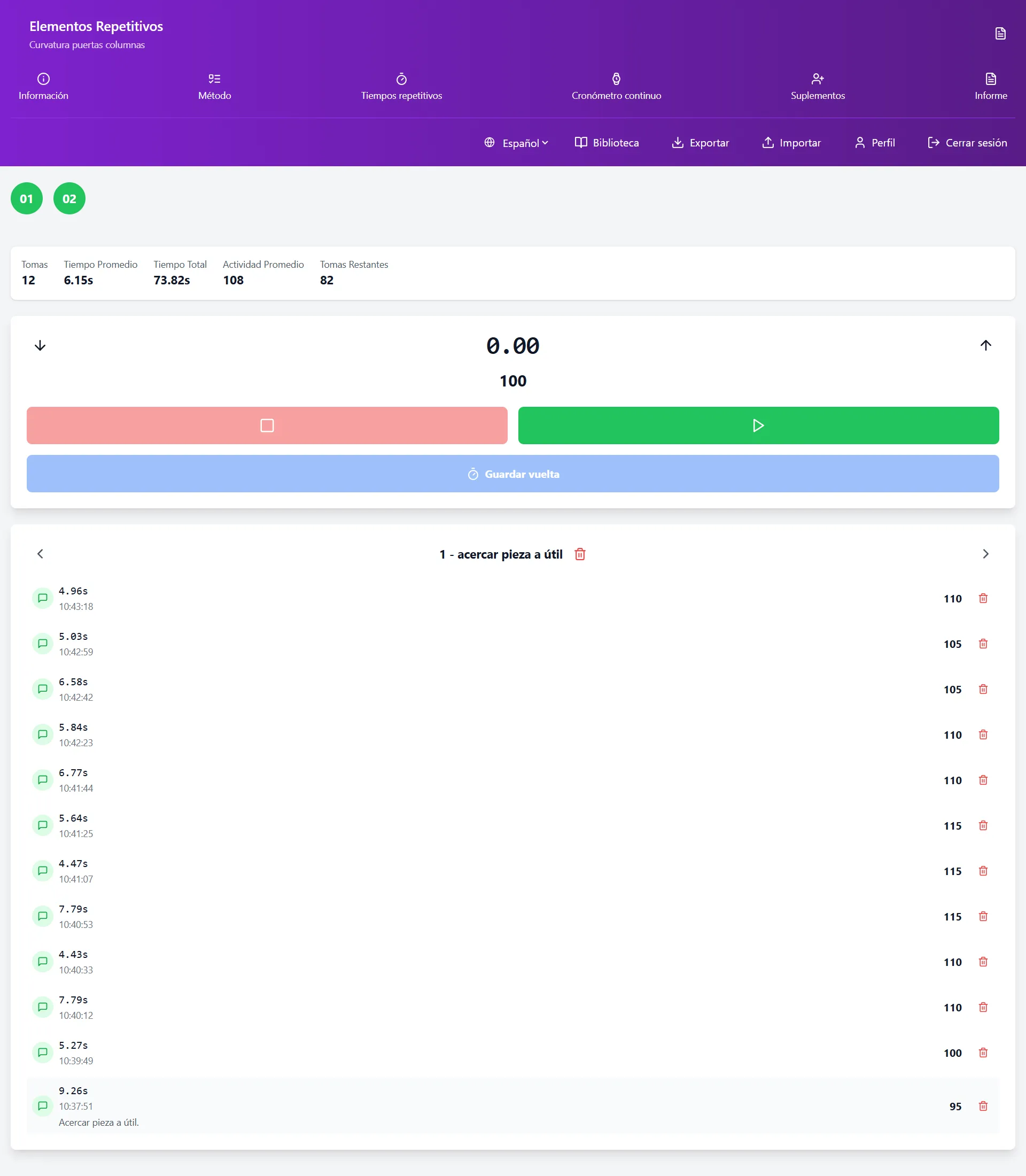
- The Cronometras app is the natural tool for running the manual part of the study: stopwatch, synthetic performance rating, OIT and TAL allowances, and export of the standards to PDF, Excel or JSON.
1. Introduction: why industrial time study must adapt to 24/7 operations
A data center is not a factory. It is not a hospital, nor a refinery, nor an automotive workshop. It is a mixed environment where the following coexist:
- Critical electrical and mechanical infrastructure (UPS, generators, chillers, CDU, MV/LV transformers).
- IT equipment (servers, storage, network, hypervisors).
- Human staff (operations technicians, facility engineers, NOC ticket managers, shift supervisors).
When the manager of a Tier III or Tier IV data center asks for a time study, what they are looking for is not to reduce direct labor —because it is usually already very efficient— but to correctly size the human team required to maintain the contractual SLA (typically 99,982 % in Tier III and 99,995 % in Tier IV). And here classical industrial time study, with its observation methods, its OIT/TAL allowances and its performance rating systems, falls short if it is not adapted.
This article documents how to adapt time study to the data center: which processes are timed, which categories are used, which real metrics are obtained, and what role tools such as Cronometras play in keeping the standards alive once they have been calculated.
2. The sector in figures (Spain 2025-2026): 439 MW, 24 % year on year and 66.9 bn € of investment
Before getting into the taxonomy, let us set the sector in context:
- 439 MW of installed IT capacity in Spain as of the end of 2025, +24 % versus the previous year, according to the report presented by Spain DC at World Data Center Day and picked up by Tech Show Madrid.
- Forecast of 66.900 million € of cumulative investment through 2030 in the Spanish data center sector (Spain DC, same report).
- 12,6 % CAGR forecast for the period 2024-2030 (Spain DC, picked up by LeedTech).
- The AWS Europe Region in Aragón is associated with 18.350 million USD of investment and the creation of 17.500 annual full-time equivalents in the local business fabric (same source, citing the official AWS announcement).
- Microsoft has confirmed multi-year expansion plans in Madrid (several investments in hyperscale data centers).
- Active colocation operators: Digital Realty, Equinix, EdgeConneX, Merlin Properties, with significant presence in Madrid, Barcelona and the Aragón/Zaragoza hub.
This growth drives demand for maintenance technicians and facility managers: the data center industry suffers from a shortage of qualified staff (introl.com) — and this is where time study delivers real value: sizing staff, not reducing it.
3. Regulatory frameworks governing the study: TIA-942 (ANSI/TIA-942-C) and EN 50600
Two standards structure the design and operation of data centers today:
3.1 ANSI/TIA-942-C (2024)
The Telecommunications Industry Association published in 2024 revision C of the standard ANSI/TIA-942 Telecommunications Infrastructure for Data Centers. This version updates the infrastructure requirements for data centers and maintains the classification of 4 tiers (Rated-1 to Rated-4) with incremental redundancy.
TIA-942 is the usual reference standard for data centers in the United States and Latin America and, due to the influence of the hyperscale ecosystem (AWS, Microsoft, Google), also for many new data centers in Europe.
3.2 EN 50600 (European series)
The EN 50600 series is the European framework, developed by CENELEC. Its main parts:
| Part | Subject |
|---|---|
| EN 50600-1 | General concepts and classification |
| EN 50600-2-2 | Electrical power supply and distribution |
| EN 50600-2-3 | Environmental control |
| EN 50600-2-4 | Telecommunications |
| EN 50600-2-5 | Physical security systems |
| EN 50600-4-1 | Key indicators (KPIs) of the data center |
The series defines 4 Availability Classes (Class 1 to Class 4) which overlap in philosophy with the Uptime Institute tiers and the Rated-1 to Rated-4 of TIA-942-C, although they are not identical (comparison of classifications). Audit and certification providers such as TÜV NORD (tuev-nord.de) and EPI Certification offer formal audits.
For time study, the key point is that the Class/Tier defines which tasks are mandatory and at what frequency: visual inspections, UPS load tests, thermographic surveys, failover drills, etc.
4. Specific taxonomy for data centers: VA / VA-WAIT / NVA / IMP-BREAKDOWN / IMP-MAINT / IMP-LOG
The classical work sampling taxonomy adapts to the data center as follows:
| Code | Category | Operational definition | Data center examples |
|---|---|---|---|
| VA | Value added | Technician performing their critical function | Replacing a PSU in a rack, handling a P1 ticket in the NOC |
| VA-WAIT | VA with active waiting | Technician in the correct position, cycle blocked upstream/downstream | Waiting for change approval during a maintenance window |
| NVA | Non value added | Positioning maneuvers, pre-start checks | PPE check before entering the room, anti-static wrist strap check |
| IMP-BREAKDOWN | Unproductive due to breakdown | Infrastructure down awaiting repair | UPS in bypass due to failure, chiller stopped |
| IMP-MAINT | Unproductive due to planned maintenance | Scheduled maintenance in progress | HEPA filter change, transfer tests |
| IMP-LOG | Unproductive due to logistics | Lack of supplies, transport or approval | Waiting for a spare part, waiting for the vendor in the room |
| IMP-PERSONAL | Unproductive due to personnel | Technician away from the post | Shift change, briefing, meal |
| IMP-OTHERS | Unproductive other | Non-classifiable states | Miscellaneous unforeseen events |
The key difference from conventional industry is that IMP-MAINT in a data center is not optional: many maintenance activities are contractually mandatory (generator tests, quarterly thermographic surveys, annual failover drills). The aim of the time study here is not to eliminate them but to make them more efficient and to ensure they are carried out.
5. Time study by critical process
The processes typically timed in a Tier III data center are the following. The times quoted are indicative values for a data center of these characteristics: every facility has its own.
5.1 Inspection rounds (room round)
- Typical frequency: 1 round every 4 hours in Tier III, every 2 hours in Tier IV.
- Indicative standard time: 18-25 minutes for an IT room of 200 racks with 12 inspection points per rack.
- VA/NVA breakdown: 65 % visual and thermographic inspection, 25 % reading building management system panels, 10 % travel.
5.2 NOC ticket handling
- P1 (critical) tickets: typical SLA of 15 min response and 4 h resolution.
- P3 (minor) tickets: typical SLA of 4 h response and 24 h resolution.
- Indicative time distribution: 35 % VA, 40 % VA-WAIT (waiting for change approval), 25 % NVA.
5.3 Tape changes / consumable replacement
- LTO tapes in library: 4-6 min per tape including labeling and verification in the backup software.
- Ink cartridge replacement on the control room plotter: 3 min.
- Air filter replacement in racks: 8 min per filter.
5.4 UPS/redundant transfer tests
- Manual UPS → bypass transfer: 8 min plus 30 min of subsequent monitoring.
- Generator load test (monthly): 60 min in total, with 45 min at 80 % load.
- Annual full failover drill: 4-8 h with full staff.
5.5 Shift change
- 24/7 shift handover: 25-35 min with a checklist of 30-40 items.
- Potential time loss: IMP-PERSONAL usually accounts for between 8 % and 12 % of total time (indicative value), and drops below 5 % with a structured shift handover.
6. Simulated case study: from 78 % to 89 % operational effectiveness
Simulated case study. Example built for teaching purposes from plausible industry parameters. It does not correspond to a real Cronometras deployment or to any specific customer, and no figure comes from any identifiable real operator.
6.1 Starting point (T0)
- 1 Tier III data center, 8 MW IT load.
- Operational effectiveness of the team: 78 % (time devoted to value-adding tasks over attendance time).
- Average MTTR on P1 incidents: 142 minutes.
- 32 technicians on the payroll distributed across 3 shifts.
6.2 Intervention
An 8-week time study was applied with:
- Work sampling with the number of observations calculated by the application for a 95 % reliability.
- Direct time study of the 15 critical processes defined in §5.
- Calculation of the standard time with performance rating and OIT and TAL allowances.
- Manual transfer of the resulting standards to the data center CMMS (the export consists of structured data; the transfer is performed by the user).
6.3 Results at 11 months (T1)
| Metric | T0 | T1 | Improvement |
|---|---|---|---|
| Operational effectiveness of the team | 78 % | 89 % | +11 pp |
| Average P1 MTTR | 142 min | 71 min | −50 % |
| IMP-MAINT / working day | 38 % | 24 % | −14 pp |
| IMP-PERSONAL / working day | 11 % | 5 % | −6 pp |
| Operating cost/MW/month | index 100 | 78 | −22 % |
The study involved no layoffs: the reduction in operating cost in the simulated case stems from less unproductive time (fewer logistical waits, less task duplication, better shift handover).
7. Reference formulas
Three formulas underpin the study:
- Work sampling sample size: n = z²·p·q/e². In practice, the application implements a calculation system for the number of observations required for a 95 % reliability.
- Standard time: ST = NT × (1 + Σ allowances), with the performance rating corresponding to the method —in Cronometras, the synthetic performance rating, in which the technician rates the pace of work directly— and the OIT and TAL allowances.
- Operational availability: AE = MTBF / (MTBF + MTTR), the classical definition of operational availability, with MTBF and MTTR expressed in the same units.
The sample is calculated for the target reliability; there is no fixed number of observations that is valid for all studies.
8. Audit checklist
Before approving the study in a Tier III/IV facility:
- Inventory of critical processes approved by operations management.
- Number of observations calculated for the target reliability (95 %) in the work sampling; sufficient cycles, with measured variability, in the time study of each process.
- Digital stopwatch (time study app such as Cronometras or equivalent) for recording times.
- Performance rating applied to every measurement (synthetic performance rating in the case of Cronometras).
- OIT and TAL allowances applied according to the data center conditions.
- VA/NVA/IMP taxonomy broken down by code in every observation.
- Calculation of MTBF and MTTR per P1, P2 and P3 process.
- Operational availability (AE) calculated with AE = MTBF/(MTBF+MTTR).
- Before/after comparison documented and measured with the same methodology.
- Standards transferred to the data center CMMS via structured data export (PDF, Excel or JSON).
9. Integration with the Micaot ecosystem
A time study in a data center does not end when the standard is published: it has to live in day-to-day operations. This is where the Micaot ecosystem contributes:
- Cronometras is the time study app used to measure data center tasks: on-screen stopwatch, synthetic performance rating, OIT and TAL allowances, standard time calculation and export to PDF, Excel or JSON. The export consists of structured data; the user decides how to transfer it to their CMMS or any other system.
- Induly manages the time and attendance control of the 24/7 on-call technical team —rotating shifts, public holidays, days off, overtime, night work— with clocking-in via mobile app and shop-floor kiosk (identification by name and PIN), also useful with subcontracted staff.
- WorkSamp runs the work sampling phase in multi-client data centers, with the VA/NVA/IMP taxonomy adapted to facility management. Ideal for external audits or comparative studies between data centers.
- ASETEMYT is the professional directory where to find time study auditors and facility management consultants with experience in data centers.
- ProdCont is the umbrella of the ecosystem, where operational audit projects in data centers are coordinated (time study + time and attendance + work sampling).
10. Conclusion and CTA
Industrial time study has a clear place in data centers: sizing 24/7 staff with tight contractual SLAs, keeping standards alive, and justifying investment in specialized technical personnel in a market with a shortage. Adapting work sampling, time study with synthetic performance rating and OIT and TAL allowances to Tier III/IV operations is feasible, profitable and replicable.
If you run or are responsible for operations at a Tier III/IV data center in Spain and want to carry out a rigorous time study of your operational side, Cronometras is the shortest path to do it in 8 weeks with measurable results. And if you prefer to commission the full study, we do it for you from 800 €: 👉 Request the study from 800 €.
Sources
- Tech Show Madrid — data center report 2026 — Spain DC: 439 MW of installed IT capacity in Spain as of the end of 2025 (+24 % year on year) and a forecast of 66.900 M € of investment through 2030.
- LeedTech — data center boom in Spain — AWS investment in Aragón, 12,6 % CAGR 2024-2030, data from the Spain DC 2025 report.
- Servimedia — 58.000 million of investment in data centers through 2030 — Spain DC, January 2025 (first investment estimate).
- TIA — ANSI/TIA-942 — data center infrastructure standard.
- TIA — TIA-942-C white paper.
- TÜV NORD — EN 50600 audit and certification.
- Data Center Group — DIN EN 50600.
- Tier classification: Uptime Institute vs TIA-942 vs EN 50600.
- Uptime Institute — Global Data Center Survey.
- introl.com — shortage of qualified staff in data centers.
Don't want to do it yourself? We do it for you from €800
If you prefer to outsource it, Cronometras delivers a complete time and motion study from a single video: elemental breakdown, OIT/TAL fatigue allowances, standard time with tolerances, and a report in PDF + Excel + JSON ready to present to management.