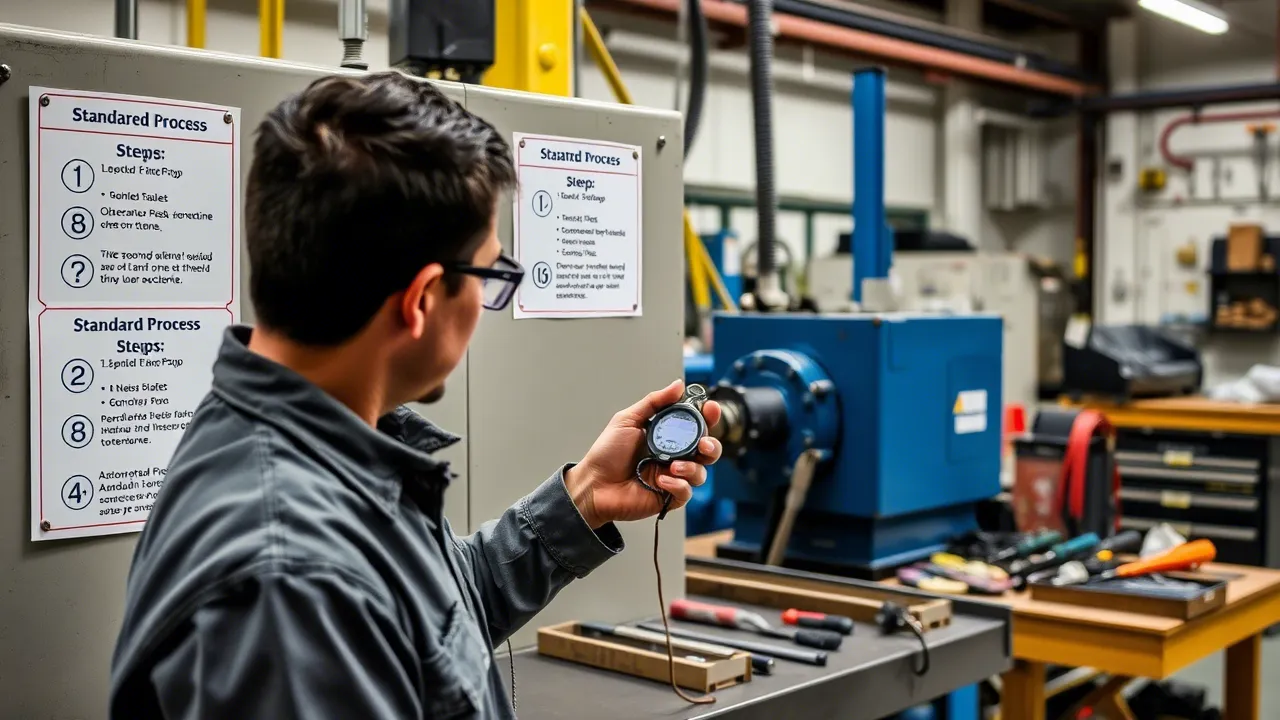
The problem is endemic in industry: There is still the mistaken belief that time study simply means "using a stopwatch" to pressure the operator. This archaic view ignores the scientific basis of the discipline.
The reality is that work measurement is a branch of applied statistics, critical for Industry 4.0. Without it, plant engineering is navigating blind.
The promise: In this technical guide we break down the ILO methodology, the mathematics behind the Standard Time equation ($T_{std}$) and why, without this rigorous measurement, the capacity data in your ERP are nothing but dangerous estimates.
Definition of Time Study according to the ILO (Theoretical Framework)
To address methods engineering with rigor, we must turn to the primary source: the International Labour Organization (ILO). In its reference work, Introduction to Work Study (Kanawaty), the canonical definition is established that separates professional engineering from improvisation.
The Anatomy of the Definition
"Time study is a work measurement technique employed to record the times and rates of working corresponding to the elements of a defined task, carried out under defined conditions, and to analyze the data so as to ascertain the time required for carrying out the task in accordance with a pre-established standard of performance." — ILO
For a Methods Engineer, this definition breaks down into three critical vectors:
- Sine Qua Non Condition (The Method): "You cannot measure what has not been standardized." Any attempt to carry out time study without first validating the method (layout, material flow, ergonomics) produces null data (the Garbage In, Garbage Out principle).
- The Qualified Worker: A specific individual is not measured; instead, the aim is to project statistically to the "average qualified operator."
- Standard of Performance: The expected pace that can be maintained shift after shift without excessive accumulated fatigue.
Difference between Method Study and Work Measurement
It is vital to distinguish technically between the two phases:
- Method Study: Focuses on reducing the work content by eliminating Muda (waste), redesigning workstations and improving motions (Motion Economy).
- Work Measurement: Quantifies the time of the remaining work content once the method has been optimized.
The Standard Time Equation ($T_{std}$): The Mathematics of Measurement
Here lies the technical heart of the discipline. The time shown by the stopwatch is not the standard; it is only a raw variable that must be mathematically normalized.
General Formula
The calculation of Standard Time is governed by the following fundamental equation:
Critical Variables
To obtain a reliable figure that can be loaded into the management system, we must control:
1. Observed Time ($T_{obs}$)
It is the arithmetic mean or the mode of the sample of recorded times. However, this figure is useless without validating the sample size ($n$). An engineer must calculate based on the dispersion of the data (standard deviation) to ensure a confidence level (generally 95%) and an acceptable margin of error (±5%).
2. Pace Factor (Rating/Activity)
This is the leveling of the observed time according to the analyst's technical judgment.
- The objective: To normalize to the observed operator. If an operator works at 120% activity, the observed time will be shorter, but by multiplying by the factor 1.20, the normalized time is balanced out.
- Scales: Although the Bedaux scale (60/80) was historically used, the current standard tends toward the British Standard / Centesimal Scale (0-100), where 100 represents standard performance.
3. ILO Allowances
The normalized time is a "theoretical" time of uninterrupted execution. To humanize the standard, coefficients are applied according to ILO tables:
- Physical and Mental Fatigue: Energy recovery.
- Personal Needs: Physiological breaks.
- Spain Context 2025: Current regulations and collective agreements require the integration of ergonomic factors (ISO 11228, OCRA/RULA methods) and psychosocial risks. Allowances are no longer arbitrary; they must be justified before health and safety committees.
Strategic Objectives: What Is Time Study Really For?
Time study does not seek to "make people work faster," but to eliminate process variability. Its impact on the business is structural:
- Industrial Cost Setting: Standard time determines the direct labor cost. Without precision here, the product's calculated gross margin is fictitious.
- Planning (ERP/MRP/APS): Systems such as SAP or Microsoft Dynamics require exact routing times (finite capacity). An error in the standard causes stockouts or idle overcapacity.
- Line Balancing (Heijunka): In Lean Manufacturing, compliance with Takt Time depends on leveling the workloads. Time study identifies the technical bottlenecks that prevent continuous flow.
- Incentive Systems: It is the legal basis for production bonuses. A poorly calculated standard ("soft" or "hard") is a direct source of labor conflict and collective agreement violations.
Measurement Methodologies: Time Study vs. Predetermined Time Systems (PMTS)
The engineer must select the right tool according to the nature of the cycle.
Industrial Time Study (Direct Measurement)
- When to use it: Long cycles, non-repetitive tasks, maintenance, logistics, or to validate outliers and deviations in existing processes.
- Requirement: The assessment of activity (Pace) requires highly calibrated analysts.
MTM and MOST Systems (Predetermined Times)
- When to use it: Short cycles, high volume (e.g. Automotive, assembly), and fundamentally for Work Design (setting times before the physical workstation exists).
- Advantage: It completely eliminates performance rating. The time is determined by the nature of the motion (reach, grasp, move, position). The pace is intrinsic to the system.
Digital Transformation: Time Study in Industry 4.0
According to 2024-2025 market reports, methods engineering is going through a critical technological disruption.
- The End of the Analog Era: The use of a board, paper and a stopwatch generates 40% of "efficiency leaks" in the engineering department. Time lost transcribing data into Excel is time not invested in value analysis.
- Real-Time Statistics: The greatest risk of the traditional method is discovering that the sample is statistically insufficient ($n$) after the plant has already been left. Digitalization makes it possible to calculate the confidence interval on site.
- Traceability and Auditing: In the face of union claims about required paces, raw data, geolocated and with a digital timestamp offer superior legal and technical protection compared to paper.
Optimize Your Methods Engineering with Cronometras
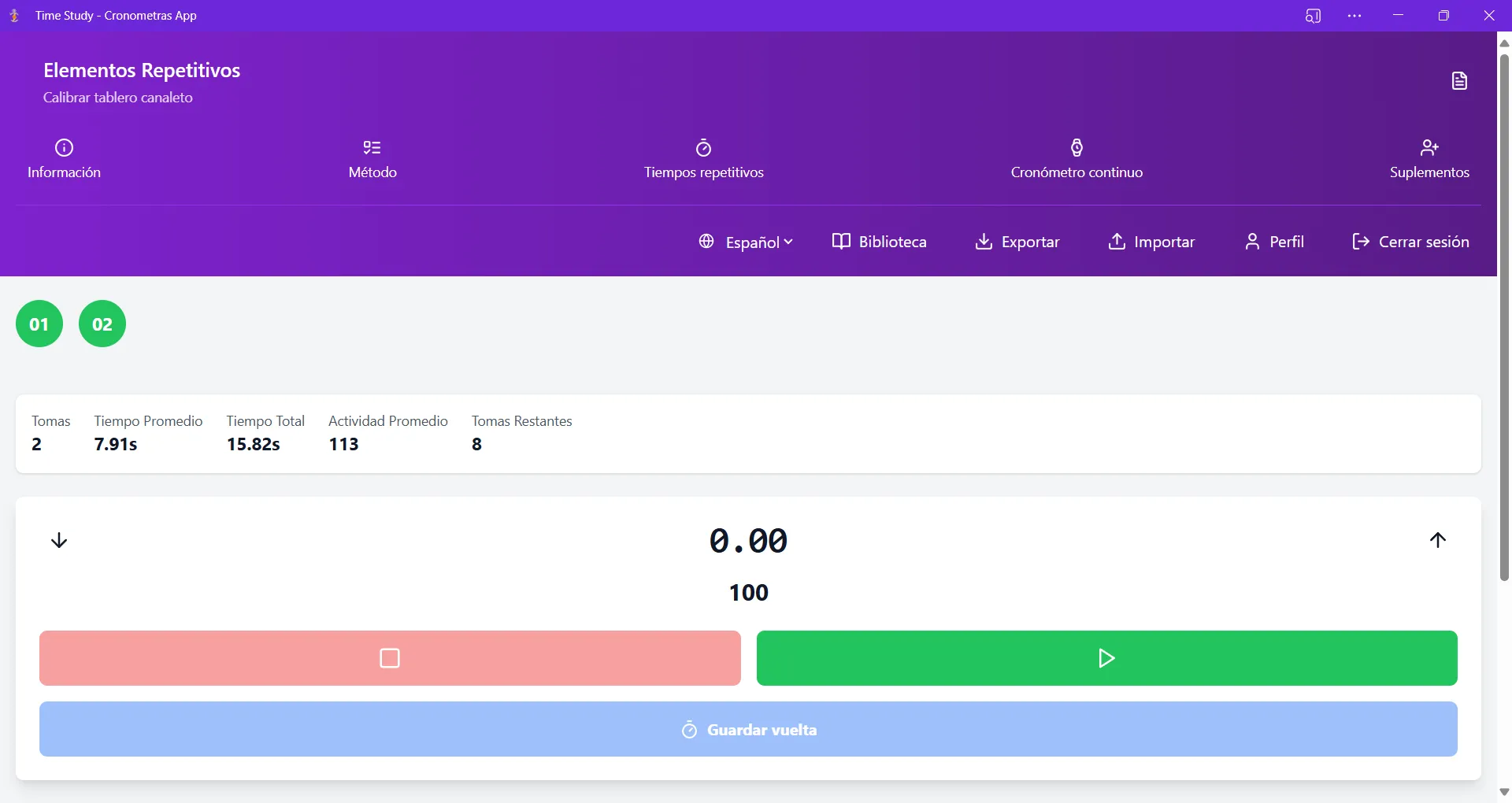
Mathematical precision does not tolerate transcription errors or manual allowance calculations. Cronometras is the answer to the need to transform the traditional ILO methodology into an efficient digital workflow.
Our platform enables Methods Engineers to:
- Automatic calculation of : Real-time algorithms that indicate when the sample has reached 95% reliability.
- Integration of ILO Allowances: Parameterization of standardized fatigue and personal needs coefficients.
- Instant data analysis: Elimination of "data entry." Go from time recording to learning curve analysis and loading into the ERP in minutes.
- Hybridization: Support for time study and management of predetermined time blocks.
[Digitize your Methods department today and ensure the accuracy of your standards with Cronometras]
Frequently Asked Questions (Technical FAQ)
What is the difference between normal time and standard time?
Normal time is the observed time adjusted only by the pace factor (activity). Standard time is normal time plus the allowances for fatigue and personal needs. The operator must be able to meet the standard time sustainably; normal time is a mathematical abstraction.
How is the sample size calculated in a time study?
Inferential statistics based on the standard deviation of the preliminary times are used. The common formula for a 95% confidence level and ±5% accuracy requires calculating the dispersion of the recorded data. Digital tools such as Cronometras calculate it automatically after the first readings.
What fatigue allowances are mandatory according to the ILO?
The ILO suggests constant allowances (personal needs and basic fatigue) and variable ones (posture, force exerted, environmental conditions, visual/mental strain). In Spain, the specific application is usually validated through ergonomic risk assessments (ISO 11228).
How does time study affect OEE?
Directly in the Performance factor. OEE compares the actual speed against the ideal theoretical speed (Standard Cycle Time). If the standard is incorrect, the OEE indicator will be false, hiding productivity losses or showing unrealistic efficiencies above 100%.
Don't want to do it yourself? We do it for you from €800
If you prefer to outsource it, Cronometras delivers a complete time and motion study from a single video: elemental breakdown, OIT/TAL fatigue allowances, standard time with tolerances, and a report in PDF + Excel + JSON ready to present to management.