Direct work measurement by time study remains, in 2025, the fundamental pillar for calculating standard times in discrete, repetitive and process manufacturing environments. Among the continuous time study techniques, two historic methods compete for analysts' preference: Zero-Reset (VAC) and Cumulative (ACU). This technical guide breaks down their mechanisms, accuracy, industrial applicability and regulatory context, providing industrial engineers, plant managers and time study analysts with objective criteria for their selection and implementation.
What is industrial time study and why is it still relevant in 2025?
Technical definition of direct work measurement
Industrial time study is the work measurement technique that consists in determining, by means of a stopwatch instrument and a systematic method, the duration of the tasks that make up a process or work cycle. Its purpose is to establish a standard time for a defined task, performed by a qualified operator, working at a normal pace and considering the regulatory allowances.
Unlike predetermined time systems (PTS) such as MTM (Methods-Time Measurement) or MOST (Maynard Operation Sequence Technique), which assign theoretical times to basic motions, time study measures the actual time consumed at the workstation. Its value lies in capturing the variations of the real environment: machine conditions, operator fatigue, minor interruptions and the effect of learning.
Difference between time study and predetermined time systems (MTM, MOST)
- Direct time study (VAC/ACU): Measures the real time of an observed sequence of motions. It is ideal for existing processes, where the aim is to optimize and standardize.
- Predetermined Time Systems (PTS): Assign a theoretical time to each basic elementary motion (reach, grasp, release). They are method design tools, ideal for new lines or products.
In modern practice, the two are complementary. A time study can validate or adjust the theoretical times of a PTS. For an in-depth methods analysis, tools such as Induly make it possible to integrate time study data with real-time production control, correlating standard times with OEE (Overall Equipment Effectiveness).
Current context: automation, OEE and the role of the human analyst
With Industry 4.0, many processes are automated, but human work measurement does not disappear; it is transformed. The analyst now focuses on:
- Complex manual assembly tasks where robotics is not yet cost-effective.
- Maintenance and internal logistics operations.
- OEE analysis, where time study identifies performance losses (cycles slower than the standard) and quality losses (rework).
- ** Work Sampling studies** to analyze machine and operator utilization. For this type of sampling, specific applications such as WorkSamp automate the collection of random data and the calculation of activity percentages, complementing a continuous time study.
Current regulations: ILO and the legal framework in Spain
In Spain, work measurement falls within the scope of the Workers' Statute and collective bargaining. The International Labour Organization (ILO) sets out key guidelines in its Convention 115 and technical manuals:
- Transparency: The worker must be informed of the method and the results.
- Equity: The standard time must be achievable by a qualified worker with reasonable effort.
- Consideration of allowances: Allowances must be included for fatigue, personal needs and unavoidable delays.
- Participation: Consultation with worker representatives is encouraged.
A time study that fails to meet these principles may be challenged in court. Therefore, the choice of method (VAC or ACU) must also consider its transparency and ease of explanation to the worker.
Zero-Reset Time Study Method: definition, mechanism and operation
How does the Zero-Reset time study work step by step?
The Zero-Reset (VAC) method is intuitive. The analyst follows this procedure:
- Cycle division: The process is broken down into elements with clear and repeatable breakpoints.
- Starting: At the start of the first element, the stopwatch is started.
- Reading and reset: At the end of the element, the elapsed time is read and, almost simultaneously, the stopwatch is stopped and reset to zero.
- Recording: The reading is written down directly as the duration of the element.
- Repetition: The cycle is repeated for the next element. The stopwatch starts from zero to measure the next interval.
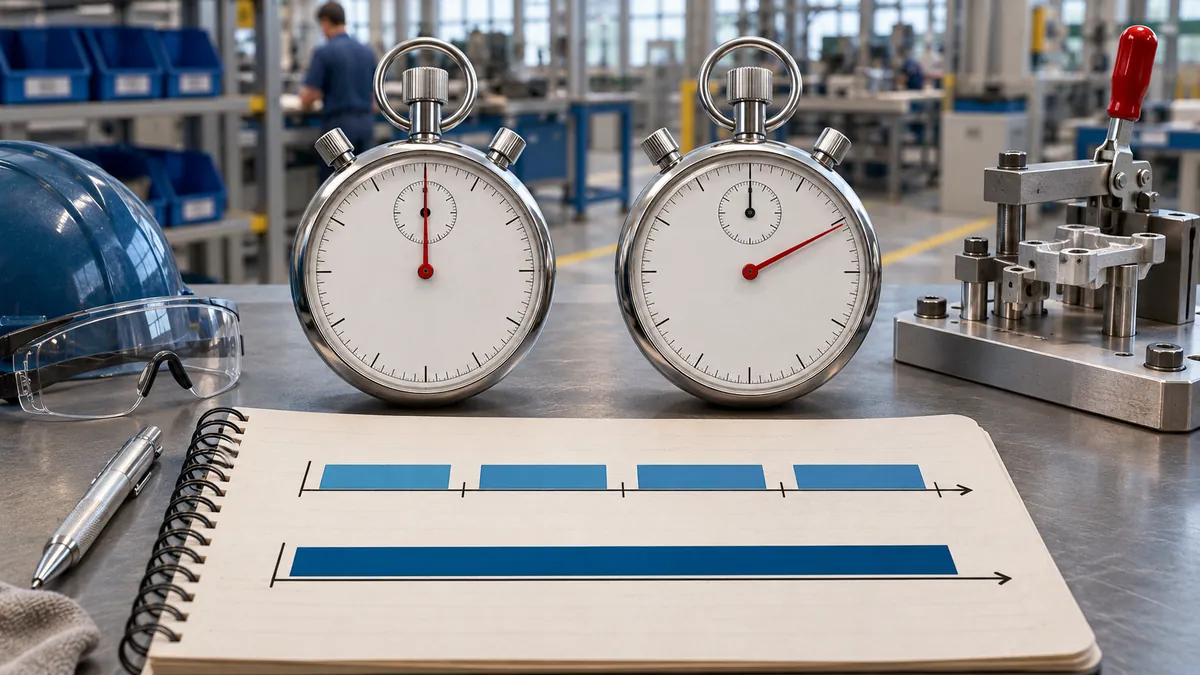
Graphical representation of the time flow (start → read → reset)
Real time line:    |--E1--|---E2---|--E3--|--E4--|...
Analyst action:    START -> READ/RESET -> START -> READ/RESET ->...
Stopwatch reading:    0.12 min     0.08 min     0.15 min     0.21 min
Each reading is independent. There is no arithmetic dependence between them.
Technical characteristics of the VAC method
- Direct reading: The recorded value is the pure elemental time.
- Minimal processing: The sum of the readings of one cycle gives the observed cycle time.
- Time interruption: There is a dead time (Δt) between the end of one element and the start of the next, corresponding to the physical action of stopping/resetting/starting.
- Sensitivity to synchronization error: If the analyst is late in pressing the button at the end of the element, that time is lost and is attributed to the next element.
Resolution and accuracy parameters (analog vs. digital)
- Analog (wind-up) stopwatches: Typical resolution of 1/100 of a minute (0.01 min or 0.6 s). The mechanical reset error is significant.
- Digital stopwatches: Resolution of 1/1000 of a minute (0.001 min or 0.06 s) or 1/100 of a second. The reset is electronic and much more accurate.
Mechanical reset error: quantification and real impact
In an analog stopwatch, the reset mechanism involves:
- Stopping the balance wheel.
- Returning the hands to zero.
- Releasing the balance wheel again. This process introduces a discrepancy of ±0.004 seconds for each reset. In a cycle of 10 elements, this means a potential cumulative error of ±0.04 seconds, which may be negligible in long cycles (>1 min) but significant in very short cycles (<0.20 min).
Cumulative Time Study Method: definition, mechanism and operation
How does the Cumulative time study work step by step?
The Cumulative (ACU) method eliminates the reset. The procedure is:
- Continuous start: The stopwatch is started at the beginning of the first element and is not stopped until the study is finished.
- Cumulative reading: At the end of each element, the analyst records the total accumulated reading from the start.
- Differential calculation: The elemental times are obtained by successive subtraction of the cumulative readings.
Process for obtaining elemental times by successive subtraction
Cycle with 4 elements:
Cumulative readings (L): L0=0.00, L1=0.12, L2=0.20, L3=0.35, L4=0.56

Calculation:
Time E1 = L1 - L0 = 0.12 - 0.00 = 0.12 min
Time E2 = L2 - L1 = 0.20 - 0.12 = 0.08 min
Time E3 = L3 - L2 = 0.35 - 0.20 = 0.15 min
Time E4 = L4 - L3 = 0.56 - 0.35 = 0.21 min
Technical characteristics of the ACU method
- Continuous recording: Captures all of the time flow, including irregular or unforeseen elements that may arise.
- Elimination of reset error: Since the stopwatch is not stopped, the Δt associated with mechanical reset is eliminated.
- Higher processing workload: Requires a subsequent calculation phase, subject to arithmetic errors.
- Use of split-hand stopwatches: Ideal for this method. A main hand marks the seconds continuously, while a second hand (or display) freezes when a button is pressed to record the cumulative reading, without stopping the total time.
Data verification: Σ(elemental time) = L_final − L_initial
A critical advantage of the ACU method is its self-verification. The sum of all calculated elemental times must be exactly equal to the difference between the last and the first cumulative reading:
Σ (E1 + E2 + ... + En) = L_final - L_initial
If it does not add up, there is an error in the recording or in the calculation, allowing it to be corrected. This verification is impossible in the VAC method.
Technical comparison Zero-Reset vs. Cumulative: complete table
Parameter matrix: reading type, errors, speed and processing
| Parameter | Zero-Reset (VAC) | Cumulative (ACU) |
|---|---|---|
| Reading type | Direct per element | Differential by subtraction |
| Reset error | Present (±0.004 s in analog) | Non-existent |
| Transcription error | Low (direct reading) | Medium (possible subtraction error) |
| Capture of irregular elements | Difficult, may be omitted | Automatic capture in the flow |
| Recording speed by the analyst | Higher (one entry per element) | Lower (entry + subsequent calculation) |
| Subsequent processing time | Minimal (only summing) | Requires subtraction and verification phase |
| Suitable for short cycles (<0.20 min) | Limited by reset error | Recommended |
| Suitable for long cycles (>5 min) | Recommended (simplicity) | Acceptable |
| Internal verification capability | Low (only cycle sum) | High (ΣE = ΔL) |
| Analyst learning curve | Low | Medium |
| Optimal use with digital stopwatch | Yes, minimizes reset error | Yes |
| Optimal use with analog stopwatch | Acceptable | Preferred (with two hands) |
Intra-analyst coefficient of variation by cycle range
The accuracy of a study does not depend only on the method, but on the analyst's skill and the cycle length. Methods engineering studies (based on ILO manuals and classic works such as the Industrial Engineering Handbook by Maynard) report the following typical coefficient of variation (CV) for the same analyst:
| Method | Cycle > 1.0 min | Cycle 0.2 - 1.0 min | Cycle < 0.20 min |
|---|---|---|---|
| Zero-Reset (VAC) | ±2.5% | ±4.1% | ±7.8% |
| Cumulative (ACU) | ±2.3% | ±3.2% | ±4.5% |
Technical interpretation:
- In standard cycles (>1 min), the difference is marginal and may not be statistically significant.
- In short cycles (0.2-1 min), ACU begins to show an advantage.
- In very short cycles (<0.20 min or 12 seconds), the ACU method is clearly superior. The reset error of VAC (±0.004s) represents a very high percentage of the elemental time, distorting the measurement.
Accuracy in short cycles (<0.20 min): why does ACU win?
A 10-second cycle (0.167 min) with 4 elements of ~2.5 seconds each.
- With VAC (analog): Each reset introduces ±0.004s (±0.000067 min) of error. In a 2.5s element, this is ±0.27% additional error per reset. But human synchronization error can be much greater.
- With ACU: There is no reset. The main error is the reading error when reading the scale at the end of the element (±0.01 min), but it is constant and is not repeated for each element. Successive subtraction minimizes the relative impact.
Accuracy in long cycles (>5 min): when is VAC advisable?
In long cycles with well-defined elements (>30 seconds per element), the simplicity of VAC is an operational advantage:
- It reduces the risk of later arithmetic error.
- It allows the analyst to focus on observation and performance rating.
- The reset error becomes negligible (<0.1% of the elemental time).
Capture capability
Don't want to do it yourself? We do it for you from €800
If you prefer to outsource it, Cronometras delivers a complete time and motion study from a single video: elemental breakdown, OIT/TAL fatigue allowances, standard time with tolerances, and a report in PDF + Excel + JSON ready to present to management.