Pillar 1: Foundations and Regulatory Context
Methods and time engineering is a living discipline, in constant evolution, that remains the backbone of industrial productivity. A critical and often misunderstood concept in this area is that of contingency allowances. Mastering their calculation and implementation is not an option, but a requirement for establishing fair, achievable and sustainable standards. In 2025, with the pressure for efficiency and regulatory transparency, their proper management becomes even more strategic.
1.1. Technical Definition and Purpose
In essence, contingency allowances (or allowances) are percentage increases that are added to the base time or observed time of a task. This base time is the result of a time study carried out through time study, work sampling or predetermined time systems (MTM, MOST). Their fundamental purpose is to guarantee the achievability of the standard.
Without these allowances, the standard time would be unrealistic. It would ignore the inevitable interruptions and human limitations, leading to unattainable goals, demotivation, poor quality and, ultimately, the breakdown of the measurement system. They are the technical bridge between the ideal world of measurement and the operational reality of the shop floor.
1.2. OIT Classification: The Global Frame of Reference
The International Labour Organization (OIT) establishes the most accepted and structured classification, which must be the basis of any serious calculation:
- Personal Contingencies: They cover basic physiological needs such as going to the bathroom, drinking water or a brief rest break. They usually account for 5% of the base time in standard environments.
- Allowances for Unavoidable Delays: Interruptions not attributable to the operator, such as minor equipment breakdowns, waits for a crane, quality-related interruptions or unplanned tool changes. Their percentage varies enormously and must be measured.
- Variable Fatigue Allowances: This is the most complex. It depends on the physical load (effort, posture), mental load (attention, monotony) and environmental conditions (noise, lighting, temperature). It can range between 0% and more than 10%.
1.3. Legal and Reference Framework in Spain (2025)
In Spain, there is no single standard dictating exact percentages, but the legal and technical framework conditions their application:
- Sectoral Collective Agreements: They are the main negotiated reference. In sectors such as automotive or metalworking, it is common to find clauses setting maximum ranges for total allowances (e.g., between 12% and 18%). Being unaware of them can lead to labor conflicts.
- Standard UNE-EN 15628:2023: This standard on maintenance of competence requires the documentation and traceability of processes, including the calculation basis of work standards. An undocumented allowance is a potential non-conformity.
- Law on the Prevention of Occupational Risks (LPRL): It requires integrating ergonomics and psychosociology into work organization. This means that factors such as cognitive fatigue or stress caused by monotony must be considered when setting times; they are not optional.
- 2025 Trend – Digitalization and Transparency: Audits, both internal and from clients, increasingly demand digital traceability. Tools such as WorkSamp for work sampling or production control platforms such as Induly provide the objective data that supports these calculations, meeting these requirements.
Pillar 2: Calculation Methods and Practical Application
Choosing the right calculation method is crucial. A rough estimate is not the same as an analytical measurement based on real production data. Accuracy here translates directly into credibility and fair standards.
2.1. Statistical Method (OIT): The Conceptual Basis
This method, promoted by the OIT, uses standard tables and percentages derived from general statistical studies. It is a good starting point for environments without detailed historical data.
- Base formula:
Standard Time = Observed Time × (1 + % Total Allowance) - Typical percentage breakdown in manufacturing:
- Personal contingencies: 5%
- Basic fatigue: 4%
- Unavoidable delays: 3%
- Variable fatigue (depending on the environment): 0-10% (added to the previous one).
Its limitation is generalization. A 3% for unavoidable delays may be insufficient in a cell with obsolete machinery and excessive on a new, automated line.
2.2. Analytical Method (Methods Engineering): Data-Based Precision
This is the most rigorous method. It is based on collecting specific data from the work area. Work sampling (Work Sampling) is the central technique here.
- Step 1 - Identification: Through random observations, the real contingencies that occur are identified and categorized (e.g., "waiting for material", "nozzle cleaning", "consultation with supervisor").
- Step 2 - Quantification: The frequency and average duration of each event are calculated. Historical OEE (Overall Equipment Effectiveness) data are a goldmine for this step, breaking down losses by availability, performance and quality.
- Step 3 - Calculation: The formula is applied:
Mobile applications such as WorkSamp automate and greatly speed up this field data collection phase.% Allowance = (Σ (Event frequency × Average duration)) / (Total observed production time) × 100
2.3. Integration with Predetermined Time Systems (MTM, MOST)
Predetermined systems such as MTM and MOST provide highly accurate base times for elemental motions. Allowances are ALWAYS applied to this calculated base time; they are never integrated into the motion sequence.
- MTM (Methods-Time Measurement): Once the TMU time (Time Measurement Unit) of the sequence has been calculated, it is converted to minutes and the total allowance percentage determined for the operation is applied to it.
- MOST (Maynard Operation Sequence Technique): The process is analogous. The index time of the MOST sequence is multiplied by the allowance factor. The advantage of MOST is its speed, which allows standards to be recalculated with different allowances to evaluate scenarios.
2.4. Worked Practical Example: Subassembly Assembly Line
Let us imagine a workstation where a component is assembled. We will use combined data (MTM + sampling).
Input data:
- Base time calculated with MTM-2: 1.20 min/piece.
- Personal contingencies (sectoral standard): 5%.
- Delays due to micro-breakdowns (cell OEE history): 2.5%.
- Fatigue due to a noisy environment (measurement with sound level meter + OIT table): 3%.
- Unplanned tool change time (WorkSamp sampling): 1.5%.
Calculation process:
- Add allowance percentages: 5% + 2.5% + 3% + 1.5% = 12%.
- Apply formula:
Standard Time = 1.20 min × (1 + 0.12) = 1.344 min/piece.
This standard time of 1.344 min/piece is the one that must be used for production planning, cost calculation and performance evaluation. It is achievable, sustainable and technically justified.
Pillar 3: Frequent Errors and Advanced Solutions
3.1. The 4 Common Errors You Must Avoid
- Applying generic "textbook" allowances: Using 12% for the entire plant without considering the particularities of each cell (a welding area is not the same as a warehouse).
- Not updating the allowances: The production environment changes (new machinery, new products). The allowances calculated three years ago are probably no longer valid.
- Double counting with scheduled breaks: Adding an allowance for "rest" and, on top of that, having legal or agreed 15-minute breaks in the morning and afternoon. This artificially inflates the standard.
- Ignoring cognitive and mental fatigue: In fine assembly processes, quality inspection or screen monitoring, the mental load is a determining fatigue factor that must be quantified.
3.2. Technical Solutions and Best Practices
- Specific sampling by cell: Carry out Work Sampling studies in each area or significant type of operation. The granularity of the data is key.
- Semi-annual or annual review: Establish a formal procedure for reviewing the allowance percentages, using the latest OEE data, maintenance records and incident reports.
- Consider cognitive fatigue: For tasks with high mental demands, methods such as the RWL (Recommended Weight Limit) of NIOSH adapted to mental load can be used, or specific tables assigning additional percentages.
- Break down clearly: Document what each allowance percentage covers and ensure that it does not overlap with waiting times already included in the OEE calculation or with regulatory breaks.
3.3. Audit and Traceability: The Required Documentation
In the context of 2025, traceability is not negotiable. For any internal audit, client audit or union negotiation, the following must be available:
- Measurement protocol: Document describing the method used (OIT, analytical), measurement tools (stopwatch, software, WorkSamp) and the sampling procedure.
- Contingency database: Record of the observed events, frequencies and durations.
- Minutes of agreement: If the allowances are the result of a negotiation with the workers' legal representation, this must be recorded in writing.
- Traceability software: Use tools such as Induly that record in an unalterable log the changes to the standards and their justifications.
Pillar 4: 2025 Trends and Digitalization
Contingency management is being transformed by Industry 4.0. Far from being an obsolete discipline, time engineering is reinventing itself with digital tools that provide real-time data and unprecedented accuracy.
4.1. Applied Industry 4.0: Real-Time Measurements
- IoT and Sensors: Sensors on machines automatically detect micro-stops, irregular cycles or adverse environmental conditions (temperature, vibration). This data directly feeds the calculation of allowances for delays and variable fatigue.
- Wearables: Wristbands or physiological monitors can measure physical fatigue indicators (heart rate, body temperature) anonymously and in aggregate, providing an objective basis for adjusting fatigue allowances in demanding environments.
- Digital Twins: Before implementing a new line or changing a method, it can be simulated in a virtual environment. The digital twin can predict congestion points, waiting times and stress factors, allowing highly accurate theoretical allowances to be calculated before commissioning.
4.2. Big Data and Machine Learning: Toward Prediction
The true qualitative leap comes with the analysis of large volumes of historical production data.
- Prediction of optimal percentages: Machine Learning algorithms can analyze years of OEE data, maintenance records, environmental conditions and historical standards to predict the most suitable allowance percentage for a new operation, rather than only measuring it a posteriori.
- Anomaly detection: These systems can alert in real time when actual contingencies deviate significantly from the assigned standard percentage, indicating an underlying problem (an operator needs training, a machine requires preventive maintenance).
4.3. Specialized Software: Workflow Automation
Modern methods engineering software already integrates specific modules for allowance management.
- Tools such as TiCon, MOST Work Management or Proplanner make it possible to define contingency libraries, associate them with operations or work centers, and automatically recalculate standard times when the factors are modified.
- Integration with MES/ERP systems: Full automation is achieved when the methods software is connected to the manufacturing execution system (MES). The stops recorded by the MES are automatically classified and feed the dynamic calculation of the allowances, creating a continuous, real-time feedback loop.
Pillar 5: Resources and Tools for the Professional
For the methods engineer or plant manager seeking to implement a robust system of contingency allowances, it is essential to rely on quality resources and tools. The ecosystem of specialized solutions is rich and in full effervescence.
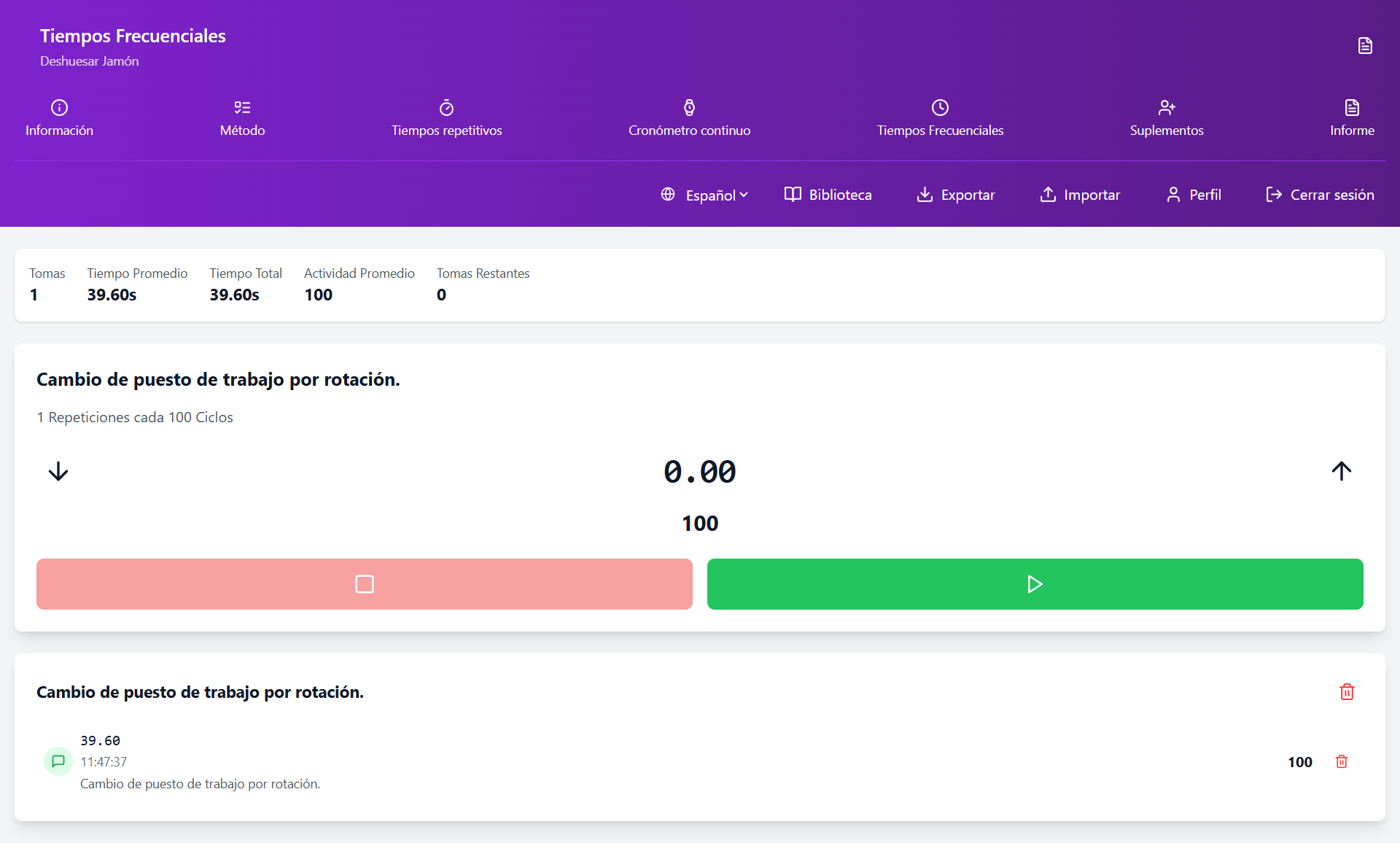
- For measurement and time study: Tools such as Cronometras have greatly simplified the performance of stopwatch time studies, enabling accurate and efficient data capture that is the first step for any calculation.
- For work sampling (Work Sampling): Applications such as WorkSamp are essential. They allow sampling studies to be scheduled and run from a mobile device, automatically calculating the frequencies of the observed contingencies, which eliminates human error and speeds up the analytical method.
- For production control and obtaining OEE data: Platforms such as Induly offer real-time production control and industrial time-recording systems. This data is vital for objectively quantifying losses due to delays (stops, reduced pace) and for feeding the calculation of allowances with real, continuous information.
- For finding suppliers and solutions: The ASETEMYT Directory is a fundamental resource for locating companies specializing in methods engineering consulting, productivity software and industrial time study services in Spain.
The proper management of contingency allowances is, in short, the hallmark of professional, ethical and technically advanced methods engineering. It is what distinguishes an imposed standard from a standard built on scientific, legal and human foundations. In 2025, with the digital tools at our disposal, there is no excuse for not doing it well.
Don't want to do it yourself? We do it for you from €800
If you prefer to outsource it, Cronometras delivers a complete time and motion study from a single video: elemental breakdown, OIT/TAL fatigue allowances, standard time with tolerances, and a report in PDF + Excel + JSON ready to present to management.