Work Measurement and the Strategic Value of Standard Time
In today's dynamic and highly competitive industrial landscape, the optimization of efficiency and technical productivity has become an imperative. However, this pursuit cannot, and must not, be disconnected from the well-being of human capital. At the heart of this equation lies the concept of standard time, a fundamental metric that goes beyond the mere stopwatch observation of a task. Standard time is a rigorous construction that quantifies the time a qualified operator, working at a normal pace, needs to complete a specific task, including the inevitable rest periods and the inherent contingencies.
The Central Role of OIT Allowances in Productivity and Well-Being
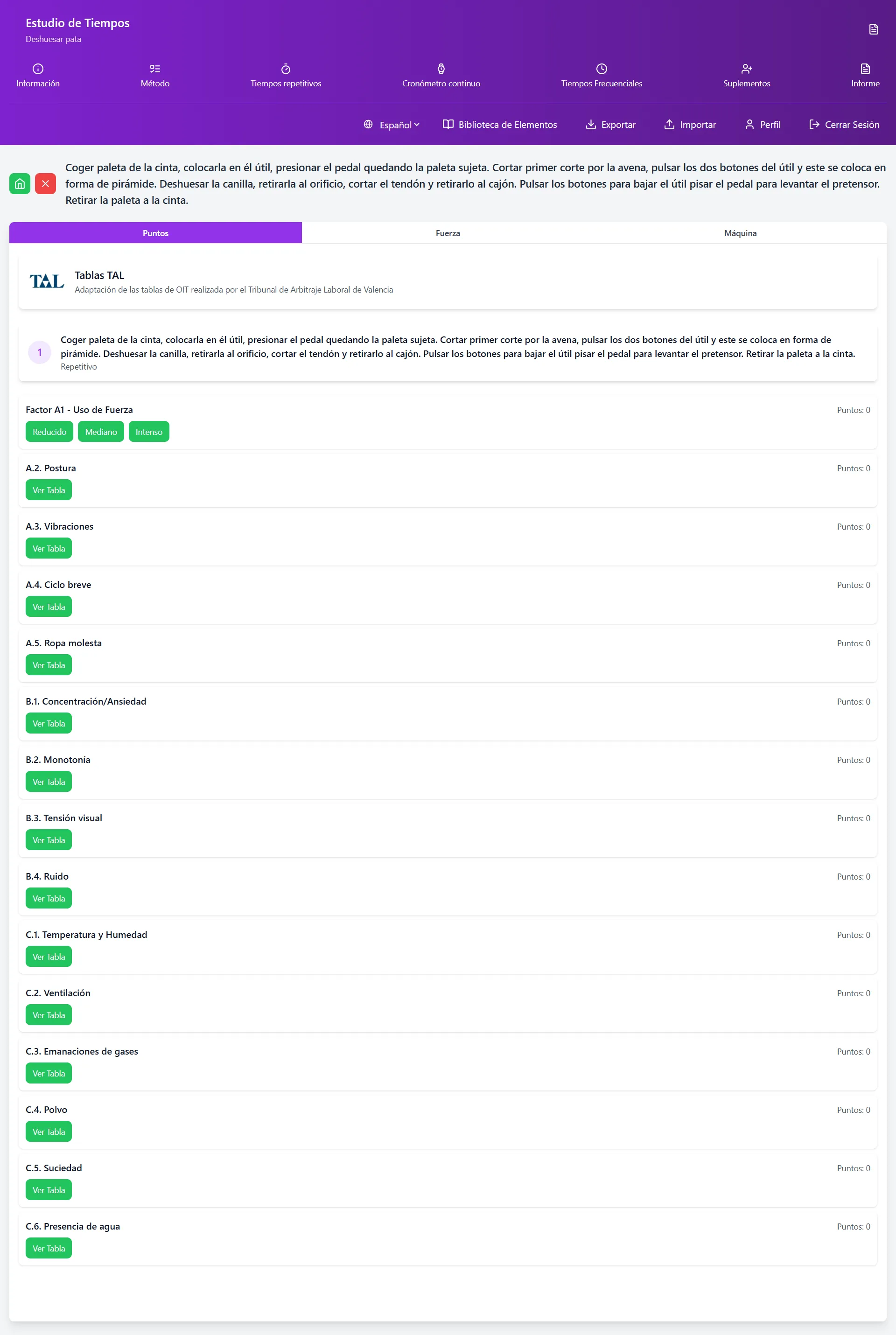
For a standard time to be truly fair and sustainable, it must systematically incorporate fatigue and personal needs allowances. This is where the allowance tables of the International Labour Organization (OIT) acquire an irreplaceable strategic value. These tables are not a mere addition, but a scientific component that compensates for accumulated physical and mental fatigue, basic physiological needs and the unavoidable interruptions that occur during the working day. Accurate application of these allowances ensures not only the viability of production targets, but also health, morale and talent retention, critical elements for long-term operational resilience.
Understanding OIT Allowances: Key Concepts and Types
In methods and time engineering, allowances are defined as percentages added to the normal time (also known as basic time or leveled observed time) of an operation. Their purpose is to allow the operator to recover energy, attend to personal needs and cope with unavoidable delays, thereby maintaining a normal and sustained work pace throughout the working day. The OIT categorizes these allowances to facilitate their systematic evaluation and application.
Fixed Allowances: Personal Needs and Basic Fatigue
These allowances are universal in nature and apply to every worker, regardless of the specific task performed, since they cover physiological needs and a minimum fatigue inherent to any work activity.
- For Personal Needs (PN): Cover unavoidable physiological interruptions, such as going to the bathroom, drinking water or making minor clothing adjustments.
- Typical OIT Range: A general range of 4% to 7% of normal time is established. Common industrial practice adopts 5% as the base value under standard conditions, adjusting upward in environments with high temperatures, difficult access to facilities or high fluid intake (e.g., work in heat).
- For Basic Fatigue (BF): Recognizes the fatigue inherent in the mere performance of a prolonged work activity, even under the most optimal conditions. It is compensation for the minimum physical and mental recovery required.
- Typical OIT Range: 4% to 5% of normal time is usually applied. 4% is widely accepted as the lower value for light-effort tasks, increasing marginally if mild fatigue conditions not covered by other variable allowances are perceived.
Variable Allowances: Environmental Factors and Workload
These allowances are the pillar of fair measurement, since they are granted according to the intrinsic characteristics of the workstation, the operating environment and the load imposed on the operator. Their correct determination requires a detailed and objective analysis of the conditions.
- For Working Position: Evaluates the postural discomfort and physical demand associated with the maintained posture.
- Example Ranges (incremental):
- Comfortable sitting, natural posture: 0%
- Standing, working at waist level: 1%
- Standing, with slight bending, frequent use of pedals: 2-3%
- Awkward or forced position (e.g., squatting, kneeling, arms above shoulder level intermittently): 5-7%
- Very forced or restrictive position (e.g., lying under equipment, arms constantly extended): 8-10%
- Example Ranges (incremental):
- For Effort or Use of Muscular Force (Load Handling): Quantifies the physical effort associated with lifting, pushing or dragging weights, considering weight, frequency, distance and posture.
- Example Ranges (depending on weight and frequency):
- Light handling (up to 2.5 kg): 0%
- Moderate handling (5-10 kg, occasional): 2-4%
- Heavy handling (15-25 kg, intermittent, with proper posture): 8-15% (requires detailed ergonomic analysis and assistive tools)
- Very heavy handling (>25 kg, repetitive): May exceed 15% and often indicates a need for workstation reengineering or the use of mechanical aids.
- Example Ranges (depending on weight and frequency):
- For Visual Strain: Evaluates the eye concentration required and the visual acuity demanded by the task.
- Example Ranges:
- Normal vision, work with large parts: 0%
- Fine precision, reading scales, assembling small components: 2-4%
- Very fine and continuous inspection, work with microscopes or high-density screens: 5-8%
- Example Ranges:
- For Noise: Noise exposure level and its impact on concentration and auditory fatigue.
- Example Ranges (measured in dB(A)):
- Low (normal conversation, <60 dB): 0%
- Moderate (noisy office, 60-75 dB): 1-2%
- Loud (workshop with machinery, use of hearing PPE, 75-90 dB): 3-5%
- Very loud (>90 dB, continuous): 6-8% (implies risks to hearing health and the need for additional corrective measures)
- Example Ranges (measured in dB(A)):
- For Atmospheric Conditions (Temperature, Humidity, Ventilation): Significant deviations from the thermal comfort zone.
- Example Ranges (assuming appropriate clothing and acclimatization):
- Thermal comfort (18-24°C, 40-70% RH): 0%
- Moderate cold/heat (e.g., work at 10-15°C or 25-30°C): 2-5%
- Extreme (e.g., cold storage chambers, furnaces, >35°C or <5°C): 8-15% (implies staff rotation, specialized PPE and specific assessment).
- Example Ranges (assuming appropriate clothing and acclimatization):
- For Monotony Risk: Repetitive, short-cycle work that can induce mental fatigue, loss of attention and boredom.
- Example Ranges:
- Varied task, long cycle: 0%
- Medium-cycle repetitive task, with some autonomy: 1-2%
- Highly repetitive, monotonous task, very short cycle (e.g., simple assembly line): 3-5%
- Example Ranges:
- For Mental Strain: Cognitive load, responsibility, need for rapid decision-making, constant vigilance or complex interaction.
- Example Ranges:
- Low (routine tasks, pre-established decisions): 0%
- Medium (routine quality control, solving simple problems): 2-3%
- High (critical supervision, solving complex problems under pressure, control of hazardous processes): 5-8%
- Example Ranges:
Special Allowances: Managing Unavoidable Contingencies
These allowances are intended to cover minor delays and interruptions that, although unavoidable, are not part of the normal operating time and are not large or predictable enough to be measured and leveled directly in the time study.
- Typical OIT Range: 2% to 5% of normal time is usually applied for general contingencies. This includes small machine adjustments, brief waits for material or information, interruptions by supervisors or colleagues, or the need to clean the work area. It is crucial to differentiate these from major delays (e.g., major breakdowns, prolonged lack of material, complex tool changes), which must be managed as planned or unplanned non-productive times, not as allowances.
Standard Time Calculation Methodology with Allowances
Once all the allowances applicable to a task have been determined, the standard time is calculated using the following formula:
Standard Time (ST) = Normal Time (NT) × (1 + Total Allowances / 100)
Where the Total Allowances are the arithmetic sum of all the fixed, variable and special allowance percentages applicable to the workstation and the operator. For example, if the normal time of a task is 1.0 minute and the sum of allowances is 15%, the standard time would be: 1.0 min × (1 + 15/100) = 1.15 minutes.
Current Impact of OIT Allowance Tables in Industry
OIT allowance tables are, in practice, the globally recognized standard in industrial engineering for determining standard times that are equitable and sustainable. Their implementation directly impacts:
- Accuracy of Production Planning and Scheduling: They make it possible to establish realistic capacities and reliable delivery dates.
- Unit Cost Calculation: They directly influence direct labor and, consequently, product cost, affecting pricing and profitability decisions.
- Design of Fair Incentive Systems: An incorrect standard time can demotivate workers or, conversely, create an economic imbalance in piece-rate bonus systems.
- Ergonomic and Workload Assessment: They provide a quantitative framework for understanding the real demand of a workstation, essential for risk prevention and the design of healthy workstations.
Common Challenges in Applying Fatigue and Rest Allowances
Despite their undeniable value, the application of OIT allowances is not without challenges:
- Subjectivity: The assignment of certain variable allowances, especially those related to mental strain or monotony, can become subjective if the time study analyst team lacks advanced training or unified criteria.
- Resistance to Change: Reviewing or introducing allowance tables may generate reluctance from management (if times increase) or from workers (if an unfair reduction in rest is perceived), making transparent, data-based communication essential.
- Outdated Data: Work methods, technology and environmental conditions evolve. Static allowance tables will not reflect this reality, leading to unrealistic standard times and, consequently, distortions in productivity and OEE (Overall Equipment Effectiveness).
- Lack of Ergonomic Auditing: The failure to integrate objective ergonomic assessments can lead to underestimating or overestimating critical allowances, especially those related to posture or muscular effort.
Data and Authoritative Arguments: Costly Errors and the Benefits of Precise Application
The International Labour Organization (OIT) has been a pioneer in validating the need to compensate for fatigue and personal needs, based on decades of physiological and ergonomic research. Ignoring these guidelines has tangible consequences:
- Standard Time Errors: Operational efficiency studies show that inadequate calibration of allowances can introduce errors in standard times of up to 20-30%. This directly impacts OEE, artificially inflating performance or underestimating real production capacity, resulting in flawed planning and unattainable targets.
- Impact on Human Capital: A standard time underestimated due to insufficient allowances leads to chronic overexertion. This translates into an increase in workplace absenteeism in the range of 8-12% in high-demand environments, higher staff turnover (with the consequent recruitment and training costs) and a deterioration of the work climate.
- Labor Disputes: The perception of unfairness in work paces is a frequent cause of union grievances and labor disputes, which negatively affect morale, cooperation and, ultimately, effective productivity.
Spanish Legal Framework and Its Convergence with Fatigue and Rest Management (2025)
Although there is no Spanish law that mandates the specific use of the OIT Allowance Tables, their application aligns perfectly with the spirit and the letter of labor and occupational risk prevention legislation. The trend for 2025, with a growing focus on occupational health and psychosocial risks, reinforces the need for tools such as the OIT allowances.
Occupational Risk Prevention Act (LPRL) and the Requirement of Occupational Health
Act 31/1995 on Occupational Risk Prevention (LPRL) is the fundamental pillar. It requires the employer to guarantee the safety and health of workers in all aspects related to work, which includes assessing risks arising from physical and mental workload, work organization and fatigue.
- 2025 Outlook: A clear trend is observed toward deeper assessment and management of psychosocial and ergonomic risks. Labor inspections are already placing increasing emphasis on workload, recovery times and their health consequences. A methodical and documented application of the OIT allowances acts as a proactive and defensive tool to quantify and mitigate fatigue, demonstrating a real commitment to the LPRL.
Workers' Statute and Collective Bargaining
Royal Legislative Decree 2/2015, approving the recast text of the Workers' Statute Act (ET), establishes the general regulation of working hours, minimum daily and weekly rest periods, and holidays. Although it does not go down to the level of micro-breaks for inherent fatigue, it does lay the groundwork for working conditions, as defined by the LPRL, to allow such breaks to be taken.
- Collective Bargaining: Sectoral and company-level collective agreements are the forum where many working conditions are specified, including work paces and, in some cases, bonus systems linked to standard times. Companies that have transparent and fair work measurement systems, based on methodologies recognized such as those of the OIT, are in a much stronger position to negotiate and justify their productivity models. The trend is for agreements from 2025 onward to place greater emphasis on work sustainability and employee well-being.
ISO Standards and Their Indirect Relevance to Allowances
Although they are not laws, standards such as ISO 9001 (Quality Management) and ISO 45001 (Occupational Health and Safety Management Systems), once adopted, imply compliance with requirements that indirectly call for the optimization of workstations and the consideration of human factors. Rigorous management of standard times with OIT allowances contributes to the continuous improvement of processes (ISO 9001) and to the prevention of occupational risks associated with workload (ISO 45001).
Consequences of Poor Application before the Labor Inspectorate
Poor application of fatigue and rest allowances, resulting in unrealistically tight standard times and excessive workloads, can have serious consequences:
- Penalties: The Labor and Social Security Inspectorate may impose significant financial penalties for breaches of the LPRL regarding workload, ergonomics and psychosocial risks.
- Labor Claims: Risk of lawsuits for work-related stress, musculoskeletal injuries or harassment through unattainable targets.
- Deterioration of Corporate Reputation: Negative impact on the company's image, making it harder to attract and retain talent.
Optimizing Work Measurement with Cronometras: Our Methodology
Cronometras is your go-to consultancy for technical productivity optimization, with an ethical and sustainable focus on human capital. Our methodology integrates best practices from methods and time engineering to ensure a rigorous, objective and up-to-date application of the OIT allowance tables.
Professional Diagnosis and Audit of Time Study Systems
We begin with a comprehensive analysis of your current processes. This includes an audit of the existing time study methodology, the way allowances are applied, and the identification of deviations, subjectivities and opportunities for improvement in order to standardize criteria and ensure impartiality.
Advanced Methods Engineering: Industrial Time Study, MTM, MOST and Work Sampling
Our approach to work measurement is comprehensive and multifaceted:
- Industrial Time Study: Application of time study techniques with proper performance rating, to establish accurate normal times, adjusted to the pace of a qualified operator.
- Predetermined Time Systems (PTS): We use MTM (Methods-Time Measurement) and MOST (Maynard Operation Sequence Technique) for micromotion analysis. These tools make it possible to break tasks down into basic elements and assign predetermined times to them, which reduces the variability and subjectivity inherent in time study, as well as facilitating the design of optimized methods.
- Work Sampling: The implementation of advanced tools such as WorkSamp for work sampling studies makes it possible to accurately quantify the proportions of time devoted to various activities, facilitating a more objective determination of allowances for contingencies and unavoidable delays, and providing a granular view of time utilization.
Development of Customized, Ergonomics-Based OIT Allowance Tables
We go beyond applying generic values. Cronometras designs OIT allowance tables specifically tailored to the conditions of your company, sector and each workstation. This involves:
- Objective Ergonomic Assessment: Integration of validated ergonomic assessment tools (e.g., REBA, RULA, NIOSH for load lifting) to rigorously quantify postural load, physical effort and biomechanical factors, objectively grounding the variable fatigue allowances.
- Environmental and Psychosocial Analysis: Consideration of the environmental (noise, temperature, lighting) and psychosocial factors specific to your plant (monotony, mental strain, responsibility) for the precise determination of the corresponding allowances.
Specialized Training for Engineering and Production Teams
We offer advanced training programs for industrial engineers, plant managers and time study analysts. Our training focuses on the correct application, interpretation and technical justification of the OIT, MTM and MOST allowance tables, promoting consistency of criteria and the development of a culture of precision and fairness.
Integration of Technological Solutions for Time Management
We advise on the implementation and optimization of time management software that incorporates allowance calculation in an automated and parametric manner. For efficient time management and production control, integration with technology platforms such as Induly is essential. Production control software like Induly enables not only real-time data collection of work cycles, but also the parametric management of standard times, including the automated application and dynamic updating of the OIT allowances. This provides uninterrupted visibility over OEE and performance, ensuring that any variation in the allowances or in the work methods is reflected instantly in productivity metrics.
Investment in OIT Allowances: Profitability, Sustainability and Workplace Well-Being
The correct application of the OIT allowance tables is not a cost, but a strategic investment with multiple returns:
- Impact on Financial Accuracy and Profitability: Realistic standard times enable competitive pricing, accurate estimation of labor costs and greater reliability in financial and investment planning.
- Promotion of Sustainable Productivity and Quality: Achievable and equitable work paces minimize fatigue, reduce the risk of errors and accidents, and help maintain product quality and long-term efficiency.
- Proactive Regulatory Compliance and Corporate Reputation: Demonstrating an active commitment to worker health and safety, anticipating regulatory requirements and improving the company's image and social responsibility.
- Improved Workplace Well-Being and Talent Retention: A fair work environment that values human effort translates into greater motivation, lower absenteeism, reduced turnover and a greater ability to attract and retain qualified professionals.
Essential Strategies for Optimal Productivity and Human Capital Management
For organizations committed to operational excellence and the well-being of their workforce, Cronometras proposes the following key strategies:
- Implement Periodic Audits and Continuous Training: Ensure that time studies and allowance tables are reviewed and updated regularly, and that key personnel are always trained in the latest methodologies and best practices.
- Integrate Ergonomic Analysis and Transparent Communication: Make ergonomic analysis an inherent part of the methods and time study, and foster open and constructive dialogue with workers and their representatives about how times and rest periods are calculated.
- Consider the Support of Specialized Methods and Time Engineering Consultants: To guarantee objectivity, the application of advanced techniques (MTM, MOST, work sampling) and expertise in customizing allowances, collaboration with external experts is invaluable.
Investing in accurate and humane work measurement, through the correct application of the OIT allowance tables, is a strategic investment in the competitiveness, sustainability and operational excellence of your organization.
DATA: TECHNICAL REPORT: In-Depth Analysis of the OIT Allowance Tables for Calculating Fatigue and Rest in Work Measurement
Consultancy: Cronometras Lead Researcher: [Senior Market Researcher Name - Assumed by the AI] Date: October 25, 2023 Product/Service: Methods and Time Engineering Consulting
Don't want to do it yourself? We do it for you from €800
If you prefer to outsource it, Cronometras delivers a complete time and motion study from a single video: elemental breakdown, OIT/TAL fatigue allowances, standard time with tolerances, and a report in PDF + Excel + JSON ready to present to management.