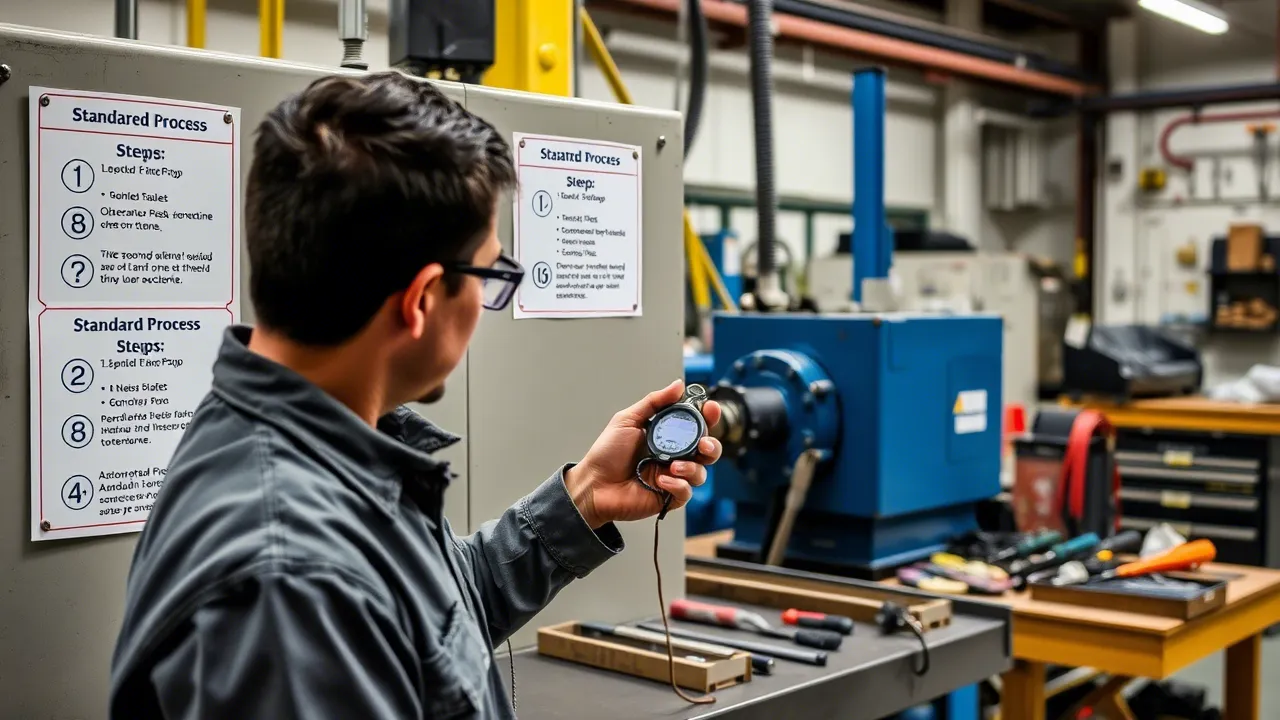
Did you know that a poorly designed incentive system can reduce productivity instead of increasing it? Bonus plans based on standard times are one of the most powerful tools in industrial engineering, but also one of the worst implemented. When they work, they align the interests of the worker with those of the company, reduce unit costs and improve job satisfaction. When they fail, they generate conflict, wage inflation without productivity gains and a deterioration in quality.
In this article, we explore how to design, calculate and implement wage incentive systems based on standard times, from the historical foundations to current best practices with digital tools such as CronometrasApp.
The Foundations: Why Incentives Matter
The principle is simple: if a worker produces more in the same amount of time, they generate more value for the company. An incentive system transfers part of that additional value to the worker, creating a virtuous circle. Frederick W. Taylor identified it as early as the beginning of the 20th century: "the principal obstacle to attaining maximum productivity is the natural tendency of workers to systematic soldiering".
Modern studies confirm that well-designed incentive systems can increase productivity by between 15% and 35% without additional investment in machinery. The key lies in the standard times: without accurate and fair measurement of work, any bonus plan is doomed to fail.
Standard Time as the Basis of the Incentive
Standard time is the time required for a qualified operator, working at a normal pace, to complete a specific task following the established method. It is calculated using the fundamental formula of industrial time study:
Where:
- = Standard time
- = Normal time (observed time × performance rating factor)
- = Allowances (expressed as a decimal fraction; typically 0.10 to 0.25 according to ILO tables)
This standard time becomes the unit of measure on which the entire incentive system is built. If the standard is too loose, workers will earn bonuses without real effort and costs will skyrocket. If it is too tight, demotivation and conflict are guaranteed. Accuracy in measurement is non-negotiable.
Main Types of Incentive Systems
There are three major families of wage incentive systems. Each has its own advantages, disadvantages and specific calculation formulas.
1. Piece Rate System
The oldest and simplest: the worker is paid a fixed amount for each unit produced. It is suitable for repetitive work where quality is easy to verify and the pace depends entirely on the operator.
Formula for calculating the piece rate:
Where:
- = Piece rate (€/unit)
- = Base hourly wage (€/hour)
- = Standard time in minutes per unit
Practical example: If the base wage is 12 €/hour and the standard time is 3 minutes per piece:
A worker who produces 250 pieces a day would earn 150 €, compared to the base wage of 96 € (8 hours). The bonus is 54 € and the company obtains 50 additional pieces.
Advantages: Easy to understand and calculate, direct motivation, predictable unit costs.
Disadvantages: May sacrifice quality for quantity, does not encourage teamwork, difficult to apply in non-standardized tasks.
2. Halsey Plan (Time-Saved Bonus)
Developed by Frederick A. Halsey in 1891, this system shares the benefit of the time saved between the company and the worker. It is more conservative than pure piece rate and protects the company against imperfect standards.
Formula for the standard Halsey Plan (50-50):
Where:
- = Total daily wage
- = Standard time for the task (hours)
- = Actual time taken (hours)
- = Base hourly wage
- = Worker's share percentage (typically 0.50 in Halsey 50-50)
Total wage with the Halsey Plan:
Practical example: Standard time = 8 hours, actual time = 6 hours, base wage = 12 €/hour:
The total saving was 24 € (2 hours × 12 €/hour), shared on a 50% basis: 12 € for the worker, 12 € for the company.
3. Rowan Plan
Similar to Halsey but with a decreasing incentive curve: the bonus percentage decreases as the time saving increases, which discourages pushing the pace excessively.
Formula for the Rowan Plan:
Practical example with the same data: Standard time = 8 h, actual time = 6 h, base wage = 12 €/hour:
With Rowan, the bonus is higher for moderate savings (18 € versus 12 € with Halsey 50-50) but grows more slowly for large savings, protecting against overexertion.
4. Bedaux / B-Point System
The Bedaux system measures work in B points, where one B point is equivalent to one minute of work at normal pace including proportional rest allowance. Standard output is set at 60 B points per hour (60 B/h).
Calculation formula:
Where are the B points produced. The worker receives 75% of the value of the points produced above the standard, with the company retaining the remaining 25% to cover indirect costs.
Comparison of Systems: Which One to Choose?
| System | Worker's Share | Risk for the Company | Complexity | Recommended for |
|---|---|---|---|---|
| Piece rate | 100% of the saving | High | Low | Highly repetitive and standardized tasks |
| Halsey 50-50 | 50% of the saving | Medium | Medium | Standards in the tuning phase |
| Rowan | Decreasing with the saving | Low | Medium | Work with a risk of excessive fatigue |
| Bedaux | 75% of the saving | Medium | High | Large plants with multiple operations |
The choice depends on several factors: the accuracy of the standard times, the nature of the work, the organizational culture and the applicable legal framework. In Spain, the Workers' Statute allows incentive systems provided they are negotiated with the workers' legal representatives and the minimum wage guarantees are respected.
What About the Gantt System?
The Gantt plan (Henry L. Gantt, 1910) guarantees the base wage even if the standard is not reached and pays a fixed bonus (typically 20-50%) when 100% of standard output is reached or exceeded. It is suitable for apprentices and start-up phases of new processes, since it eliminates the penalty for low performance during the learning curve.
Practical Implementation in 7 Steps
Step 1: Establish Reliable Standard Times
Without accurate times, the system is stillborn. The time study must be carried out with rigorous methodology:
Where is the number of observations required, the value of the normal distribution for the desired confidence level, the standard deviation, the observed mean and the allowable error.
Tools such as CronometrasApp automate this calculation and eliminate human error in time taking through a digital stopwatch with lap/reset and cumulative modes, voice entry for hands-free operation and customizable element libraries that speed up the building of standards.
Step 2: Define the Unit of Measure
Output can be measured in pieces, kilograms, meters, completed operations or B points. The unit must be objective, verifiable and directly attributable to the worker's effort. Avoid composite or ambiguous units that generate disputes.
Step 3: Calculate the Base Rate and the Bonus
Determine the guaranteed base wage (legal or collective agreement minimum) and the bonus formula. Simulate scenarios at different performance levels (80%, 100%, 120%, 150%) to verify that:
- At 100% performance, the worker earns the base wage
- At 120% performance, the bonus is attractive but not excessive
- The company's unit costs decrease as output increases
Step 4: Establish Quality Controls
Every incentive system must incorporate mechanisms that prevent quality being sacrificed for quantity. Common options:
- Quality clause: the bonus is only paid if the percentage of defects is below the established threshold (e.g. < 2%)
- Corrective factor: multiply the bonus by a quality index ($I_c$) that penalizes defects
- Operator responsibility: the worker bears the cost of reworking defective pieces
Step 5: Communicate with Transparency
Distrust is the main enemy of incentive systems. Each worker must understand exactly:
- How their standard time was calculated
- What factors influence their daily/weekly bonus
- How the quantities produced are recorded and verified
- Whom to contact in the event of a discrepancy
Documenting the standards, sharing the spreadsheets and running training sessions before launch is an investment that avoids future conflicts.
Step 6: Trial Period and Adjustment
Implement for 4-8 weeks with the following rules:
- The bonus is calculated but paid as a recoverable advance
- Daily incidents are recorded: machine stoppages, material shortages, quality problems
- The standards are adjusted if systematic errors are detected
After the trial period, the final standards are consolidated and the agreement is signed with the workers' representatives.
Step 7: Continuous Monitoring
An incentive system is not static. It should be reviewed when:
- New machinery or technology is introduced
- The working method changes
- Raw materials or product specifications are modified
- More than 2 years pass without review (obsolescence of the standard)
Continuous monitoring with time study software makes it possible to detect deviations before they become structural problems.
Common Mistakes You Must Avoid
Mistake 1: Standards Based on Historical Data
Using historical averages without an actual time study is the perfect recipe for inflated standards. If historically 100 units/day were produced with systematic soldiering, setting 100 as the standard perpetuates the inefficiency. Always carry out a fresh time study with scientific methodology.
Mistake 2: Ignoring Allowances
A standard without allowances for fatigue, personal needs and contingencies is unachievable in the long term. The ILO tables provide reference values that must be adapted to the actual conditions of the workstation.
Mistake 3: Overly Complex System
If a worker needs a calculator and 10 minutes to work out how much they will earn today, the system fails. Simplicity is essential: the worker must be able to estimate their bonus mentally in real time.
Mistake 4: Not Updating the Standards
A system that worked in 2020 can be profoundly unfair in 2026 after changes in machinery, layout or methods. Periodic review is not optional.
Mistake 5: Forgetting Teamwork
Purely individual systems can generate destructive competition: withholding information, sabotage between colleagues and refusal to help new employees. Combining individual incentives (60-70%) with group incentives (30-40%) usually yields better results.
The Role of Technology: CronometrasApp in Incentive Systems
The accuracy of the standard times determines the success or failure of the incentive system. CronometrasApp provides capabilities that transform this process:
- Dual digital stopwatch: lap/reset and cumulative modes with hundredths-of-a-second accuracy to capture every element of the work cycle
- Voice entry: the analyst dictates observations and performance ratings without taking their eyes off the operator, reducing transcription error
- Customizable element libraries: standard times are built by reusing previously timed elements, speeding up the rollout of standards for new products
- Automatic calculation of ILO allowances: the app applies the allowance tables for posture, effort, environmental conditions and monotony, ensuring fair and defensible standards
- Export to Excel and PDF: standards and bonus sheets are shared transparently with supervisors and operators
- Collaborative work in organizations: several analysts can work simultaneously in the same plant, consolidating data in real time
- Offline operation as a PWA: the app works without a connection on the shop floor and synchronizes once coverage is regained
The difference between a standard based on 5 quick time studies and one built with 30 statistically validated observations is the difference between an incentive system that works and one that generates union conflicts.
Conclusion: Accuracy Pays Off
Wage incentive systems based on standard times are one of the most effective levers for improving industrial productivity without capital investment. Their success depends on three pillars: accurate standard times, fair bonus formulas and transparent communication.
The difference between an incentive system that increases productivity by 25% and one that generates conflict and staff turnover comes down, in most cases, to the quality of the standard times that support it. Rigorous time study is not an expense: it is the investment that determines the return on the entire bonus system.
In the era of Industry 4.0, digital time study tools have removed the technical barriers that traditionally made the implementation of incentive systems difficult. The question is no longer whether your plant can afford to implement a time-based bonus system, but whether it can afford not to.
Don't want to do it yourself? We do it for you from €800
If you prefer to outsource it, Cronometras delivers a complete time and motion study from a single video: elemental breakdown, OIT/TAL fatigue allowances, standard time with tolerances, and a report in PDF + Excel + JSON ready to present to management.