An unscheduled breakdown is, before it is a technical emergency, an economic one. According to figures cited in open sources and attributed to Boeing (via Wikipedia, "Aircraft on ground"), each hour of an aircraft standing idle costs between 10,000 and 20,000 USD for a single-aisle commercial aircraft, and up to 150,000 USD per hour for a widebody on long-haul routes with high density. To that bill are added passenger re-accommodation, lost slots and possible compensation.
But the problem starts before the breakdown. When your organization does not know how long each task really takes, it cannot plan the hangar, nor promise a deadline to the airline, nor quote with confidence: commitments are made on estimation and experience, shifts are wrongly sized and some contracts are signed at a loss without knowing it. And in aviation there is an aggravating factor: time data that does not withstand an audit is useless for decision-making, because the regulations require every intervention to be reconstructed piece by piece, signature by signature.
What is happening in your organization
Four causes explain almost everything in an MRO (Maintenance, Repair and Overhaul):
- The manual time is not the real time. Every intervention must be carried out in accordance with the manufacturer's AMM (Aircraft Maintenance Manual) or SRM (Structural Repair Manual), and any deviation from the manual invalidates the certificate of airworthiness. But almost nobody records the difference between what the manual says and what the task really costs. The result: plans that are not met and quotations that go out of balance.
- A huge part of the shift is not work on the aircraft. Waiting for parts, waiting for documentation, waiting for the licensed supervisor who has to sign. As long as these waits are not measured separately, the problem is blamed on the crew when it lies in logistics.
- Profiles that are not interchangeable are mixed together. The Part-66 licence (Regulation (EU) No 1178/2014, Annex III) defines categories with different scopes: A (minor line maintenance tasks and simple tasks in Part-145 organizations), B1 (structure, powerplants and mechanical/electrical systems, excluding complex avionics), B2 (electrical systems, avionics and instrumentation) and B3 (non-pressurized piston aircraft of 2,000 kg or less). The same item — for example, "replacement of pitot probe" — can be analyzed as a mechanical or an avionics task depending on the manual, with different time series. Mixing the series inflates the dispersion and breaks any forecast.
- Measurement is not hooked up to traceability. EASA Part-145 (Reg. EU 1321/2014) requires every maintenance to be documented and released with the applicable maintenance data (145.A.45 and 145.A.50) and adequate equipment and tools to be available (145.A.40). A time record that does not link to that documentary chain does not audit: it only describes.
Reg. (EU) 1321/2014 (Annex II, numbered 145.A.*; the maintenance data requirement is 145.A.45) is available in the official EASA document library (https://www.easa.europa.eu/en/document-library/regulations/commission-regulation-eu-no-13212014). Three points weigh on your time system. First: the maintenance organisation exposition (the MOE, Maintenance Organisation Exposition, required by 145.A.70 for Part-145 organizations; the aircraft maintenance program is regulated separately, in M.A.302) must declare how each task is planned, carried out and recorded — if your time tool is not cited there, it is not compliant. Second: M.A.501 (Classification and installation) requires installed components to be traceable by means of the EASA Form 1, so each measured time must be linked to the Form 1 of the part. Third: 145.A.35 (certifying staff, with current licence and type rating) and 145.A.50 — Certification of maintenance require the Certificate of Release to Service (CRS) signed by the B1/B2 certifier to identify the work performed. In other words: your time data must be linked to the signed CRS in the same workflow, not afterwards.
How it is solved: measure to decide, not to control anyone
In aircraft maintenance you do not measure the worker: you measure the certified process. And measuring has a single purpose: to know what each intervention costs you in order to plan, quote and commit to deadlines with data. Three different questions, three approaches.
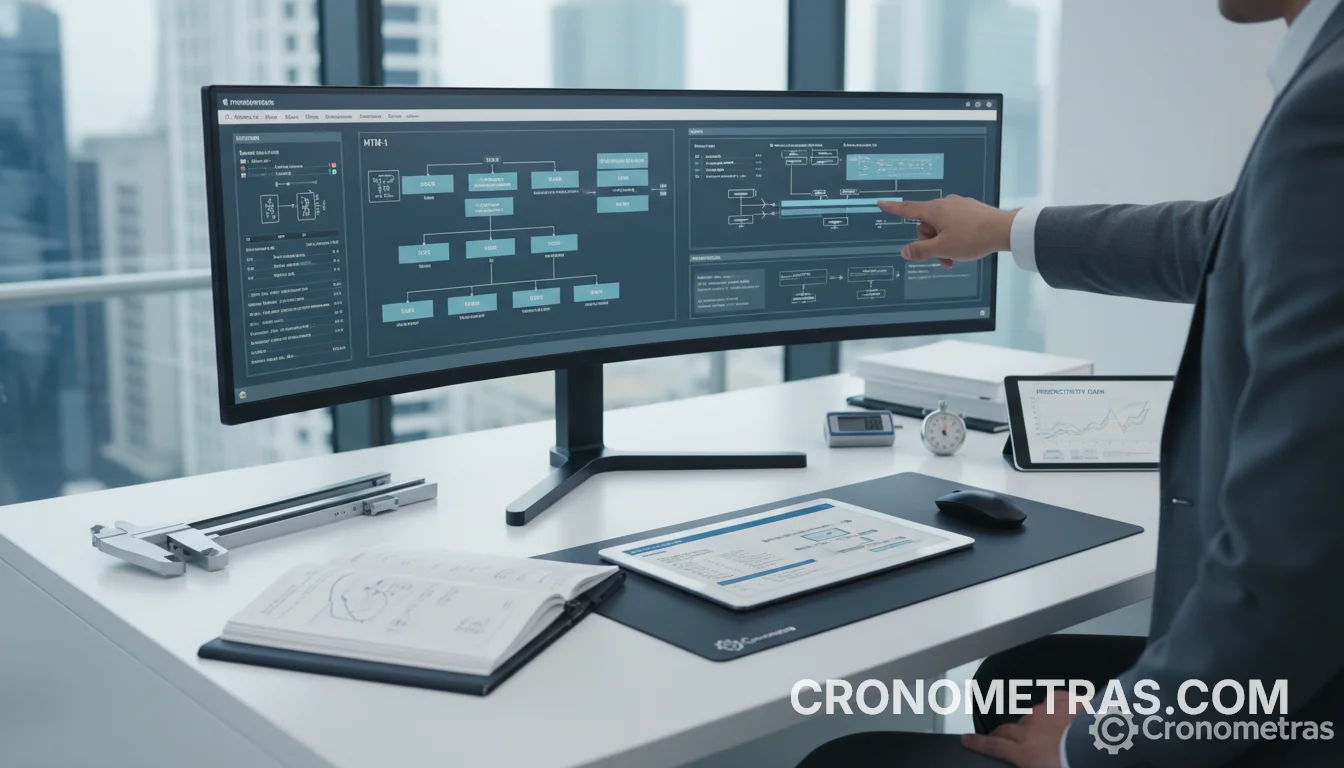
1st. What does each recurring task really cost? The answer is the standard time: what it costs to carry out an intervention in your plant and the basis for planning. It is obtained by time studying high-rotation tasks —A-checks, B-checks, the visual inspection phase of C-checks, brake, tire, filter and sensor changes, engine or APU (Auxiliary Power Unit) bench tests— breaking them down into elements. Cronometras fits in here: stopwatch time study (Multi Crono system), ILO and TAL allowances, synthetic performance rating and standard time calculation, with export to PDF/Excel/JSON. With that data you decide what each task costs, what deviation exists with respect to the manual and what to promise at what price. This approach is not suitable for unstructured diagnosis, for one-off repairs after bird strike or FOD (Foreign Object Damage), nor for modifications documented by SB (Service Bulletin), where the manual itself sets the times and signatures.
2nd. Where does the shift go when no work is being done on the aircraft? The answer comes from work sampling: random observations throughout the shift, with the activity classified into categories —VA (work that adds value), VA-WAIT (correct position with the cycle blocked upstream, e.g. waiting for the Ground Power Unit), NVA (movements to the tool store, briefings), IMP-FAULT (waiting for a part), IMP-LOG (waiting for documentation or for an available B1/B2 supervisor to sign), IMP-PERSONNEL (scheduled breaks and meals)—. The WorkSamp application calculates the number of observations needed for a reliability of 95 %. It is used to detect bottlenecks at traffic peaks and to compare shifts.
3rd. What is the minimum theoretical time of an intervention, to negotiate an SLA with numbers? For that there are predetermined time systems: MTM-1 (Methods-Time Measurement, first edition 1948), MTM-UAS (Universal Analysis System) and, for MRO, process block systems such as MTM-MEK (unit production and small series). They break the task down into basic motions —reach, move, turn, apply pressure, release— each with an assigned time; documented in the post "Introduction to MTM-1: The Gold Standard in Predetermined Times". They add value on rotable overhaul lines (engines, hydraulic pumps, generators, APU), in wiring and electrical harness assembly and in rigging operations; they add no value in avionics system diagnosis, in fuselage repair after impact or in detailed visual inspection.
In AOG tasks the object of measurement changes. You do not measure one cycle, but three segments with very different dispersions: the response time (from notification to the first mechanic on the aircraft, dominated by parts logistics), the diagnosis time (until the cause is isolated, which is cognitive time) and the effective repair time (where elementary decomposition techniques recover all their value). Separating them lets you know where to attack first: if the problem is the part, pushing the mechanic is pointless.
What your time system must be able to demonstrate
Twelve points to validate before implementing anything:
- The MOE cites the time measurement system as a planning tool (see M.A.602).
- The statistical series separate the Part-66 categories (A, B1, B1+B2 combined, pure B2 and B3); they are not mixed.
- Each measurement carries the AMM task card id (or ATA chapter), the AMM revision id, the Part-66 worker id, timestamp and id of the signed CRS.
- The measured time is linked to the EASA Form 1 issued for each certified component; without this it does not audit.
- The capture tool is calibrated with a standard traceable to a national standard (UNE-EN ISO/IEC 17025).
- The sample size is documented: the application calculates the number of observations needed for a reliability of 95 % per shift, and records it by category.
- When predetermined times are used, the appropriate block system is applied (e.g. MTM-MEK or MTM-UAS), not the generic one.
- A "total time" is never recorded without decomposition into elements: this way it is possible to reconstruct who did and signed each part of the intervention.
- It is validated against the MEL (Minimum Equipment List) and the CDL, so that a task the manual allows to be deferred is not measured as outstanding (this distorts slot planning).
- The system alerts when a task card exceeds its standard by more than a threshold defined in the MOE (typical 15–25 %, indicative example).
- The documentation of the studies from the last 12 months is ready for supervision by the competent authority (EASA or AESA).
- Whoever measures knows the EASA Part-145 and Part-66 framework: no licence is needed, but good judgement is.
A compliance note that almost nobody connects: the measurements generate activity records per mechanic, and this overlaps with the daily working time record required in Spain by Real Decreto-ley 8/2019. Ramp maintenance personnel are also subject to the human factors requirements of Part-145 (flight and duty times, FTL, apply to flight crews, not to maintenance personnel). The efficient approach: dump each observation into the working time record as well, avoiding double capture and the associated errors.
Simulated practical case
Simulated practical case. Example built for teaching purposes. It does not correspond to a real implementation of Cronometras nor to any specific client.
Let us imagine a European MRO with a mixed A320/B737 fleet that records in 2024 a total of 47 AOG events, with an average response time of 1h 22min and an average repair time of 3h 47min (n=47, σ response = 38 min, σ repair = 2h 11min). 62% of the dispersion in response time came from parts logistics: the certified component took a long time to arrive from the store. After a work sampling study on the logistics team, the case envisages redesigning the contract with the urgent transport operator, with the average response time dropping to 54 min over the following 6 months. The decision was not "work faster", but to change the transport contract: the data showed where the money was.
Simulated practical case. Example built for teaching purposes from plausible industry parameters. It does not correspond to a real implementation of Cronometras nor to any specific client.
The second example is an MRO based at a Spanish regional airport that performs line maintenance for a fleet of 12 A320 and 6 B737 aircraft. In the reference period (Q1-2024) it recorded an average of 18 AOG events per month, with an average resolution time of 5h 24min and an estimated average cost of 94,000 USD per event (assuming an average rate of 17,400 USD/h: a conservative assumption within the 10,000–20,000 USD/hour range cited for single-aisle aircraft). The measurement program was organized in three phases:
- Inventory of recurring tasks (6 weeks of observation with stopwatch and video of the 8 most frequent task cards: brake change, tire change, IDG replacement, APU swap, etc.). Result: deviations between the real time and the manual time of −8% to +35% depending on the task.
- Work sampling on the AOG response team (1,200 random observations over 4 shifts, classified into 8 categories: VA, NVA, IMP-FAULT, IMP-LOG, IMP-PERSONNEL, IMP-DOC, IMP-SUPERV, IMP-OTHERS). Result: only 38% of the response mechanic's time was work on the aircraft; 39% was waiting for a part or documentation and waiting for an available B1/B2 supervisor to sign the CRS; 12% was scheduled breaks and meals. The margin for improvement was not in labour, but in logistics and in the availability of signatures.
- Analysis of 3 component overhaul task cards with predetermined times: angle-of-attack sensor change (ATA 34), fuel manifold replacement (ATA 28) and hydraulic pump overhaul (ATA 29). Result: the calculated times were 18% lower than the historical ones, which made it possible to renegotiate the SLA with the client airline.
Results at 6 months:
- Average AOG resolution time: 5h 24min → 3h 51min (reduction of 28.7%).
- AOGs per month: 18 → 11 (reduction of 39% thanks to better preventive maintenance).
- Estimated average cost per AOG: 94,000 USD → 67,000 USD (3h 51min × 17,400 USD/h ≈ 67,000 USD; 27,000 USD less per event, −28.7%).
- Estimated savings with the 18 → 11 AOG/month cadence: 7 AOG avoided × 94,000 USD = 658,000 USD, plus 27,000 USD less on each of the 11 AOG handled = 297,000 USD; total ≈ 955,000 USD/month.
- Estimated annualized cost of the measurement program: 38,000 EUR (consulting + tools + planning time), that is, about 3,200 EUR/month.
- Estimated payback: less than the first month, against estimated monthly savings in the region of 955,000 USD.
This case is simulated: the numerical data are realistic but not attributable to any real client. The methodology itself is cited and replicable. The decisions it enables: renegotiate an SLA, redesign an urgent transport contract, reorder preventive maintenance and rethink the availability of signatures.
What you gain and what you decide
- You know what each intervention costs you and quote with a known margin.
- You plan hangar and shifts on real data, with the deviation with respect to the manual quantified task by task.
- You promise deadlines you can meet, because you know the dispersion of each segment of an AOG, not just its average.
- You negotiate with numbers: the SLA with the airline, the urgent transport contract, signature coverage on shift.
- You decide where to invest first: parts, documentation, supervision or method.
- You face the EASA audit without stress, with each time linked to its task card, its Form 1 and its CRS.
A practical note: for projects shorter than 12 months, subcontracting the study to a specialized engineering firm is usually more cost-effective than a permanent hire. And when it is done well, the result is a system where every AOG reduces its average resolution time by 25-35 % (indicative example), with the program paid back in less than a quarter (indicative example). The regulatory framework cited is public (EASA, EUR-Lex). All that is left is to execute it with the discipline the sector demands.
The next step
If you need to know what each task costs and how long it takes in order to plan and commit with confidence, Cronometras gives you the standard time of each intervention with its ILO and TAL allowances and export to PDF/Excel/JSON, and WorkSamp shows you where your team's shift goes. If you also need a working time record that will withstand an inspection, Induly is industrial time and attendance —mobile app and plant kiosk with name/PIN— designed for medium-sized workforces of between 50 and 500 operators (indicative figure). And if you prefer a single counterpart with turnkey delivery capability (study + implementation + integration with the MOE), at ProdCont you will find fixed packages with predefined scope and price.
Don't want to do it yourself? We do it for you from €800
If you prefer to outsource it, Cronometras delivers a complete time and motion study from a single video: elemental breakdown, OIT/TAL fatigue allowances, standard time with tolerances, and a report in PDF + Excel + JSON ready to present to management.