The problem: shop hours nobody can justify
When a rail operator —RENFE, a private freight operator or a light metro concessionaire— renegotiates the maintenance fee for its fleet, the question is always the same: where does that estimate come from? If the answer is «the shop supervisor calculated it fifteen years ago», the fee collapses. If the answer is «we measured it and here is the record», the negotiation is closed.
Behind it there is money and compliance. The target availability of a commuter car moves within the range 97–99 % (MTBF 720 h, MTTR 8–24 h; illustrative example), and every hour of excess time in the shop is an hour of idle fleet valued at 1.200–1.800 € (illustrative example). A shop that estimates its workloads by eye negotiates badly, plans badly, misses deadlines and reaches the audit without evidence to support its times.
What is happening in your shop
Workloads are estimated, not measured. Without a stopwatch, the hours of an overhaul are calculated by historical rule of three or by comparison with previous jobs. A single IM5 intervention on two bogies of a commuter train accounts for 60 to 90 man-hours (illustrative example), split between pit and bench: on volumes like these, a small estimation error means days of misallocated planning.
Idle time is confused with work. The shop reports waiting times for tooling and pit logistics that in real operation overlap with other tasks: an inflated claim that nobody can defend and that drives up the fee.
The asset is expensive and complex. The rolling stock (train, locomotive, car) is an electromechanical system 18–22 m long (illustrative figure), with bogies, gear units, converters, air-conditioning units, on-board software and pneumatic brake. The tasks have a granularity and an hourly cost far above those of conventional industry, and the jobs are planned by cycle (every X thousands of km or X months), not by failure.
And on top of that there is the regulator. The Agencia Estatal de Seguridad Ferroviaria (AESF), under Ley 38/2015 del Sector Ferroviario, is responsible for the planning, inspection and supervision of safety of the railway system in Spain, both in infrastructure (ADIF / ADIF AV) and in operation (RENFE-Operadora and the private passenger and freight operators). Two direct consequences for your company:
- Rolling-stock conformity with its maintenance plan is a necessary condition to maintain the authorization for placing in service. Skipping a periodic inspection is a major non-conformity.
- Intervention times do not usually appear in AESF audit reports. As an audit guideline practice, a common reference threshold could be a deviation of 10-15 % between the declared time and the measured time, which should be closed before the next campaign.
On top of this comes Europe: interoperability is governed by the Technical Specifications for Interoperability (ETI/TSI) of the European Union Agency for Railways (ERA), and Regulation (EU) 402/2013 on the Common Safety Method for Risk Evaluation and Assessment (CSM-RA) requires documenting the justification of risk decisions in the changes the standard considers relevant to safety. A change in the standard time of a maintenance intervention may affect decisions with safety impact —the duration of a track possession, the interval between inspections or operator fatigue—; it is therefore advisable to document it in the risk assessment under CSM-RA, because poor measurement affects those decisions and the operator is exposed to observation by ERA or its NSA (in Spain, the AESF).
How it is solved: measure to decide, not to control
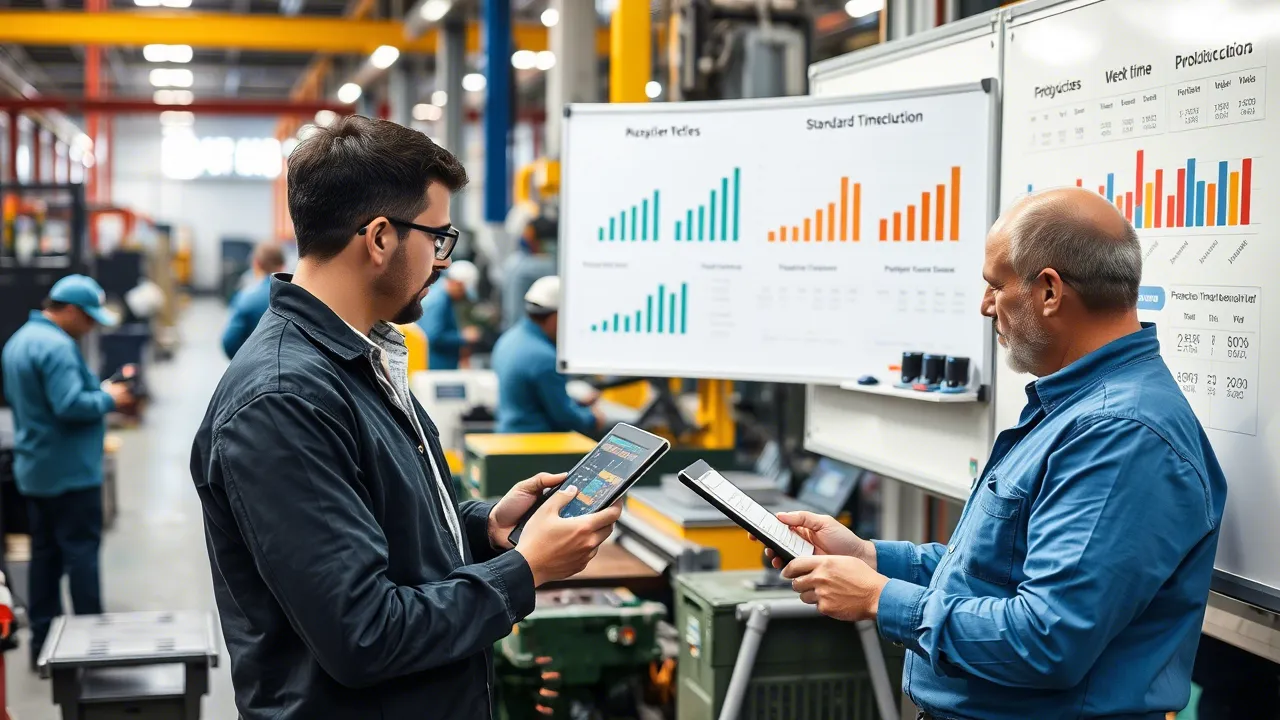
Here the stopwatch is not a tool for controlling the operator: it is documentary evidence that the time declared to the operator and to the AESF is real, measured and adjusted to the conditions of the workstation. Without that evidence, any maintenance fee is a matter of opinion; with it, it is defensible.
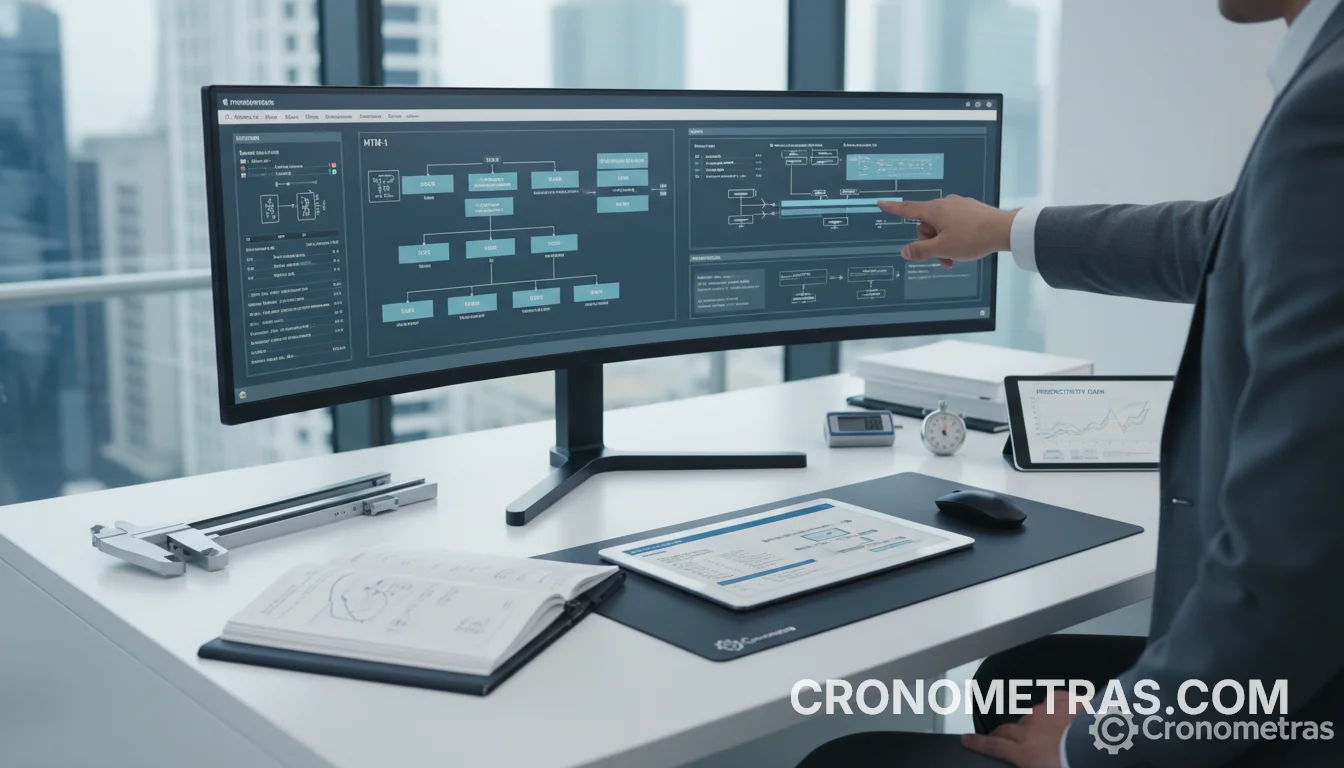
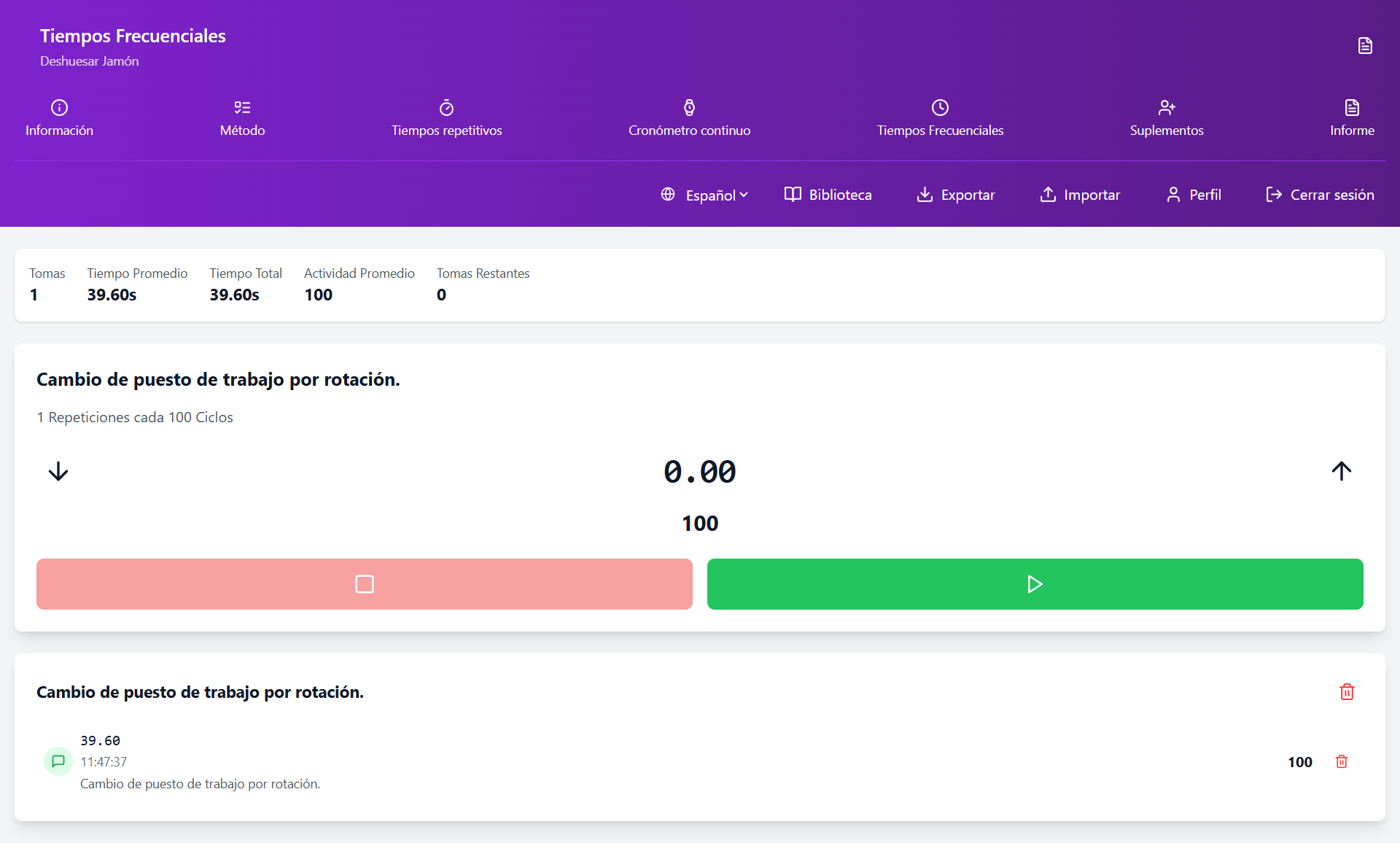
In practice, the actual tasks of the intervention are timed and those times are converted into what the company needs to know: what an intervention costs and the reliable basis for planning the fleet. The tool we use is Cronometras: time study with a stopwatch, ILO and TAL allowances, synthetic performance rating, standard time calculation and export to PDF/Excel/JSON. The application calculates the number of observations required for 95 % reliability: there is no need to decide how many measurements to make, the data decides. And the work sampling from WorkSamp (VA/NVA/IMP taxonomy) tells you what proportion of the shift goes into the essential work and what into waiting.
With that data you decide the defensible price per intervention, how many units enter per week, how teams and shifts are allocated, what to demand from the manufacturer in contractual times and how to defend yourself before the AESF and ERA.
The maintenance plan that must be read before measuring uses nomenclature that varies between manufacturers. The ITV (Rail Vehicle Technical Inspection, a strong analogy with the automotive sector) designates in shop terminology the periodic technical inspection of the vehicle; RD 1434/2010 regulates the interoperability of the General Interest Railway Network, it does not define this figure. The RGS (Series General Overhaul) is the full overhaul of the vehicle at the end of a major cycle, set by the manufacturer or the operator. IM1, IM2, IM3, IM4, IM5 are progressive modular preventive interventions of increasing scope in distance and time, set by the manufacturer's maintenance plan (e.g. CAF, Alstom, Siemens, Stadler). And R1, R2, R3, R4 are the equivalence that each operator (RENFE or others) makes with its IM levels.
Typical correspondence in commuter series (illustrative figures): IS (Inspección de Servicio / Service Inspection): daily or every 24–72 h (levels, leaks, brake, on-board systems). IM1: every 30.000–60.000 km, consumables. IM2: every 120.000–180.000 km, electrical systems and brake. IM3: every 300.000–500.000 km, partial bogie. IM4: every 600.000–900.000 km, in-depth bogie without wheel removal. IM5 (≈ R1): every 1.200.000–1.800.000 km or 6–8 years, full teardown of bogies, wheels, discs and gear motor.
Within a major intervention: in the 599 series documented by CFM Grupo CAF, the R1 is equivalent to an IM5 (intervention published by CFM Grupo CAF, 2018): dimensional verification of frame and crossmember, removal and testing of springs, full overhaul of dampers, replacement of the crossmember silentblock, overhaul of kingpin bolts and bushings, replacement of elastic joints, full overhaul of brake cylinders, maintenance of compensating and leveling valves, replacement of wheels and discs, systematic replacement of bearings and general overhaul of the gear unit. At the Humanes (Madrid) maintenance base of Actren, the RENFE Cercanías 446 units are serviced from IS through IM4 (underframe, electrical, pneumatic, air conditioning, doors and integrated software); the documented scope of the base reaches up to IM4; the IM5 (R1) falls outside that scope.
Why the measured time is not the stopwatch time. The operator works in the pit, in an uncomfortable posture and with physical effort: their pace is not constant. That is why the observed time is adjusted with ILO and TAL allowances and with a synthetic performance rating. The reference allowances considered are: personal needs 5 % (illustrative value), basic fatigue 4 % (minimum), posture 0–9 %, muscular force 0–22 %, lighting 0–5 %, atmospheric conditions 0–10 %, mental strain 0–10 %, nervous strain 0–10 %, monotony 0–4 % and boredom 0–5 % (illustrative values). In a typical rail maintenance intervention (frame in pit, medium uncomfortable posture, medium muscular force for spring extraction, medium lighting, medium mental strain for track work with possession), the total S ranges from 22 % to 28 % per intervention and from 9 % to 14 % in cab or software work (illustrative figures). Applying S = 23 % to a NT = 120 s, ST = 147,6 s.
In one sentence, the calculation that supports everything is ST = NT × (1 + S): the standard time is how long the measured task takes, plus the margin that the reality of the workstation demands; and the size of the study responds to N = 4 · p · (1 − p) / e², where p is the expected proportion of tasks on time (initial value 0,5 if unknown) and e the allowable margin of error (fraction; 0,05 = ±5 %). In practice, the application calculates the number of observations required for 95 % reliability and distributes those observations among the interventions.
One final guarantee: a work sample with WorkSamp contrasts the standard time with the reality of the shift, and an external validation with predetermined time systems —MTM-1 (Maynard, Stegemerten and Schwab, Westinghouse, 1948) or MOST (K. B. Zandin, Swedish division of H.B. Maynard, 1960s-70s)— checks that the figure does not include useless movements. MTM-1 works in TMU (1 TMU = 0,00001 h = 0,036 s); MOST is applied much faster than MTM-1 (usually cited as 5 to 10 times; illustrative example), at the cost of lower precision in very short movements.
What your company receives at the end. A report with a histogram per task (mean, standard deviation, 5/50/95 percentiles), digital stopwatch sheets and export to PDF/Excel/JSON, ILO and TAL allowances with the table signed by the shop supervisor, standard time rounded to 0,1 min, documentary traceability (operator, shift, tool, pit, date, atmospheric conditions), documented CSM-RA compliance, declared target availability (A = MTBF / (MTBF + MTTR)), a 1-page executive summary, an annex with simulated cases and a 6-month follow-up plan with re-measurement of the 3 critical tasks. If your shop works with a CMMS, the dumping of the time library into your system is done manually by the user.
Simulated practical case: a bogie IM5 in a Spanish rail workshop
Simulated practical case. Example built for educational purposes from plausible industry parameters. It does not correspond to a real Cronometras implementation or to any specific client.
Context (simulated): rail operator with a fleet of 28 electric commuter units, regional series with a current AESF authorization, IM1–IM5 maintenance plan from the manufacturer. An external time study is carried out after an AESF observation on the declared IM5 times.
Scope of the study:
- 1 IM5 (R1) intervention timed in the shop, 2 bogies of the unit (CAF brand). Total 78 elementary tasks.
- 60 man-hours declared by the shop.
- Audit with 95 % reliability → N calculated by the application (met by timing the 78 tasks in 6 cycles among 3 operators and 2 shifts).
Results:
| Block | Tasks | Mean OT (min) | Total OT (h) | S factor | Calculated ST (h) |
|---|---|---|---|---|---|
| Bogie removal | 12 | 18,4 | 3,7 | 27 % | 4,7 |
| Wheel and disc overhaul | 9 | 22,7 | 3,4 | 24 % | 4,2 |
| Gear motor overhaul | 14 | 31,2 | 7,3 | 23 % | 9,0 |
| Brake overhaul | 11 | 19,5 | 3,6 | 25 % | 4,5 |
| Damper and spring overhaul | 10 | 14,3 | 2,4 | 28 % | 3,1 |
| Dimensional verification and software | 12 | 11,8 | 2,4 | 18 % | 2,8 |
| Assembly and bench testing | 10 | 28,6 | 4,8 | 22 % | 5,9 |
| TOTAL | 78 | — | 27,6 | ~24 % average | 34,2 |
What the study found: the shop declares 60 man-hours; the calculated ST is 34,2 h. The deviation is −43 % (the shop overestimates the hours required by almost half), explained by the waiting times for tooling and pit logistics that overlap with other tasks of the team. Recommendation: splitting the IM5 into 2 parallel teams (4 people in the pit + 2 on the bench) reduces the cycle time to 18–20 h while maintaining quality.
Quantified benefit (estimate):
- Reduction in car immobilization time: from 60 declared h to 20 effective h → 40 h less per car.
- At 28 cars, IM5 cycle every 7 years: 4 cars/year × 40 h = 160 train-hours recovered per year.
- Valuation applied in the example: 1 commuter train-hour = 1.200–1.800 € (simulated parameter).
- Estimated return: 192.000–288.000 € per year in fleet availability, against a time-study cost of ≈ 8.000 €.
Figures marked as simulated: the 28 cars, the 60 declared h, the 1.200–1.800 €/train-hour are plausible and simulated parameters, not data from an identified operator. The study can be reproduced with the same principles on any commuter series.
What you gain and what you decide with the data in hand
| Aspect | General industry (plant) | Rail maintenance |
|---|---|---|
| Process cycle | Continuous, 1–8 h per batch (illustrative example) | Discontinuous, 6–24 h per intervention (illustrative example) |
| Measurement basis | 20–50 cycles (illustrative example) | 1 complete intervention, N according to the application calculation |
| Work pace | Fixed cadence | Variable cadence due to track possession |
| Typical S allowances | 13–18 % (illustrative example) | 22–28 % (posture, force, strain; illustrative example) |
| External audit | Customer / AENOR | AESF / ERA / operator / manufacturer |
| Cost/hour of the idle asset | 50–200 €/h (illustrative example) | 1.200–1.800 €/h (commuter train, illustrative example) |
| Capture software | Sheet + stopwatch | Digital stopwatch + data logging + export to PDF/Excel/JSON |
The key figure is the cost/hour of the idle asset: if in a conventional plant a time study is justified with savings of 50 €/h, in a rail workshop it pays for itself with a single train-hour recovered (1.200–1.800 €/h, illustrative example). That is why operators usually outsource the time study to specialized consultancies instead of maintaining an in-house team.
With the study closed, your company decides on data:
- It sets a defensible fee per intervention, backed by the histogram of each task.
- It plans the fleet with guarantees: it knows how long each IM level takes and when each car returns to service.
- It recovers train-hours by reorganizing teams and shifts, without touching quality.
- It arrives calmly at the audit with measured times, justified allowances and complete traceability.
- It detects drift: the 6-month follow-up turns the time library into the baseline of each campaign.
Request your first study
If you want to know what maintaining your fleet costs and be able to demonstrate it to whoever buys from you, audits you or finances you, start with Cronometras: time study with a stopwatch, ILO and TAL allowances, synthetic performance rating and standard time calculation, with export to PDF/Excel/JSON. To complete the picture with the actual distribution of the shift, the work sampling from WorkSamp.
And the time and attendance control of those shifts is covered by Induly with a mobile app and a plant kiosk by name/PIN.
And if what you need is to put all this into words for management and operations, at ProdCont we write it.
Don't want to do it yourself? We do it for you from €800
If you prefer to outsource it, Cronometras delivers a complete time and motion study from a single video: elemental breakdown, OIT/TAL fatigue allowances, standard time with tolerances, and a report in PDF + Excel + JSON ready to present to management.